
China’s factories are accelerating. Its consumers, rather inconveniently, aren’t. And that gap makes the latest economic rebound much less reassuring than the headline suggests.
Official third-quarter GDP growth reached 4.5% year-on-year, bringing Beijing’s annual target within reach. Meanwhile, Chinese companies accounted for a reported 97% of global humanoid robot shipments in the first half of 2026. Put those figures together, and you have the ingredients for a compelling industrial success story.
But there is a catch. Producing more goods does not necessarily mean creating more prosperity. And shipping more robots does not necessarily mean those robots can do useful work.
These are different problems, but they demand the same uncomfortable question: how much of China’s industrial expansion is translating into sustainable economic value?
Key Takeaways
- Official GDP growth accelerated to 4.5%, but weak consumption and falling investment undermine the recovery story.
- Rising export dependence exposes China to greater trade friction and does not necessarily indicate strong profitability.
- Chinese companies supplied a reported 97% of global humanoid shipments in early 2026, although productive deployment remains limited.
- Robotics leadership will depend on affordable components, reliable AI and useful work—not shipment volumes alone.
Table of Contents
- The GDP Rebound Looks Better From a Factory Than a Household
- Property Is Still Dragging the Wider Economy Down
- The Consumer Improvement Comes With Fine Print
- China’s Export Success Is Becoming a Source of Risk
- Why a Bigger Trade Surplus Is Not Necessarily Good News
- China’s Humanoid Robot Lead Is Real—But So Is the Hype
- The Most Important Robot Advantage May Be the Parts
- America Has Software Strength. China Has a Vast Testing Ground.
- The Decisive Test Is Value, Not Volume
The GDP Rebound Looks Better From a Factory Than a Household
First, the headline numbers. China’s National Bureau of Statistics reported that annual GDP growth accelerated from 4.3% in the second quarter to 4.5% in the third. Growth across the first nine months reached 4.6%, inside the government’s full-year target range of 4.5% to 5%.
These are official figures, not an independent verdict on the economy’s health. Even taken at face value, however, they reveal a recovery with a distinctly lopsided shape.
- Industrial production: up 5.5% year-on-year in September, its fastest growth in six months.
- Retail sales: up just 1.1%.
- Real estate investment: down 20.6% over the first nine months.
- Overall fixed-asset investment: down 7.2% over the same period.
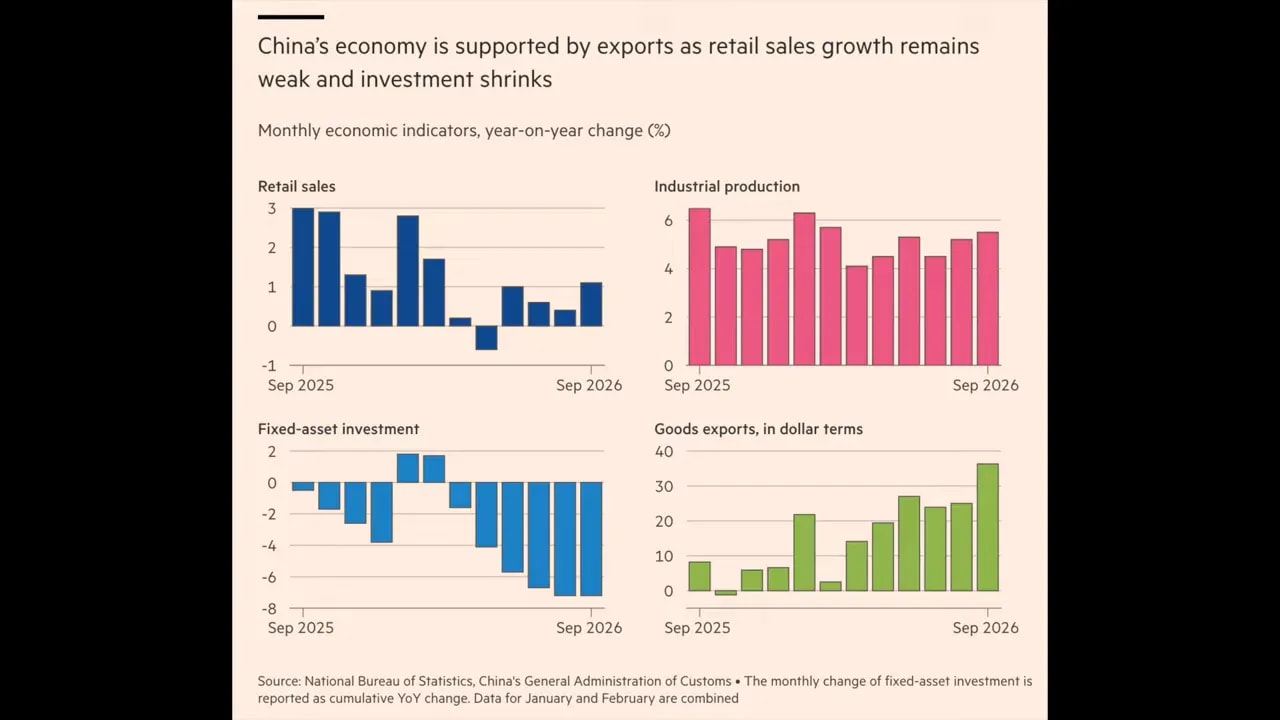
The manufacturing sector has benefited from overseas demand, the global artificial intelligence investment boom and substantial state subsidies. But households are still dealing with a prolonged property downturn and uncertain employment prospects.
That distinction matters. As the IMF’s introduction to GDP explains, GDP measures economic production. A better aggregate number does not, by itself, establish that household conditions have improved.
China’s challenge is not simply to keep factories busy. It is to turn that activity into the income and confidence needed to revive domestic spending. So far, the connection looks weak.
Property Is Still Dragging the Wider Economy Down
The 20.6% collapse in real estate investment is not a minor blemish on an otherwise healthy picture. It is a major obstacle to a broader recovery.
Oxford Economics economist Serena Yue argues that the property slump will continue to limit the benefits spilling over from stronger industrial activity into the wider economy. September’s investment figures offer little comfort: infrastructure investment also deteriorated, despite government efforts to accelerate financing.
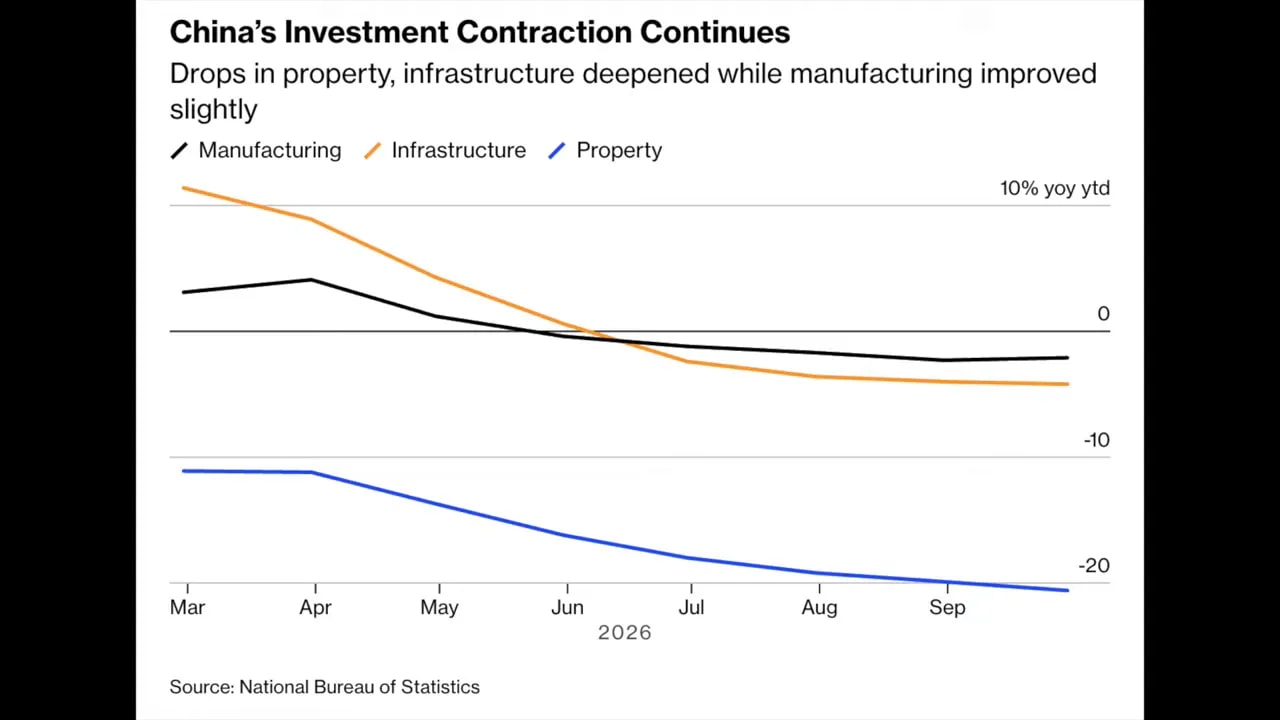
Beijing has responded with additional targeted support, largely focused on investment. Household assistance has been more limited, including mortgage subsidies for some eligible buyers.
Local governments accelerated special investment bond issuance in the third quarter to its fastest pace since at least early 2025. Yet fiscal spending has lagged behind plans. More borrowing authority is useful only if it produces effective spending; authorising support and delivering it are different things.
Additional provincial borrowing quotas and the “six networks” project are expected to provide some support. But with the annual growth target now within reach, economists expect policymakers to rely on existing measures rather than launch a substantially larger stimulus.
Here is the awkward part: meeting the target may reduce the urgency for further intervention without resolving the weakness underneath it.
The Consumer Improvement Comes With Fine Print
There are some encouraging signals. Excluding cars, retail sales rose 3.9%, the strongest growth since October 2025. Telecommunications equipment, food, tobacco and alcohol helped lift the figure. Holiday timing also supported travel, catering and shopping.
The surveyed urban unemployment rate edged down from 5.3% to 5.2%. That is an improvement, albeit a modest one.
But retail sales are not adjusted for inflation. Higher spending can therefore reflect higher prices rather than a corresponding increase in the volume of goods purchased. The apparent improvement should not automatically be read as evidence that households are buying substantially more.
Car sales, meanwhile, continued to contract after government subsidies were reduced. That complicates any claim that consumption is becoming self-sustaining.
The real test is whether spending strengthens beyond holiday effects, price increases and policy incentives. Until then, a few better indicators do not overturn the broader picture of cautious households and persistent housing weakness.
China’s Export Success Is Becoming a Source of Risk
When domestic demand disappoints, selling abroad provides an outlet. China’s trade surplus is on course to exceed the previous year’s record of $1.2 trillion.
That sounds impressive. It also means the economy is becoming more dependent on foreign customers continuing to absorb its production.
Moody’s Analytics economist Dave Chia describes growth as increasingly reliant on a single external engine that is already showing signs of strain. Trade risks are building precisely because China’s reliance on exports is intensifying friction with its trading partners.
The European Union is preparing powers that could restrict Chinese access to its single market. Foreign leaders have also pressed Beijing to allow greater currency appreciation, arguing that an undervalued yuan gives Chinese exporters an unfair advantage. The IMF estimate cited in this analysis puts the currency’s undervaluation between 17.3% and 25.3% in 2026.
This is the vulnerability in outsourcing demand to the rest of the world. Foreign consumers may want inexpensive manufactured goods, but foreign governments also face pressure over the consequences for their own industries.
The structural dilemma is explored further in this examination of why China’s export-led growth model is unsustainable. More output cannot indefinitely substitute for stronger domestic demand, especially when trading partners are considering new barriers.
Why a Bigger Trade Surplus Is Not Necessarily Good News

Peking University finance professor Michael Pettis offers a sharper critique of the familiar “two-track economy” description: a struggling domestic economy supposedly balanced by a brilliant export sector.
His objection is that export volumes tell us too little about profitability or the economic cost of sustaining production.
Pettis argues that Chinese exports are not especially profitable except relative to domestic sales, where many businesses struggle to make money at all. More controversially, he contends that once direct and indirect subsidies are removed, much export activity destroys net economic value, with losses accumulating on balance sheets as debt.
That is an analytical argument, not something proved by the GDP release alone. But the mechanism he describes is important.
If an economy produces more than domestic consumption and investment can absorb, it must export the excess or reduce production. Beijing’s concern about unemployment, particularly among young people, creates powerful pressure to keep production running.
Exports can therefore become an outlet for domestic weakness rather than proof that the underlying model is healthy.
The distinction is between selling more because production is profitable and competitive, and selling more because domestic demand cannot absorb what is being produced. Rising net exports do not tell us, on their own, which story dominates.
This is why Nomura chief China economist Lu Ting warns that weak domestic demand may overwhelm market enthusiasm for numerical improvements in GDP. His concern extends into 2027. Hitting this year’s target does not make next year’s structural problems disappear.
China’s Humanoid Robot Lead Is Real—But So Is the Hype
Now consider an industry where China’s manufacturing advantages are especially visible: humanoid robotics.
According to Bloomberg reporting, Chinese companies supplied 97% of global humanoid shipments in the first half of 2026. Morgan Stanley estimates the industry could exceed $5 trillion by 2050.
Those are striking figures. But one measures shipments in an early market, while the other is a long-term forecast. Neither demonstrates that humanoid robots are already commercially transformative.
LinkeBot founder Alex Zhu estimates that roughly 20,000 humanoids were installed worldwide in the previous year, with only a few thousand performing actual work.
That is a rather important qualification. A machine can run, balance or perform a choreographed routine and still struggle with the precise hand movements required for everyday tasks. Impressive motion is not the same thing as reliable manipulation.
Without dependable grasping and dexterity, the usefulness of humanoids in factories, homes and service industries remains limited. The industry’s central challenge is not merely to make robots look capable. It is to make them consistently useful.
The Most Important Robot Advantage May Be the Parts

Beijing-based LinkeBot is targeting that dexterity bottleneck. Researcher Smart Analytics Global estimates that it supplies more than 80% of advanced robotic hands deployed worldwide. Zhu says its customers include Samsung, Meta and Siemens, and that the company plans to double production capacity to 10,000 hands a month.
The broader advantage extends well beyond one supplier.
China’s electric vehicle, drone and other manufacturing industries have helped build extensive networks of motor, sensor and precision-component suppliers. Those businesses can increasingly serve robotics manufacturers, supporting faster deployment and lower production costs.
This creates an uncomfortable dependency for American competitors. Morgan Stanley estimates that Tesla’s Optimus humanoid would cost nearly three times as much without Chinese components.
China’s dominance in permanent magnets, essential for robotic movement, adds another strategic advantage. A company can own the robot brand without controlling the industrial system needed to manufacture it affordably.
That is why shipment leadership understates one part of China’s position while overstating another. It does not prove widespread commercial usefulness, but the supply chains behind those shipments are a substantial competitive asset.
America Has Software Strength. China Has a Vast Testing Ground.
The United States retains important advantages in the software that allows machines to understand and navigate the physical world.
American companies benefit from advanced AI research, access to leading semiconductors and deeper capital markets. Some Chinese investors acknowledge that certain American embodied-AI models currently outperform domestic alternatives.
China is trying to narrow that gap by deploying robots in factories and warehouses. Practical deployment generates data that can help improve machine capabilities. Its vast manufacturing base potentially connects hardware scale with a large environment for testing and learning.
This is not a simple contest between Chinese hardware and American software. Both sides need an effective combination of the two. Related analysis of China’s advanced-chip constraints helps explain why manufacturing strength does not automatically eliminate the technological bottlenecks.
Costs could nevertheless change the commercial equation. Bank of America Institute projects that component costs for an average Chinese humanoid could fall below $17,000 by the end of the decade. That is a component-cost forecast, not a retail price or a guarantee of profitable deployment.
Aging populations and shrinking workforces could create demand for machines that handle repetitive or physically demanding tasks. But demand for useful automation is not the same thing as demand for every humanoid currently being developed.
Chinese authorities have warned against companies blindly entering the sector. Volatile valuations also reflect concern about unrealistic expectations. Meanwhile, American robotics companies are pressing Washington for domestic supply chains and adoption incentives.
The Decisive Test Is Value, Not Volume
China’s economic rebound and its robotics expansion should not be dismissed. Its industrial capabilities are formidable, and its humanoid supply chains give it a powerful starting position.
But the limits deserve equal attention. An economy does not become balanced simply because its factories produce more. A robotics industry does not become commercially successful simply because more machines leave those factories.
For the wider economy, the decisive evidence will be stronger household demand, healthier investment and less dependence on foreign customers. For humanoids, it will be affordable machines combining reliable intelligence with practical workplace performance.
China is demonstrating that it can build at scale. The harder question is whether that scale delivers durable prosperity. Neither the GDP headline nor the robot shipment figure answers it yet.
Frequently Asked Questions
Why is China’s GDP rebound not a broad recovery?
Industrial production grew strongly, but September retail sales increased just 1.1%. Over the first nine months, property investment fell 20.6% and overall fixed-asset investment declined 7.2%, showing persistent domestic weakness.
Why can a rising trade surplus indicate economic weakness?
It can reflect production exceeding what domestic consumption and investment can absorb. Pettis argues that exporting the excess may sustain production while concealing weak demand and subsidy-supported losses.
Has China already won the humanoid robot race?
No. China leads shipments and has major component-supply advantages, but commercial usefulness remains uncertain. Reliable dexterity, capable AI and practical workplace performance are still decisive challenges.