There is a difference between looking powerful and making that power pay. China’s latest developments offer a fairly sharp demonstration of the gap.
Beijing could host talks bringing together Xi Jinping, Vladimir Putin and Donald Trump. Its technology giants are pouring billions into enormous computing facilities. On paper, these are the ingredients of a country becoming indispensable: diplomatic influence, technological infrastructure and the economic weight to support both.
But look underneath that impressive exterior, and things become considerably less comfortable. A proposed Ukraine negotiation could alienate Europe. Youth unemployment remains stubbornly elevated. And the communities hosting China’s data centre boom are discovering that a building full of expensive computers does not necessarily produce a town full of well-paid workers.
Meanwhile, a reported American effort to expand deep-cover intelligence operations threatens to make an already suspicious business environment even worse.
These are different stories, but they share a question: how much of China’s growing strategic power translates into lasting economic security—and for whom?
Key Takeaways
- A proposed Xi–Putin–Trump meeting could elevate Beijing’s influence but deepen distrust by excluding Ukraine and Europe.
- China’s youth unemployment fell to 18% in September but remained above the same month in the previous two years.
- Shaoguan’s enormous data centre investment is boosting activity, while lasting benefits for local residents remain uncertain.
- A reported Pentagon deep-cover expansion could increase scrutiny of legitimate foreign businesses in China.
Table of Contents
- A Ukraine Peace Summit With One Rather Important Absence
- Youth Unemployment Improves—Until You Make the Relevant Comparison
- Shaoguan’s AI Boom Has a Jobs Problem
- When Business Becomes Suspected Cover for Espionage
- The Real Test Is What Power Delivers
A Ukraine Peace Summit With One Rather Important Absence
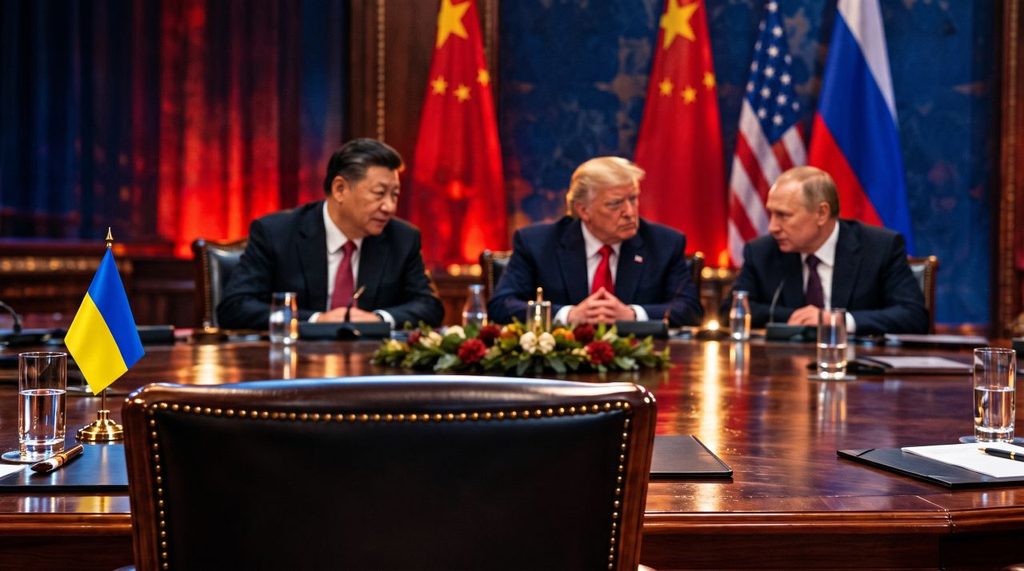
First, the diplomatic opportunity. According to reporting by The Wall Street Journal, Putin proposed a meeting with Trump and Xi during an October 9 phone call with the American president. Russian officials suggested holding it alongside the Asia-Pacific Economic Cooperation summit in Shenzhen on November 18–19.
People familiar with discussions between Moscow and Beijing said China had indicated it would not object if Trump agreed. A senior American official, however, said Trump had not accepted.
That distinction matters. This was a proposal, not an agreed summit, much less a peace agreement waiting for signatures.
Still, the attraction for Xi is obvious. Hosting the leaders of Russia and the United States would allow Beijing to present itself as an indispensable diplomatic power. China would not merely be responding to decisions made elsewhere. It would be helping determine where, and potentially how, those decisions were made.
That fits Beijing’s wider ambition to reshape an international order long dominated by Anglo-American influence. The photograph alone would carry considerable political value.
There is, however, a rather substantial problem: neither Ukraine nor European leaders would participate in the proposed format.
Three powerful countries discussing another country’s future without that country at the table is hardly a reassuring foundation for peace. Ukraine’s foreign minister rejected the proposal, warning that excluding Kyiv would encourage Putin to continue fighting.
For Beijing, this turns an apparent diplomatic prize into a balancing act. China wants to maintain its strategic partnership with Russia while protecting economically important relationships with Europe. Hosting a process perceived as favouring Moscow could deepen European distrust precisely when trade relations are already strained.
Even the venue creates complications. APEC is an economic cooperation forum, and Chinese officials reportedly worry that Ukraine negotiations could overshadow their plans to showcase regional leadership. A summit intended to advertise China’s economic influence could instead become an argument about its geopolitical loyalties.
The symbolism also reaches Taiwan. A negotiation in which major powers discuss a smaller country’s fate without its participation could intensify concerns about how Taiwan’s own future might be discussed.
For Xi, then, the calculation is not simply whether hosting looks impressive. It is whether the prestige outweighs the distrust it could generate among partners China still needs.
Youth Unemployment Improves—Until You Make the Relevant Comparison
Those economic relationships matter because China’s domestic economy is still struggling to offer enough reassurance of its own.
The surveyed urban unemployment rate for people aged 16–24, excluding students, fell to 18% in September, according to official figures reported by Caixin. That was down 0.9 percentage points from August.
At first glance, good news. But the monthly comparison is doing a lot of work.
The September figure was still 0.4 percentage points above September 2024 and 0.3 points above September 2025. It was the highest September reading since the National Bureau of Statistics began publishing this revised measure in January 2024.
The official explanation for the monthly improvement was seasonal. Graduates enter the labour market in July and August, pushing unemployment higher. By September, more have found jobs, bringing the rate down.
That explains why September might look better than August. It does not explain why September looks worse than the equivalent month in the previous two years.
This is the important distinction. A predictable seasonal improvement is not the same thing as a convincing recovery.
Nor is youth unemployment a problem confined to the people sending out applications. Uncertain earnings can delay major purchases and increase reliance on parents. That can constrain spending across generations, reinforcing the weak confidence that makes a stronger consumption-led economy harder to achieve.
Then there is the question of what education is supposed to deliver. If years of competition and academic achievement do not lead to credible career prospects, the promise underpinning that effort begins to look fragile.
The Pressure Starts Long Before Graduation

A separate Caixin commentary explored the psychological strain behind two familiar expressions: "involution", describing relentless competition, and “lying flat", referring to withdrawal from that struggle.
It cited Quantified Youth, a report by the Beijing Enjoy Voluntary Center based on surveys of more than 1,300 undergraduates and detailed interviews with 72 students, predominantly from leading universities.
The research identified five sources of pressure:
- Academic grades.
- Extracurricular competitions.
- Family expectations.
- Comparisons with peers.
- A punishing employment market.
The uncomfortable point is that these pressures reinforce one another. Students are pushed to compete intensely for the qualifications and achievements expected to secure their futures. A difficult job market then calls the value of that competition into question.
Getting more graduates into employment is necessary. But the larger challenge is giving them a believable route from educational achievement to financial security. A slightly better monthly statistic cannot do that on its own.
Shaoguan’s AI Boom Has a Jobs Problem

In Shaoguan, a mountainous city in Guangdong, Alibaba, Tencent and Huawei are among the technology companies investing in data centres. The attractions are straightforward: abundant land, inexpensive electricity and a relatively cool climate.
For Beijing, the development supports a broader effort to build computing capacity away from the major coastal cities while serving their demand and advancing China’s artificial intelligence ambitions.
For local officials, it offers something equally important: a potential replacement for weakening traditional growth engines.
According to a Financial Times report, Shaoguan plans 23 data centre complexes involving an investment of 111.6 billion yuan. That is roughly equivalent to 65% of the city’s economic output in the previous year.
This is not a modest experiment. It is an enormous bet on a different economic future.
There are already measurable results. Data centre energy consumption increased fivefold in the first half of the year. Local economic growth reached 5%, exceeding the provincial and national averages cited in the reporting.
In a presentation to investors, that looks rather good. Unfortunately, residents do not pay their bills with regional GDP growth.
A Server Hall Is Not a Manufacturing Workforce
Shaoguan largely missed the manufacturing and export boom that enriched nearby Pearl River Delta cities. According to the Financial Times, annual disposable income averaged approximately 36,000 yuan in 2025, falling below 26,000 yuan in rural areas.
The question is whether data centers can meaningfully change that picture.
Construction creates demand for materials, workers and local services. But completed facilities require relatively few employees. Higher-skilled workers often arrive from larger cities, while the infrastructure consumes substantial amounts of local electricity.
So a project can be capital-intensive, strategically important and impressive in economic statistics without becoming a broad source of well-paid local employment.
That is the awkward gap in the promise.
Residents described dust, disruption and uncertain financial returns. One shopkeeper reported monthly earnings of 4,000 yuan that barely covered rent and utilities. Another described cleaning work paying around 2,000 yuan a month, approximately $300.
Some villagers also said their land had been repossessed before compensation arrived, leaving older farmers dependent on relatives. Local officials argue that compensation, rental income and service jobs will improve livelihoods.
Those potential benefits matter. But so does their timing—and whether they endure after the construction workers leave.
The fiscal pressure helps explain the enthusiasm. Land sales previously generated around one-third of local government revenues, making alternative investment increasingly attractive as the property sector struggles.
Yet replacing property investment with computing investment does not automatically solve the underlying problem of creating durable household prosperity. As explored in China’s electricity-driven AI push, power infrastructure is becoming central to the country’s technology strategy. Shaoguan shows why the local economic consequences deserve just as much scrutiny as the computing capacity.
The meaningful test is not simply how many facilities get built. It is what remains for the surrounding community once building them stops.
When Business Becomes Suspected Cover for Espionage

The final development concerns a different kind of infrastructure: intelligence networks operating behind commercial identities.
According to an exclusive Washington Post report citing six people familiar with the initiative, the Pentagon is seeking to expand a deep-cover espionage program intended to support economic warfare against China and other American competitors.
Operatives would reportedly pose as businesspeople or other private-sector employees without an overt connection to the US government.
These are known as non-official cover officers, or NOCs. Unlike intelligence officers operating under diplomatic cover, they cannot work openly from American embassies or other government facilities, and they cannot claim diplomatic immunity if detained.
The initiative reportedly sits within a broader Pentagon economic warfare campaign. The newspaper also reported, citing former agency officials, that the CIA’s own non-official cover program had been dismantled.
There is an essential limit to what this establishes: the report describes an effort to expand capabilities. It does not establish that the proposed program was already operating in China.
That caveat should not be buried. A proposed capability and a confirmed operation are not interchangeable.
Nevertheless, the publicity could have consequences for people who have nothing to do with intelligence work.
Chinese security officials may interpret the report as grounds for greater scrutiny of foreign executives, consultants and other private-sector workers. Legitimate commercial activity could become harder to distinguish, in their eyes, from possible covert activity.
That fits the broader tension examined in Beijing’s increasingly security-focused worldview: economic relationships are being assessed not just for their commercial value, but for their potential strategic danger.
The resulting suspicion could complicate ordinary business, discourage travel and weaken trust between commercial communities. Companies trying to preserve trade and professional exchanges could find themselves dealing with the fallout from an intelligence initiative they neither control nor participate in.
The Real Test Is What Power Delivers
Put these developments together and a consistent tension emerges.
China can gain diplomatic prominence without gaining European trust. It can record a monthly improvement in youth unemployment without resolving the deterioration beneath it. It can build strategically valuable data centers without producing widespread local prosperity.
And commercial relationships can remain economically useful while becoming politically harder to sustain.
None of this means diplomatic influence or computing investment is worthless. It means the headline achievement is only the beginning of the assessment.
The more demanding questions come afterwards. Who participates in the negotiation? Who gets a credible career? Who benefits once construction ends? And can ordinary business survive when both sides increasingly see economic activity through a security lens?
Those answers will tell us more about China’s trajectory than another impressive summit photograph or investment announcement.
Frequently Asked Questions
Has the proposed Xi–Putin–Trump meeting been agreed?
No. The reporting described a Russian proposal and indicated that China would not object if Trump agreed. A senior American official said Trump had not accepted.
What does China’s 18% youth unemployment figure measure?
It measures surveyed urban unemployment among people aged 16–24, excluding students. September’s decline from August was consistent with seasonal hiring after graduation, but the rate remained higher than in the previous two Septembers.
Why might data centers create limited lasting local employment?
Construction generates temporary jobs and service demand, but completed facilities require relatively few workers. Higher-skilled employees may also come from larger cities rather than the host community.
Does the Pentagon report confirm covert operations in China?
No. It describes a proposed expansion of deep-cover intelligence capabilities, not proof that the proposed program was already operating in China.