China has a problem that cannot be fixed with another reassuring speech. Japanese companies are reducing their exposure, domestic investment funds are struggling to survive, and Germany—the European heavyweight that once resisted tougher trade measures against Beijing—is now demanding them.
These are not three versions of the same crisis. A Japanese manufacturer relocating production faces different pressures from a Chinese fund manager losing investors. Neither operates under the same constraints as a German chancellor trying to protect an industrial base.
But put the developments together, and a pattern emerges. China’s economic relationships are becoming harder to sustain on their old terms. Foreign businesses want less concentration risk. Domestic investors want returns rather than promises. European governments increasingly see Chinese competition as a threat requiring intervention, not merely an inconvenience to be managed.
None of this means China is about to become economically isolated. It remains enormously important. The trouble is that being important and being attractive are not the same thing.
Key Takeaways
- Japan’s corporate presence in China has fallen sharply as commercial pressures combine with diplomatic and security risks.
- China’s fund closures reflect weak long-term returns, insufficient assets, regulatory deadlines, and product oversupply.
- Germany’s support for stronger EU trade defences marks a significant shift from its earlier resistance.
- The shared issue is declining willingness to maintain economic relationships on their previous terms—not complete separation from China.
Table of Contents
- Japan’s Retreat Is Bigger Than a Diplomatic Spot
- China’s Fund Industry Has a Survival Problem
- Germany Has Changed Its Mind About China
- The Common Thread: Confidence Is Becoming Conditional
Japan’s Retreat Is Bigger Than a Diplomatic Spot
Start with the numbers. According to Teikoku Databank figures cited by the Financial Times, 10,118 Japanese companies maintained a mainland Chinese presence in June 2026. That was the lowest total since records began in 2010, down 22% from 2024 and 30% from the 2012 peak.
Between 2024 and 2026, a record 4,137 Japanese companies completely withdrew. Another 1,221 entered through subsidiaries, factories, or representative offices. Excluding the pandemic period, those new entries were the lowest on record.
That distinction matters. This is not simply a story about companies leaving. It is also about fewer companies deciding that China is where their next expansion should happen.
The research describes a transition from expansion to restructuring. In less corporate language, businesses are looking at their existing exposure and asking whether they have put too many eggs in one increasingly complicated basket.
India, Vietnam, Thailand, and other Southeast Asian markets are emerging as alternatives. The objective is generally diversification, rather than a clean break with China. There is a substantial difference between abandoning a market and deciding it should no longer dominate your international strategy.
The Commercial Case Has Weakened
For years, China offered a powerful combination: a manufacturing base and a vast consumer market. Both sides of that proposition are now under pressure.
Rising labour costs weaken its manufacturing appeal. The property downturn weighs on the broader economic environment. Industrial overcapacity and increasingly capable Chinese competitors make it harder for foreign businesses to defend their position.
China’s prolonged property adjustment is particularly important here. As explored in this analysis of China’s property contraction and Japan–China tensions, stabilisation would not necessarily mean a return to the conditions that supported the old growth model. A lower, less buoyant equilibrium is a very different proposition for companies planning investment.
Then there are American tariffs. Around 60% of Japanese manufacturers with Chinese production facilities reported that US tariffs had affected revenues. A factory in China is not insulated from Washington’s trade policy simply because its owner is Japanese.
This is what makes the retreat difficult to reverse. Even a diplomatic breakthrough would not automatically lower labour costs, remove tariffs, repair property demand, or make domestic competitors less formidable.
Politics Adds Another Layer of Risk
Relations deteriorated sharply after Japanese Prime Minister Sanae Takaichi suggested in the previous month that a Taiwan conflict could trigger Japanese military involvement. Beijing responded with restrictions on critical mineral exports and warnings against travel to Japan.
Chinese tourist arrivals in Japan subsequently fell 59% year on year in August, according to Japanese tourism figures. That is a reminder that a political confrontation can quickly become a commercial problem, even for businesses far removed from defence policy.
The dispute also sits on top of longstanding friction over Taiwan, the Senkaku Islands—known in China as the Diaoyu Islands—and Japan’s release of treated Fukushima wastewater. The International Atomic Energy Agency’s assessment of the discharge provides useful context on the safety framework, but technical reassurance has not removed the issue’s political potency.
There is a more immediate concern for expatriate families. In June 2024, a knife attack in Suzhou injured a Japanese mother and child and killed the Chinese bus attendant who intervened. In September, a 10-year-old Japanese schoolboy was fatally stabbed in Shenzhen.
Tokyo demanded stronger protection for Japanese residents and action against inflammatory online rhetoric. Beijing described the attacks as isolated incidents and cautioned against assuming they demonstrated a coordinated anti-Japanese campaign.
That distinction should be preserved. These attacks do not, by themselves, establish such a campaign. But companies still have to make decisions about employee safety, family relocation, and the confidence of people they send overseas.
Taiwan Is the Risk That Overshadows Everything Else
The largest strategic danger is a Taiwan crisis. Japan hosts major US military bases that could support American operations, potentially drawing Japan into a confrontation before Tokyo decides whether to intervene directly.
Escalation would not necessarily begin with a carefully planned declaration. A collision between ships or aircraft, a misread manoeuvre, or an exchange of fire could create a crisis. Weak crisis-management guardrails and nationalist pressure would make compromise harder.
War remains a risk, not an inevitability. That is an essential distinction. Yet companies do not need to believe war is certain before they diversify. A prolonged confrontation alone could disrupt shipping, critical materials, and regional manufacturing.
Takaichi adopted a more conciliatory tone in her October 5 parliamentary address, describing China as an important neighbour and promising communication and dialogue. She also pledged to defend Japan’s positions and demand responsible behaviour.
Warmer language is welcome. It is not a substitute for predictable trade rules, credible protection for expatriate families, and evidence that investment will remain profitable. Corporate confidence is much easier to damage than to rebuild.
China’s Fund Industry Has a Survival Problem
Meanwhile, inside China, another retreat is unfolding. Mutual funds are closing at their fastest pace in eight years as weak returns, withdrawals, and an overcrowded market leave products too small to survive.
Bloomberg-compiled figures show that about 256 publicly offered funds had been liquidated through September 30. Another 46 had warned they could close. Potential closures could exceed 300 by year-end, producing the highest annual total since sweeping industry reforms triggered a shutdown wave in 2018.
For Beijing, this is awkward. Encouraging household savings into capital markets is one thing. Persuading households to keep their money there is another.
The performance figures help explain the gap. The China Securities Index’s active stock fund index recorded a five-year annualised return of minus 0.8%, despite gaining 3.6% during 2026. The benchmark CSI 300, meanwhile, had fallen approximately 6% that year.
A positive year does not erase a disappointing five-year experience. Nor does launching another product necessarily persuade investors that the next one will be different.
Why Small Funds Are Being Forced Out
Regulatory thresholds turn dwindling investor interest into a concrete survival issue. Managers must submit proposed remedies when a fund’s net assets remain below 50 million yuan for 60 consecutive trading sessions.
A separate rule affects sponsor-backed funds launched during the 2023 confidence-building push. These face mandatory termination if their assets remain below 50 million yuan three years after launch. According to Morningstar analyst Wang Shan, that requirement drove nearly 100 liquidations during 2026.
These are related but distinct mechanisms. One requires a response to prolonged undersizing. The other creates a termination deadline for a particular category of funds.
And here is the uncomfortable part: good performance does not necessarily save a fund. The Great Wall SSE Science and Technology Innovation Board Composite Index Fund gained 23% before closing just over a year after its debut.
That example exposes the difference between investment returns and business viability. A fund can perform well and still fail to attract or retain enough assets to survive.
Too Many Products, Not Enough Conviction
China had 14,585 publicly offered fund products at the end of August, more than 10% above the previous year’s total. So, even as funds shut down, the overall product count was expanding.
The problem is not simply a shortage of investment choices. Analysts argue that too many products offer similar strategies, while retail investors frequently chase past performance. The result is an industry capable of producing more options without necessarily producing more durable investor confidence.
Closures could push managers toward genuinely differentiated products and sustained results. But continued launches suggest that excess capacity is not disappearing quickly.
The broader lesson is straightforward. A policy push can encourage supply. It cannot guarantee demand. Investors ultimately need a reason to commit their savings—and a reason to leave them invested when the excitement wears off.
Germany Has Changed Its Mind About China
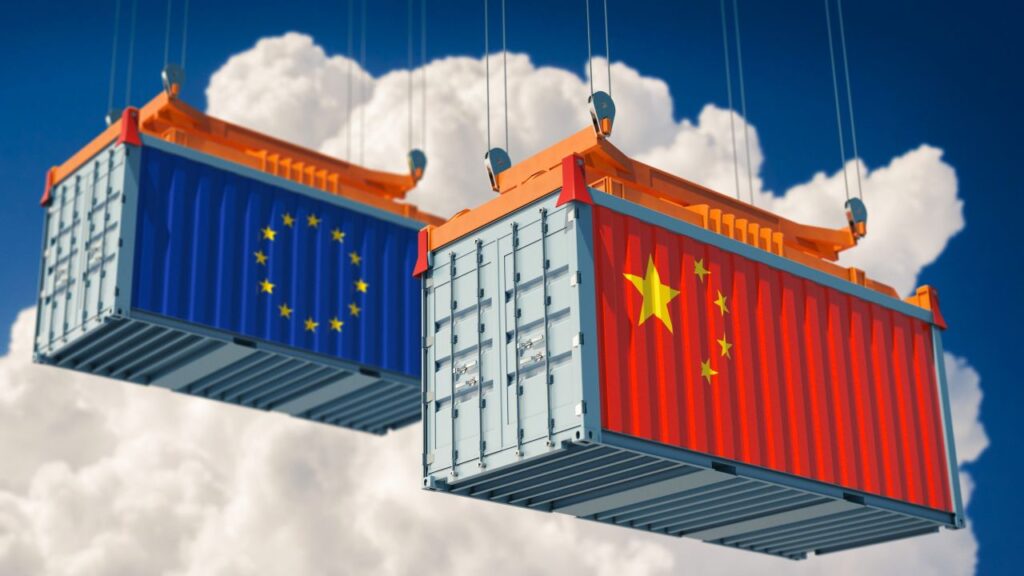
The third development may have the widest international consequences. Germany has joined France in demanding stronger European trade defenses against unfair competition.
Chancellor Friedrich Merz and French President Emmanuel Macron wrote to European Commission President Ursula von der Leyen calling for new powers to restrict market access for countries that undermine fair competition.
The proposal names no country. Its focus is nevertheless clear. Reuters reported that the document highlights dumping, widespread subsidies, and restrictions on currency convertibility, while demanding urgent action on imports of chemicals, PET, and hybrid vehicles.
Germany’s participation is the significant part. Berlin traditionally resisted tougher measures against Beijing because German manufacturers depended heavily on Chinese demand. Just two years earlier, Germany opposed EU anti-subsidy duties on Chinese electric vehicles.
Now, falling German exports to China and rising Chinese imports have changed the calculation. European reporting describes pressure from industry and shifting attitudes within Merz’s Christian Democrats.
Put bluntly, the relationship looks different when China becomes less valuable as a customer and more formidable as a competitor.
Europe Wants Faster, Broader Countermeasures
France and Germany warned of an industrial shock threatening strategically important sectors, including pharmaceuticals, aerospace, automobiles, machine tools, and chemicals. EU Trade Commissioner Maroš Šefčovič described the bloc’s roughly €1 billion daily trade deficit with China as unsustainable.
The proposed response goes beyond asking Brussels to investigate a little harder:
- Accelerate existing trade investigations and expand them to cover entire sectors.
- Create an instrument allowing restrictions on market access in response to unfair competition.
- Reduce dependence on single suppliers of critical goods.
- Allow countermeasures to proceed unless a qualified majority of EU governments opposes them.
That last proposal matters because it changes the decision-making default. Instead of requiring governments to assemble support for each response, measures could move ahead unless enough governments organize to block them.
German officials suggested responses could potentially be activated within days. However, the proposed instrument would first need approval from EU governments and the European Parliament. It is not an already operational power.
The Commission reportedly welcomed the proposals, suggesting momentum behind a more assertive approach. For context, the Commission’s explanation of EU trade-defense instruments outlines the existing framework within which this debate is taking place.
None of this guarantees a full-blown trade conflict. But it does make one more plausible. When Germany moves from resisting tougher measures to helping design them, Europe’s political balance has changed.
The Common Thread: Confidence Is Becoming Conditional
There is a temptation to turn these developments into a simple collapse narrative. That would miss the point.
Japanese companies are diversifying, not collectively severing every connection with China. Fund closures coexist with new launches. Europe’s proposed trade powers still require approval.
The more useful conclusion is that economic participation is becoming conditional. Businesses want China exposure without excessive dependence. Investors want performance without an endless stream of interchangeable products. European governments want trade without accepting what they regard as destructive competitive imbalances.
China remains central to all three relationships. But centrality no longer guarantees expanding commitment.
That is the challenge Beijing faces: not merely keeping markets open or issuing reassuring statements, but restoring the practical reasons people had for investing, staying invested, and resisting confrontation. Those reasons have weakened. And rebuilding them will take considerably more than warmer words.
Frequently Asked Questions
Are Japanese companies abandoning China completely?
No. The broader trend is diversification and restructuring. China remains important, but companies increasingly want alternative production locations and less concentrated exposure.
Why can a profitable Chinese fund still close?
Investment performance and fund viability are different. A fund can generate positive returns but still have insufficient assets to meet applicable requirements or sustain its operations.
Has the EU approved the proposed new trade instrument?
No. The Franco-German proposal would require approval from EU governments and the European Parliament before the new instrument could operate.
Does Japan’s corporate retreat mean a Taiwan conflict is inevitable?
No. Conflict remains a risk rather than an inevitable outcome. Companies can nevertheless reduce exposure because even a prolonged confrontation could disrupt shipping, supplies, and manufacturing.