Four developments underline the extraordinary range of pressures and opportunities shaping China today: a deadly landslide near Chongqing, a sharper than expected economic slowdown, fresh allegations from Washington over the 2020 US election, and a notable shift in international public opinion between China and the United States.
They are separate stories, but together they show the complexity of China’s present position. Authorities are confronting immediate public safety risks at home, an increasingly uneven economic recovery, a fragile relationship with the United States, and a global competition for influence that is being shaped as much by perceptions of Washington as by perceptions of Beijing.
Table of Contents
- Chongqing Landslide Leaves Deaths, Missing Residents and Fresh Safety Concerns
- China’s Economy Slows as Technology Growth Fails to Offset Weak Domestic Demand
- Trump Accuses China Over 2020 Election Data, but No New Punishment Follows
- Pew Survey Finds China Viewed More Positively Than the US in Most Countries Polled
- What These Developments Mean for China
- FAQ
Chongqing Landslide Leaves Deaths, Missing Residents and Fresh Safety Concerns
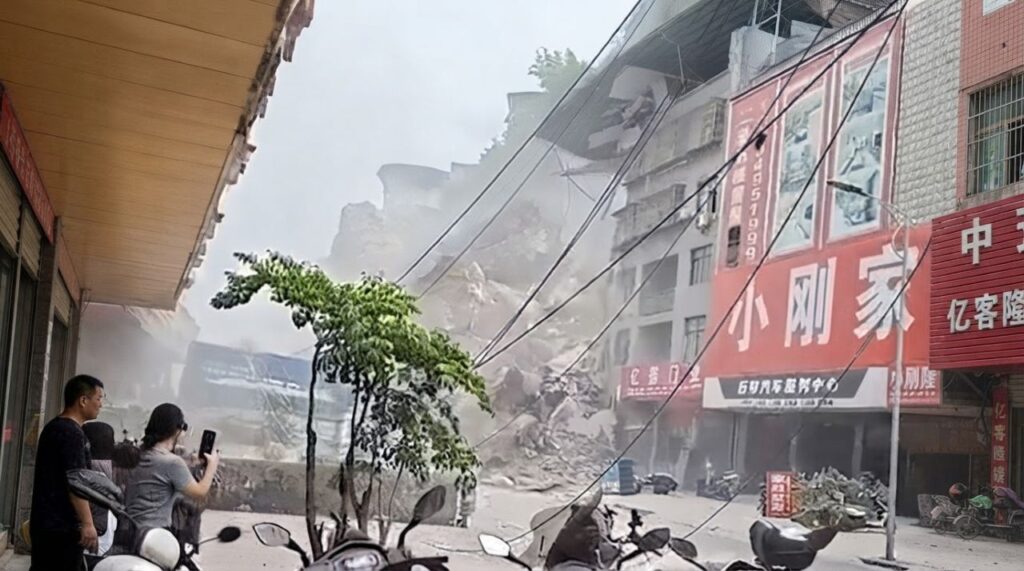
A major landslide in Pengshui County, on the outskirts of Chongqing in southwestern China, killed at least eight people and left another 34 missing beneath debris. The collapse occurred at roughly 9am on Friday, when about 18,000 cubic metres of rock and soil came down a steep mountainside.
More than 10 residential buildings were buried. Authorities evacuated over 1,100 people from the surrounding area, while rescue teams pulled 10 people from the debris. Two of those rescued suffered serious injuries.
The operation was large and difficult. More than 800 emergency personnel were deployed, using excavators and drones to locate people in an unstable disaster zone. Water, electricity and gas services were cut within a one-kilometre radius as a precaution, reflecting the risk that damaged infrastructure could create further danger.
Residents had reportedly begun leaving the area after hearing unusual sounds from the hillside and seeing small rocks fall. The main collapse came while that evacuation was already underway. That sequence likely prevented an even greater loss of life, although the scale of the disaster remains severe.
The immediate challenge is that the danger has not passed. Officials warned that unstable rocks remain above the site, leaving the area vulnerable to another collapse, particularly during extreme weather. Search and rescue efforts therefore have to be balanced against the safety of personnel operating below the slope.
Xi Jinping ordered authorities to continue rescue operations and investigate the cause of the disaster. That investigation will matter, but the event also sits within a wider pattern of deadly infrastructure, weather and geological disasters in recent years.
- A landslide in Gansu earlier this month killed 21 forestry workers.
- A recent factory fire in Fujian claimed 28 lives.
- A landslide in Yunnan killed 44 people in 2024.
- motorwayA rain-damaged expressway collapse in Guangdong killed 48 people in 2024.
- A residential building collapse in Changsha killed 54 people in 2022.
- An explosion at a barbecue restaurant in Yinchuan killed 31 people in 2023.
- The catastrophic Henan floods in 2021 caused 398 deaths and disappearances.
Each event has different causes, but they point to a recurring public safety challenge: extreme weather, urbanisation, construction standards, local enforcement and emergency response can all intersect with devastating consequences. The Chongqing landslide is another tragic reminder that disaster prevention often depends on decisions made long before the ground begins to move.
China’s Economy Slows as Technology Growth Fails to Offset Weak Domestic Demand
China’s economy slowed more sharply than expected in the second quarter of 2026. Real gross domestic product grew 4.3% year on year between April and June, down from 5% in the first quarter and below the 4.5% consensus forecast among economists.
First-half growth stood at 4.7%. On a quarter-on-quarter basis, GDP rose 0.9%, matching expectations but marking the slowest sequential pace in more than two years.
The figures matter because they fell below the lower end of Beijing’s official full-year growth target range of 4.5% to 5%. More importantly, they reveal an increasingly divided economy. China has strong pockets of expansion in artificial intelligence, high-tech manufacturing, exports and some modern services. Officials said these so-called new growth drivers accounted for more than 40% of economic growth.
Industrial production rose 5.3% in June, exceeding expectations. That is a substantial result, but it does not solve the core problem. The sectors most connected to household confidence, consumer spending and private investment remain weak.
Retail sales and investment are deteriorating
Retail sales increased just 1% year on year in June, despite the major 618 online shopping festival. Automobile sales fell by more than 16%.
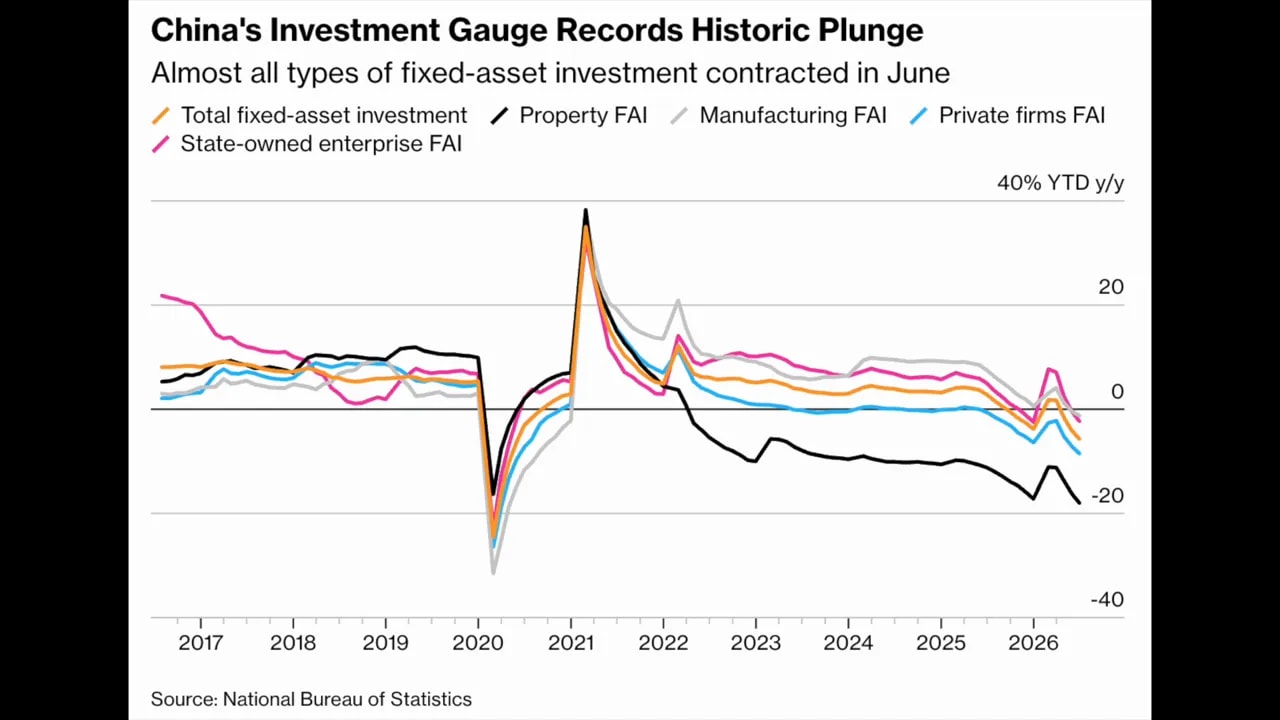
Fixed asset investment contracted 5.7% over the first half of the year, worsening from a 4.1% decline during the first five months. Almost every major category of capital expenditure fell in June. This is significant because investment, especially infrastructure and property-related investment, has traditionally been one of Beijing’s most reliable tools for stabilising activity when growth weakens.
When investment itself becomes a drag, policymakers have fewer easy options. They can accelerate fiscal spending, expand credit, support infrastructure projects or ease monetary policy. Yet each option comes with trade-offs, particularly when local governments and parts of the property sector already carry substantial financial strain.
The property crisis remains a major economic drag
The property sector continues to sit at the centre of China’s domestic weakness. Real estate development investment fell 18% year on year to 3.81 trillion yuan in the first half, the sharpest decline in data going back to 1992. This is now the fifth year of the property downturn.
The associated indicators are equally stark:
- New project starts fell 23.4%.
- Property sales by value dropped 13.6%.
- Funding available to developers declined 20.2%.
- Domestic bank lending to developers plunged 31.7%.
The property slump reaches far beyond developers. It affects construction activity, local government land sales, household wealth, confidence, furniture and appliance demand, bank balance sheets and employment. In an economy where housing has long been a principal store of household savings, falling activity in the sector has an outsized effect on how willing people feel to spend.
Industrial capacity utilisation fell to 73%, its lowest level since the first quarter of 2020. That is another sign of the imbalance facing the economy: China retains enormous productive capacity, but domestic demand is not strong enough to absorb it.
Deflation may have ended, but the cause matters
One apparent positive was the end of China’s three-year economy-wide deflation streak. Nominal GDP grew 5.9%, pushing the estimated GDP deflator into positive territory for the first time in 12 quarters. It rose by about 1.6% in the second quarter.
However, this does not necessarily represent healthy inflation driven by vigorous consumer demand. Much of the change appears linked to higher imported energy costs, particularly oil. In other words, price pressures are being driven by rising input costs while underlying deflationary forces, weak consumption and industrial overcapacity remain in place.
That distinction is crucial. Higher prices caused by stronger household demand can signal recovery. Higher prices caused by energy costs can instead squeeze businesses and consumers, making the wider economy more difficult to manage.
The data will put pressure on policymakers ahead of the Communist Party’s July Politburo meeting. Premier Li Qiang has called for stronger counter-cyclical adjustments, full implementation of existing measures and preparation of additional policies. Beijing is likely to move more quickly on already approved spending before launching a major new stimulus package.
Several major banks have reduced their 2026 forecasts, with Morgan Stanley, Goldman Sachs and ANZ expecting growth of roughly 4.5% to 4.6%. The central question is whether the technology and export boom can produce enough jobs, income and confidence to compensate for weakness in property, investment and household consumption. At present, that remains far from certain.
For further context on the connection between external shocks, producer prices and financing pressure, see this analysis of China’s producer inflation, debt strain and Hormuz-related economic risks.
Trump Accuses China Over 2020 Election Data, but No New Punishment Follows
US President Donald Trump has accused China of conducting what he described as an unprecedented operation targeting the 2020 US presidential election. The claims introduce a potentially serious point of tension into an already delicate US-China relationship.
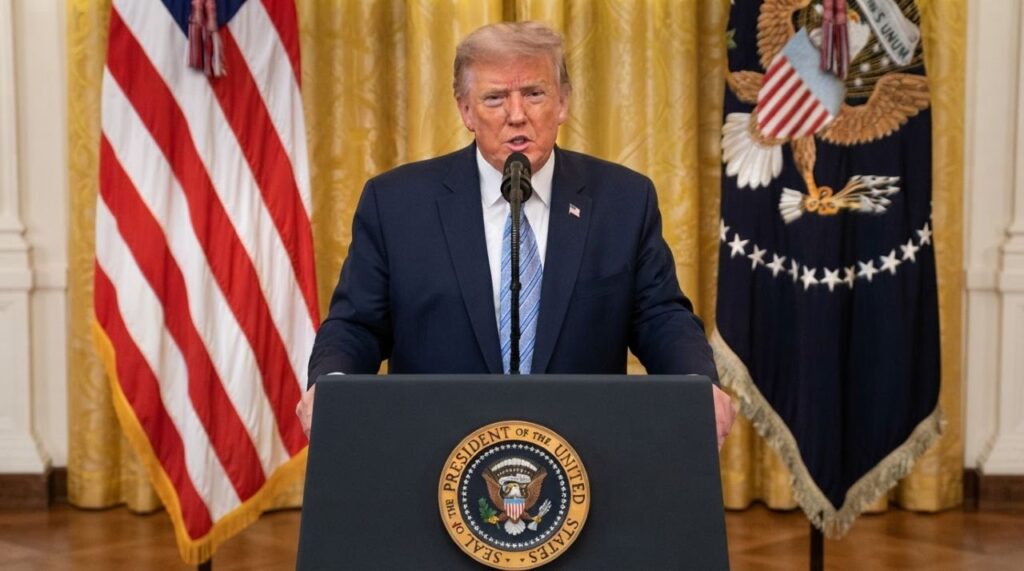
In a prime-time White House address, Trump alleged that the Chinese government stole roughly 220 million voter records containing names, addresses and other personal information. He described it as the largest compromise of election data in history and argued that Beijing wanted him to lose because of his tariffs and tougher policies toward China.
The important qualification is that the documents released by the administration did not show that China changed votes or accessed systems capable of altering the election result. A 2021 US intelligence assessment concluded that no foreign actor attempted to manipulate voter registration, ballot casting, tabulation or the reporting of results in the 2020 election.
The released intelligence did indicate that Chinese-linked hackers collected information about American voters and monitored political targets. One report suggested that hackers mapped the email accounts of Joe Biden campaign staff, potentially preparing for future intelligence collection. Other documents said Chinese actors downloaded voter registration data from several states, although some of the information was already publicly available.
Trump also accused US intelligence agencies of concealing evidence during his first term. He ordered four federal agencies to investigate the alleged cover-up, dismiss responsible officials and pursue criminal charges where appropriate.
China rejected the accusations. Foreign Ministry spokesperson Lin Jian described them as fabricated and malicious smears, saying Beijing has never interfered in US elections and has no interest in doing so. The ministry urged Washington not to use China as a domestic political issue.
Why the absence of retaliation matters
Despite the intensity of the allegations, the Trump administration did not announce new penalties against Beijing. Planning reportedly remains underway for Xi Jinping’s state visit to Washington in September, following Trump’s visit to Beijing in May.
That restraint is significant because the two governments have spent months maintaining a fragile trade truce. Under the arrangement, tariffs were reduced, restrictions on companies were paused and supplies of critical products, including Chinese rare earths, continued to flow. Both sides have accused the other of incomplete implementation, but the agreement has largely prevented another major trade war.
Trump’s remarks recall the sharp turn in US-China relations during the 2020 campaign, when he increasingly blamed Beijing for the Covid-19 pandemic after signing the Phase One trade agreement. That period brought sanctions, consulate closures and the deepest deterioration in bilateral ties for decades.
This time, the lack of concrete retaliatory action suggests the speech may have been aimed more at revisiting the 2020 election and mobilising voters before the November midterms than at beginning an immediate confrontation with China. That does not mean the issue is insignificant. Allegations around cyber activity, election interference and intelligence operations can quickly become flashpoints in a relationship already defined by strategic rivalry.
Pew Survey Finds China Viewed More Positively Than the US in Most Countries Polled
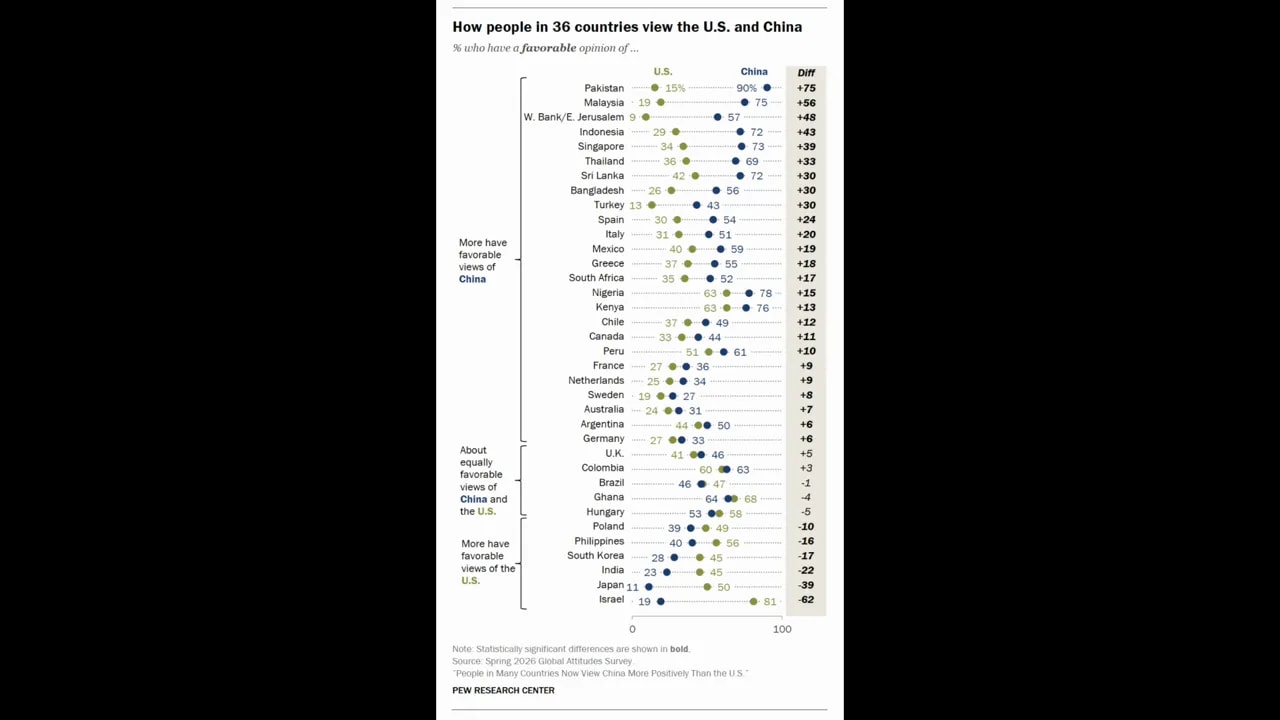
China is now viewed more positively than the United States in most of the 36 countries surveyed by the US-based Pew Research Center. The result marks a meaningful shift in global public opinion as Beijing and Washington compete for influence.
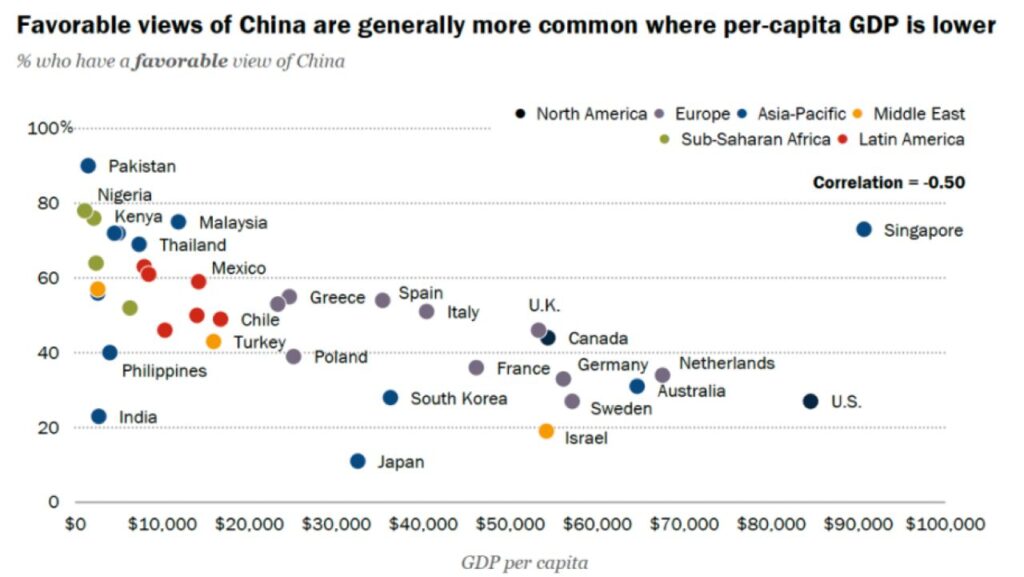
The survey included 42,151 adults and was conducted between February and May 2026. It found that views of China have improved in recent years while perceptions of the United States have deteriorated. The reversal was particularly pronounced across parts of the Asia-Pacific and the Middle East.
The United States still held a stronger image in six countries, including India, Japan, the Philippines and South Korea. That is revealing. Several countries closest to China, and with the most immediate exposure to Chinese military and political power, continue to view the United States more favourably.
Canada offers one of the starkest examples of the broader change. In 2023, 57% of Canadians had a favourable view of the United States, compared with just 14% who viewed China favourably. By 2026, China’s favourability rating had risen to 44%, while the US rating had fallen to 33%.
Canadians and Mexicans now both view China more positively than their neighbouring superpower.
A shift in views of leadership, not just countries
Confidence in national leaders has moved in a similar direction. During the latter part of Joe Biden’s presidency, respondents in most surveyed countries expressed greater confidence in Biden than in Xi Jinping. International confidence in Donald Trump, however, has fallen sharply during the first two years of his second term.
judgementThis suggests that the survey is not simply a verdict on the United States as a country. It is also a judgment on the current US administration and its foreign policy. A more assertive America First approach has prioritised US interests over those of allies, creating friction with partners that once saw Washington as highly predictable.
The United States remains more highly rated than China on perceptions of personal freedom, but even this advantage has narrowed. In Sweden, the share of people saying Washington respects the freedoms of its people fell from 61% in 2021 to 27% in 2026. Declines of at least 25 percentage points were also recorded in Canada, France, Germany, Italy, the Netherlands, South Korea and Spain.
Reliability and interference shape the competition for influence
The findings carry particular weight in middle-income countries. A median of 75% of respondents across 17 such countries said the United States interferes substantially in the affairs of other countries. By comparison, 45% said the same of China.
Many respondents also considered Beijing a more reliable partner and a greater contributor to global stability. In South Africa, 72% described China as reliable, compared with 46% for the United States. In Pakistan, China led by 84% to 36%.
The Philippines was a notable exception. There, 81% identified the United States as reliable, compared with 42% for China. Given ongoing tensions in the South China Sea, that outcome is not surprising.
The survey was conducted near the start of the Iran War, a factor that may have influenced how respondents assessed US foreign policy and global stability. The broader conclusion is clear: China’s improved standing appears to reflect not only greater support for Beijing, but also a more negative assessment of American leadership.
A wider round-up of these diplomatic, economic and public opinion developments is available in China News Bytes.
What These Developments Mean for China
China’s current position contains powerful contradictions. Its high-tech industries and export capacity are expanding, but domestic demand, property activity and investment are weak. Its international image is improving in many countries, but strategic distrust remains strong among several nearby states. Its relationship with Washington is stable enough to preserve a trade truce, but fragile enough that a major political allegation can suddenly raise the temperature.
Meanwhile, the Chongqing landslide is a reminder that macroeconomic indicators and geopolitical competition do not replace the most immediate responsibility of government: protecting lives when disaster strikes.
The challenge for Beijing is not merely to maintain headline growth. It is to build a recovery that improves household confidence, addresses the property crisis and reduces the gap between industrial capacity and real demand. Internationally, the challenge is to convert improving public sentiment into durable partnerships without escalating the security tensions that remain most acute in Asia.
FAQ
How many people were killed or missing after the Chongqing landslide?
At least eight people were killed and 34 were missing after the landslide in Pengshui County. Ten people were rescued, including two with serious injuries.
Why did China’s economy slow in the second quarter of 2026?
GDP growth slowed to 4.3% year on year because high-tech manufacturing and exports were unable to offset weak retail sales, falling investment, a severe property downturn and subdued household confidence.
Has China’s deflation problem ended?
China’s economy-wide GDP deflator turned positive in the second quarter for the first time in 12 quarters. However, much of the change appears to reflect higher imported energy costs rather than a broad recovery in consumer demand.
Did the US allegations show that China changed the 2020 election result?
No. The released documents suggested Chinese-linked actors collected voter data and monitored political targets, but they did not demonstrate vote changes or access to systems capable of altering the result. A 2021 US intelligence assessment found no foreign attempt to manipulate voting or vote counting.
Why has China’s global favourability improved?
The Pew findings indicate that China’s improved standing is partly connected to worsening perceptions of US leadership and foreign policy. The change is especially visible in parts of the Asia-Pacific, the Middle East and middle-income countries.