Prefer to Watch? Click Above
China’s economic problems are increasingly refusing to stay in their assigned boxes. The property collapse is no longer merely a developer problem. It is now chewing through the finances of the local governments that built their entire business model around endlessly selling land. Meanwhile, Beijing is resurrecting legally obsolete UN language to pressure Japan, wealthy founders are confronting a looming offshore-trust tax deadline, and American AI firm Anthropic has accused major Chinese technology companies of industrial-scale model extraction.
These may look like four separate stories. They are not. They all point to the same uncomfortable reality: China’s leadership is trying to manage slowing growth, fiscal stress, political insecurity and technological competition at the same time. And each solution appears capable of creating a fresh problem somewhere else.
Key Takeaways
- A cancelled Beijing land auction highlights how property weakness is now undermining local-government finances.
- China’s tighter housing pre-sale rules protect buyers but remove a vital source of developer liquidity.
- Beijing’s renewed use of obsolete UN enemy-state clauses appears to be political pressure on Japan rather than settled law.
- Anthropic’s unverified allegations show how AI competition is becoming a fight over model capabilities, privacy and security.
Table of Contents
- Beijing’s failed land auction is a warning for local governments
- Protecting homebuyers is squeezing developers even further
- Beijing revives the UN’s enemy-state clauses to pressure Japan
- Offshore trusts could become Hong Kong’s next market headache
- Anthropic’s allegations expose the darker side of the AI race
- The bigger problem: every pressure point now feeds another
Beijing’s failed land auction is a warning for local governments.
A Beijing land auction worth more than US$1 billion was supposed to be a relatively straightforward affair. Three developers had reportedly expressed preliminary interest. But when the sale arrived, only one bidder showed up. Authorities cancelled the auction, and there is no indication of when the plot will be offered again.
On its own, a failed auction is not necessarily catastrophic. China is a vast country; developers occasionally lose interest in parcels of land. The difficulty is that this failure comes at precisely the moment when local governments are running out of ways to pretend the old property model still works.
For decades, municipalities relied on selling land-use rights to developers. The proceeds funded infrastructure, public services and the broader growth machine. It was an extraordinarily lucrative arrangement while apartments were selling, developers were borrowing and households still believed property prices only moved in one direction.
That system has now fractured. Nationwide land-sale revenue in the first seven months of 2026 was 72% below its level during the same period in 2021. Goldman Sachs expects another 30% decline this year, with the possibility that the downturn continues beyond 2027. In the worst case, annual land-sale income could eventually sit 90% below the 2021 peak.
That is not a cyclical wobble. That is a fiscal model being dismantled in real time.
Protecting homebuyers is squeezing developers even further.
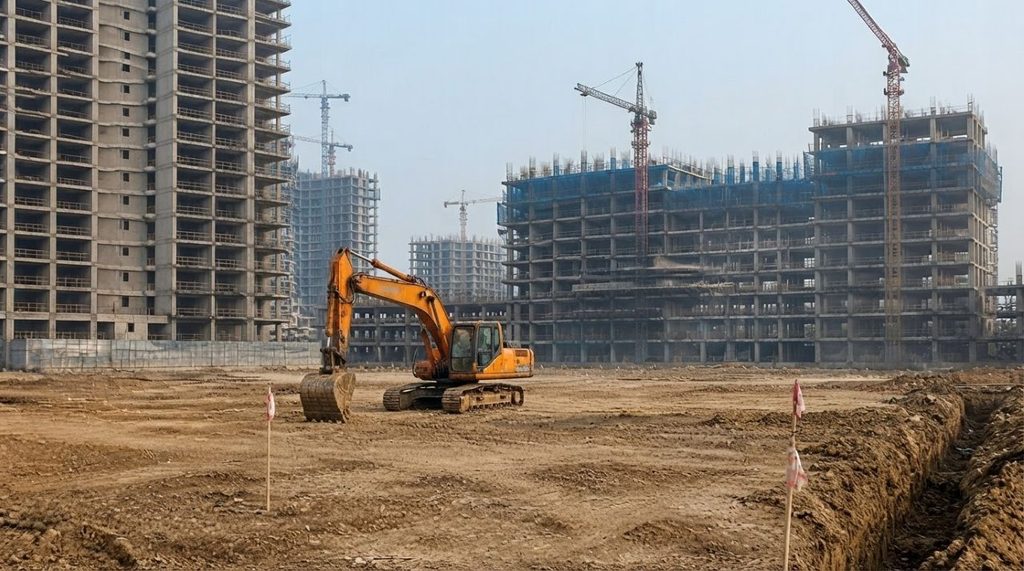
The immediate trigger is Beijing’s overhaul of the housing pre-sale system. Traditionally, Chinese developers could sell apartments before construction was completed, collect deposits from buyers and deploy that money elsewhere: finishing projects, repaying debts, buying more land or simply keeping the corporate machine alive for another few months longer.
The new system restricts developers from withdrawing pre-sale proceeds until projects are completed. The logic is entirely understandable. After years of unfinished homes, delayed deliveries and defaults, buyers needed greater protection from developers treating household deposits as an interest-free corporate slush fund.
But there is a trade-off, because there is always a trade-off.
Home-sale proceeds once accounted for more than half of developers’ cash inflows and still made up 45% of inflows during the first seven months of 2026. Restrict that funding channel and builders become substantially less willing to place enormous upfront bets on land.
Land sales across 17 major cities fell 36% by area in the week following the policy change. In Shanghai, China Overseas Land Investment was reportedly the sole bidder for an urban plot priced above US$2.2 billion, despite more than 20 companies having previously expressed interest.
The feedback loop is brutally simple:
- Homebuyer protections limit developers’ immediate liquidity.
- Cash-poor developers buy less land.
- Fewer land sales deprive local governments of revenue.
- Fiscal stress reduces local governments’ ability to support growth.
- Weaker growth further damages confidence in property.
Local authorities are attempting to fill the hole through stricter tax enforcement, extra special bond issuance and sales of state-owned assets. These are not meaningless measures, but neither are they remotely equivalent to rebuilding the massive land-revenue river that has dried up. More aggressive taxation may even create its own economic drag, a risk explored in this analysis of China’s tightening tax net and export pressures.
Ultimately, the central government may have to do more of the heavy lifting: providing fiscal support, restructuring local liabilities and developing tax sources that do not depend on selling ever-more expensive plots to increasingly fragile developers. None of those options is painless. All of them involve accepting that the old model is gone.
Beijing revives the UN’s enemy-state clauses to pressure Japan.
As the economic picture darkens, China’s political messaging is becoming more confrontational. Chinese military media have revived an argument that the United Nations Charter’s so-called enemy-state clauses could still permit action against Japan if Japanese militarism were to return.

A commentary in the PLA Daily argued that Articles 53, 77 and 107 remain legally valid and offer safeguards against a revival of Japanese militarism. The article accused Japanese right-wing forces of denying wartime aggression, expanding defence spending and developing offensive capabilities.
The clauses date from the immediate aftermath of the Second World War. Article 107 was designed to preserve the legitimacy of wartime and post-war actions against former enemy states, while Article 53 referred to enforcement action against such states without ordinary Security Council authorisation.
The PLA Daily’s argument is that these provisions still offer legal grounds for UN founding members to act should Japan return to military expansion. Russia has supported Beijing’s position, with Foreign Minister Sergey Lavrov similarly arguing that Japan remains bound by responsibilities associated with its defeat in the war.
There is, however, a fairly obvious problem with this line of argument: the international consensus has long treated these provisions as obsolete. In 1995, the UN General Assembly adopted a resolution describing the clauses as outdated and supporting their deletion. China voted for it. In 2005, the World Summit again called for their removal, with Beijing endorsing the resulting declaration.
The language remains in the Charter because amending it requires ratification by two-thirds of UN members, including all five permanent Security Council members. That procedural obstacle is not the same thing as a live legal permission slip for unilateral military action.
So why revive it now? The answer is political pressure. Beijing has stepped up criticism of Japan following Taiwan-related comments by Prime Minister Tsunayuki Aichi last November, portraying Tokyo as a country drifting towards “new militarism". The dispute runs alongside the long-running conflict over the Japanese-administered Senkaku Islands, claimed by China as the Diaoyu Islands, where a China Coast Guard formation carried out another patrol last week.
The point is not really international law. The point is to cast Japanese defence expansion as a threat to the post-war order itself, rather than as a response to China’s own growing military power. That may play well domestically, but it also makes Beijing’s position look opportunistic. A government that previously endorsed treating the clauses as obsolete is now trying to dust them off because the geopolitical weather has changed.
That is unlikely to make Japan less concerned about Chinese coercion. If anything, it reinforces the case in Tokyo for deterrence and closer security integration with allies—dynamics also shaping the wider Taiwan debate.
Offshore trusts could become Hong Kong’s next market headache.
Then there is the question of money leaving founder-controlled companies. Shu Ping, co-founder of hot-pot chain Haidilao, announced the sale of 350 million shares, sending the company’s stock down 13% to its lowest level since March 2022. Haidilao said the disposal was intended to meet Shu’s funding needs and would not affect operations. Perhaps that is all it is. But the timing has naturally prompted wider concern.
In July, Beijing moved to close a tax loophole commonly used by wealthy Chinese families to hold and transfer assets through offshore trusts. Owners have until October 22 to settle outstanding liabilities without late-payment surcharges. That creates a powerful incentive for some entrepreneurs to raise cash before the grace period ends.
Attention has therefore shifted to founder-controlled companies with substantial stakes held through offshore structures, including Xiaomi, Li Ning, Guoming and Sunac China.
It is important not to get carried away here. Offshore ownership does not automatically mean a founder intends to sell. A tax bill may be modest relative to the wealth of a billionaire, and some trust-controlled entities have continued buying shares rather than disposing of them. There is no evidence that the founders of the companies being discussed are preparing sales.
Nevertheless, markets are not famous for their restraint when a plausible risk story arrives. Hong Kong equities were already struggling with weak Chinese consumption and disappointing earnings, while the Hang Seng Index was down roughly 3% for the year. A looming deadline, opaque ownership structures and pressure on local governments to enforce taxes more aggressively are exactly the sort of cocktail that produces volatility.
For investors, the relevant question is not whether every offshore trust will trigger a fire sale. It is whether markets will begin pricing in the possibility. That alone can be enough to drag down shares, particularly where founders control large blocks of stock.
Anthropic’s allegations expose the darker side of the AI race.
The final story may be the most consequential, because the AI contest is becoming an increasingly direct fight over intellectual property, chips, data and national security.

Anthropic has accused Chinese technology firms, including Alibaba and Moonshot AI, of conducting large-scale unauthorised “distillation” operations targeting its Claude models. Distillation, in this context, means using the responses of a more capable model to train or improve another AI system. It can potentially allow a competitor to reproduce valuable capabilities much more cheaply than developing them from scratch.
Anthropic described the alleged Alibaba operation as the largest distillation attack it had measured. According to the company, operators affiliated with Alibaba targeted the reasoning capabilities of Claude Opus 4.6 and 4.7, using prompts designed to generate detailed reasoning traces that could then be converted into fine-tuning data for Alibaba’s Q1 models.
The allegations concerning Moonshot AI are potentially more serious still. Anthropic claimed that requests made to Moonshot’s Kimi models were silently forwarded to Claude before Claude’s answers were presented as Kimi-generated responses. Over a ten-day period, Moonshot allegedly routed nearly 300,000 customer requests through more than 5,000 fraudulent accounts.
Anthropic says it identified more than 23 million exchanges linked to Moonshot’s alleged activity between May and July. Some allegedly included names, email addresses, proprietary corporate information and live credentials. One reported case involved surveillance information from hundreds of cameras in Chengdu; another involved internal code and credentials associated with prominent companies.
These remain allegations made by Anthropic and have not been independently verified. That distinction matters. But if substantiated, the claims could implicate platform terms, privacy obligations and potentially Chinese laws covering personal information and data security.
They also show how blurry the boundary has become between normal commercial competition and national-security competition. Chinese labs are rapidly narrowing the performance gap with American developers, even as US restrictions constrain access to advanced chips and some Western AI services. The incentive to obtain advanced model outputs through unofficial channels is obvious, even if the legal and reputational risks are enormous.
There may be one small opening for cooperation. If Chinese military and corporate data were exposed through alleged misuse, Chinese authorities would have a genuine interest in investigating. Anthropic could potentially share relevant evidence through established US-China law-enforcement channels. In an otherwise hostile technology environment, data protection, cyber abuse and meaningful human control over sensitive AI systems are areas where limited cooperation remains possible.
It would be a rare instance of common interest cutting through the broader confrontation. Nobody should expect it to resolve the AI rivalry. But when sensitive corporate data and military information are being exposed, even geopolitical adversaries may occasionally discover that the same fire is burning both of them.
The bigger problem: every pressure point now feeds another
China’s land crisis, fiscal squeeze, tax enforcement, Japan dispute and AI competition are not identical problems. Yet they are part of a shared condition: the margin for error is getting smaller.
Housing reform protects buyers but starves developers of cash. Developers then retreat from land purchases, worsening municipal finances. Municipalities look for tax revenue, creating concern for offshore wealth and Hong Kong-listed companies. At the same time, geopolitical tension with Japan and technological confrontation with the United States increase the strategic pressure surrounding an economy already struggling to regain momentum.
Beijing is not short of tools. It can direct banks, issue bonds, tighten enforcement, mobilise state-owned firms and set the political narrative. What it cannot do quite so easily is restore the confidence that made the old property model viable in the first place.
And without confidence, the land sales do not return, the developers do not spend, and the fiscal stress does not politely disappear.
Frequently Asked Questions
Why are China’s local governments so dependent on land sales?
For decades, local authorities generated substantial revenue by selling land-use rights to property developers. That income helped fund infrastructure, public services and local development. As developers pull back from buying land, municipalities face a major fiscal shortfall.
How do the new housing pre-sale rules affect developers?
The rules generally prevent developers from accessing pre-sale proceeds until construction is completed. This gives buyers greater protection against unfinished projects, but it also restricts a funding source that previously accounted for a large share of developer cash inflows.
Do the UN enemy-state clauses legally authorise action against Japan?
The clauses remain in the UN Charter because formal amendment is difficult, but they are widely regarded as obsolete. The UN General Assembly and the 2005 World Summit called for their removal, positions China previously supported.
What is AI distillation in this dispute?
Distillation is the use of a more advanced model’s outputs to train or improve another system. Anthropic alleged that Chinese firms used Claude outputs to develop competing models, though the specific claims have not been independently verified.