Prefer to Watch: Click Above
China is facing a rather ugly convergence of pressures: a military leadership being hollowed out by investigations, a generation of graduates discovering that qualifications are not jobs, and a trade relationship with Europe that is increasingly starting to look less like commerce and more like a slow-motion political collision.
None of these problems exists in isolation. Xi Jinping’s consolidation campaign speaks to enduring distrust inside the People’s Liberation Army. Youth unemployment reflects a deeper mismatch between China’s economic model and the aspirations it has encouraged. And Europe’s increasingly blunt language on imports, industrial overcapacity and strategic dependency suggests Beijing may soon find that its export engine has fewer places left to go.
The common thread is strain. China’s system remains formidable, obviously. But it is also becoming more centralised, more defensive and more exposed to the consequences of decisions made over many years.
Key Takeaways
- The expulsion of Zhang Youxia and Liu Zhenli extends Xi Jinping’s sweeping purge into the PLA’s highest ranks.
- Youth unemployment reached 18.9% as 12.7 million new graduates entered a weak and increasingly AI-exposed job market.
- The EU is considering managed-trade measures to curb Chinese imports and reduce strategic dependence on Beijing.
- Europe’s ability to act will depend on whether member states, especially Germany, can sustain a unified position.
Table of Contents
- Xi’s Military Purge Has Reached the Very Top
- China’s Graduate Dream Is Running Into a Jobs Wall
- Europe Is Losing Patience With China’s Export Machine
- Europe’s Problem: It Wants Less Dependence Without Less Business
Xi’s Military Purge Has Reached the Very Top
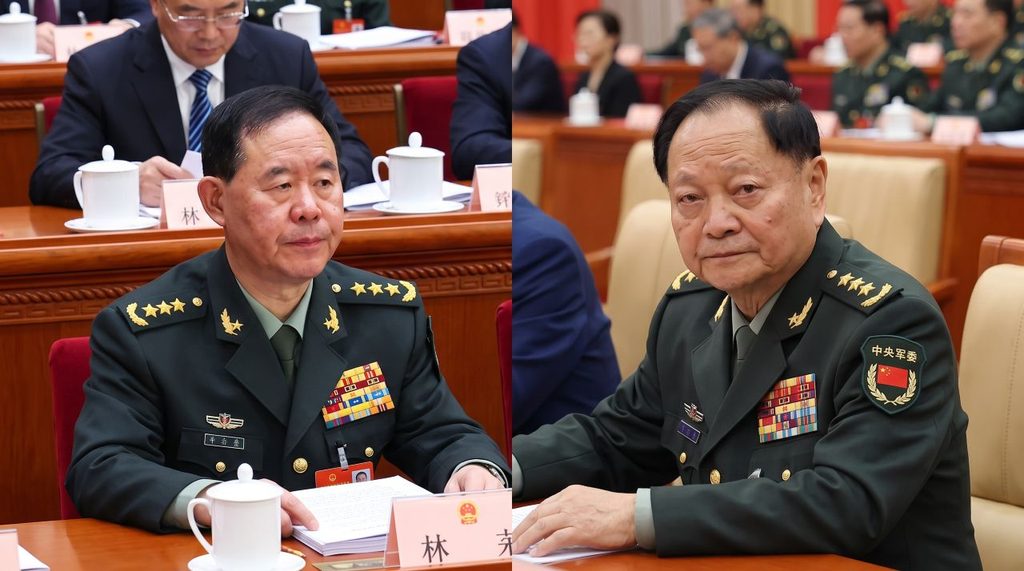
The expulsion of Zhang Youxia, formerly the top-ranked vice-chairman of the Central Military Commission, and Liu Zhenli, former chief of the Joint Staff Department, is an extraordinary development. These are not obscure officers shuffled out through the bureaucratic side door. They were among the most senior figures in China’s military establishment.
State media accused the pair of corruption, political disloyalty and “clique” activity. The allegations include accepting exceptionally large sums of money, helping others secure promotions and failing to supervise relatives and subordinates. Their cases are expected to proceed through Party procedures before transfer to military prosecutors.
In authoritarian politics, corruption charges are rarely just about corruption. They may well be true—China’s military procurement system has long been vulnerable to graft—but the political language matters enormously. Accusations of disloyalty and factionalism are a warning that the issue is not merely financial misconduct. It is trust.
Zhang’s removal is particularly striking because of his personal and family connections to Xi Jinping. He occupied one of the most powerful roles in the PLA and had long been seen as a central figure in Xi’s military inner circle. When even senior figures with that kind of proximity are discarded, it suggests that proximity is no longer a particularly reliable form of protection.
This is part of a purge on a scale that should alarm anyone assessing Chinese military readiness. The Center for Strategic and International Studies reported that dozens of generals and lieutenant generals had been formally removed since 2022, while many more officers were missing from public view or potentially under investigation. Former defence ministers Wei Fenghe and Li Shangfu were themselves sentenced to death with two-year reprieves, punishments expected to be commuted to life imprisonment.
Xi’s defenders would argue that this is necessary housekeeping. A military built around bribery, patronage and compromised procurement is not a military ready for conflict. There is truth in that. Buying rank is not generally regarded as a reliable route to battlefield competence.
But there is an obvious catch. Repeatedly removing senior commanders, procurement officials and political overseers can also damage the institution being cleaned up. Command chains become unsettled. Procurement decisions are delayed. Officials learn that initiative carries risk, while rigid compliance is safer. A military can be disciplined into paralysis just as easily as it can be reformed into effectiveness.
The broader political implication is even more sobering. These expulsions come ahead of the Communist Party’s 2027 National Congress, where Xi is widely expected to secure a fourth term. There is no clear evidence of an immediate threat to his position. Yet the removal of trusted allies reinforces the sense that political and military stability is increasingly tied to the authority—and suspicions—of one man.
China’s Graduate Dream Is Running Into a Jobs Wall
China has spent years telling its young people that education is the escalator to security, status and prosperity. The problem is that the escalator appears to have stopped somewhere between the graduation ceremony and the first job interview.
Official data showed unemployment among 16- to 24-year-olds excluding students rising to 18.9% in August, from 17.9% in July. That matched the highest level recorded since the government revised its methodology in 2023. Unemployment for people aged 25 to 29 rose to 7.5%, while the overall urban unemployment rate edged up to 5.3%.
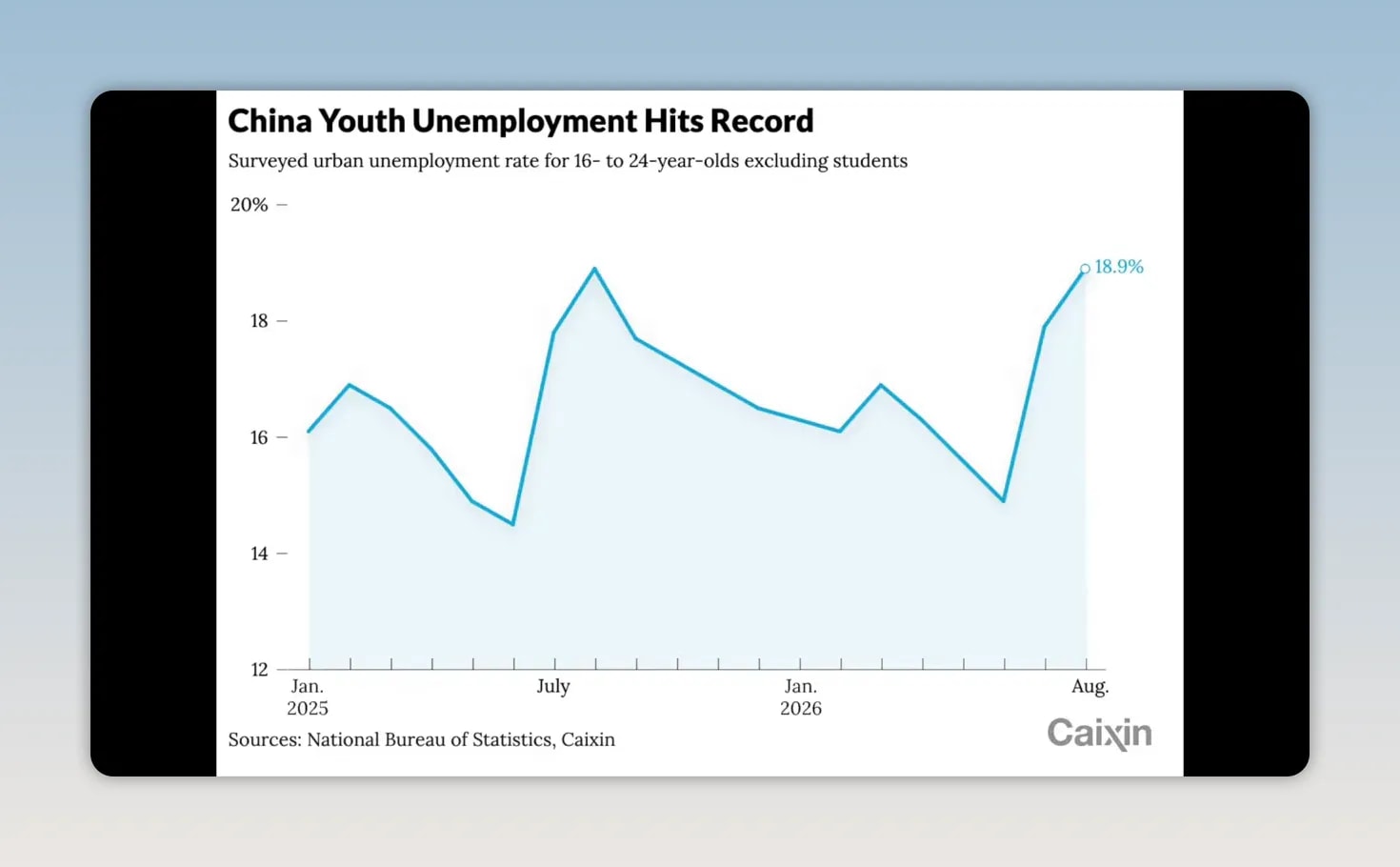
Those are official figures, and the real picture may be worse once underemployment is included. A young person doing sporadic gig work, earning very little, or waiting at home for a job that never materialises does not necessarily fit neatly into any reassuring employment statistic.
The immediate problem is volume. A record 12.7 million university students graduated this summer, entering a labour market already weakened by slower growth and anaemic domestic demand. Seasonal pressure after graduation explains some of the increase. It does not explain everything.
Artificial intelligence is now adding another complication. Entry-level technology jobs have traditionally been a pathway for graduates to accumulate skills and move up the ladder. But junior coding, basic analysis and routine office tasks are precisely the sort of work businesses are increasingly trying to automate. One recent software-engineering graduate reported making more than 100 applications without finding employment, believing AI had reduced the number of entry-level roles while intensifying competition for those left.
The International Labour Organization estimates that 7.5% of jobs held by East Asian workers aged 15 to 29 sit in occupations highly exposed to AI. Exposure is not the same thing as replacement, of course. But the timing could hardly be worse: China is producing an enormous graduate cohort just as firms are experimenting with ways to need fewer junior workers.
Even PhD Holders Are Being Pushed Into Alternative Careers
The graduate squeeze does not stop at bachelor’s degrees. It is moving upward through the education system, reaching people who once assumed elite academic credentials would guarantee a research career.
A growing number of PhD graduates from top universities are taking positions at prestigious secondary schools. Shenzhen Middle School’s latest intake reportedly included five PhDs among 21 prospective teachers, including engineering graduates from Tsinghua University and Cambridge. The school already employs more than 100 doctorate holders.
There is nothing inherently wrong with highly educated people becoming teachers. Elite schools can offer good salaries, housing, stability and social status. The concern is what this shift reveals about the alternatives. China produced 97,200 PhD graduates in 2024, an 82% increase from 2014, but universities reportedly offer only around 35,000 positions each year.
This is credential inflation in its most visible form: ever-higher qualifications chasing a limited pool of jobs. A doctorate does not automatically make someone a brilliant teacher, either, as education specialists have noted. Nor does it solve the underlying problem of an economy that is not generating sufficient high-quality work for its most skilled citizens.
That weakness matters far beyond frustrated graduates. Weak household confidence constrains consumption; constrained consumption reinforces Beijing’s reliance on manufacturing and exports; and that export reliance is now provoking a serious backlash abroad. For a fuller examination of why Beijing itself has begun to acknowledge the limits of export-led growth, see this analysis of China’s unsustainable trade model and weakening services momentum.
Europe Is Losing Patience With China’s Export Machine
For years, Brussels has talked about “de-risking” from China, a phrase sufficiently bland to survive almost any policy meeting. But the language is getting harder because the economic reality is getting harder.
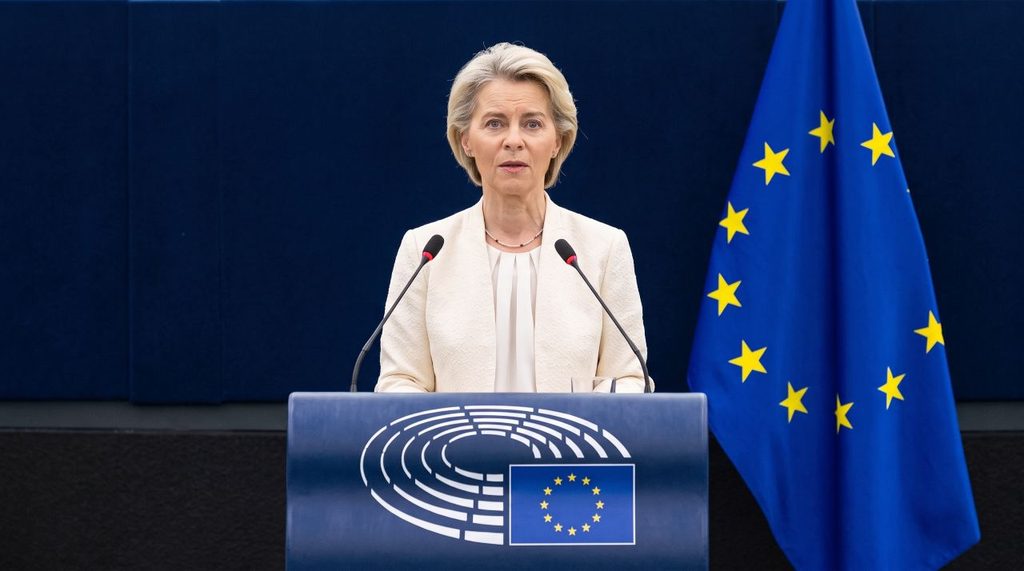
In her 2026 State of the Union address, European Commission President Ursula von der Leyen said the EU’s trade deficit with China had reached roughly €1 billion per day. She warned that a “second China shock” was already hitting European factories and communities, called the situation unsustainable, and promised to use every available tool to rebalance the relationship.
The phrase “China shock” is not decorative rhetoric. It invokes the disruption caused by China’s entry into global trade in earlier decades, when a flood of low-cost goods reshaped industries and employment across the West. Europe fears a new version now: not merely cheap textiles and toys, but subsidised electric vehicles, batteries, chemicals, clean technology and industrial equipment.
Brussels is particularly concerned about dependency in critical raw materials. The EU relies on China for more than 80% of several strategically important inputs and around 90% of some rare earths. Von der Leyen announced plans for a European critical raw materials corporation intended to help procure and stockpile materials needed for semiconductors, batteries, electric vehicles, clean technology and defence.
That is not some abstract supply-chain exercise. It is an admission that a continent trying to build a green-industrial future does not want that future contingent on decisions made in Beijing. The European Commission’s critical raw materials strategy reflects precisely this anxiety.
From Free Trade to Managed Trade
The immediate test is an October deadline for progress in EU-China trade negotiations. Brussels reportedly wants Beijing to voluntarily reduce the Chinese-made hybrid vehicle share of the European market from more than one-third to roughly 15%. It is also seeking export restraints in areas including chemicals, alongside greater Chinese purchases of European goods.
This is managed trade—an arrangement inspired by Japanese “voluntary” vehicle-export restraints in the 1980s. Such deals are voluntary in the same way that a person holding an umbrella over you during a thunderstorm is offering weather advice. The message is simple: agree to limit exports, or Europe will do it for you through tariffs, safeguards or other restrictions.
China has rejected the pressure. Its Commerce Ministry said Beijing would not engage in “microphone diplomacy” or a war of words. The Foreign Ministry, meanwhile, argued that the proposed European cybersecurity restrictions were protectionist, potentially costly for telecommunications companies and unlikely to improve European competitiveness.
Yet the political pressure is not coming only from Brussels. The European Union Chamber of Commerce in China has argued that the existing arrangement is becoming politically unsustainable. Its diagnosis is harsh but familiar: industrial overcapacity, weak Chinese consumption, an undervalued currency and US tariffs that divert Chinese exports toward Europe.
China’s manufacturing expansion has been one of the great economic achievements of the modern era. But scale can become a problem when domestic demand cannot absorb what factories produce. Surplus output has to go somewhere. Increasingly, Europe is saying, 'Not here, at least not on these terms.'
Europe’s Problem: It Wants Less Dependence Without Less Business
The EU is not a unitary actor. It is a collection of states with different industries, political pressures and appetites for confrontation. That is Beijing’s opportunity.
Germany is particularly important because major EU trade safeguards require support from a qualified majority of member states. Political instability around Chancellor Friedrich Merz could weaken support for a stronger European response. If Berlin hesitates, the emerging consensus may weaken with it.
Then there is the awkward fact that commercial ties are still expanding even as rhetoric hardens. BYD may eventually need three European assembly plants and a battery factory. Airbus has expanded production in Tianjin. These are not trivial investments; they illustrate the central dilemma.
Europe wants to reduce strategic vulnerability without blowing up a relationship that remains enormously valuable. China wants continued market access without accepting the constraints Europe increasingly sees as necessary. Neither side is likely to get everything it wants.
Geopolitics makes a compromise even harder. Ukraine’s President Volodymyr Zelenskyy has said China is not neutral in Russia’s war against Ukraine and has remained more helpful to Moscow than Kyiv. For European governments, Beijing’s economic and political relationship with Russia makes it harder to ring-fence trade as a purely commercial issue.
This is why the coming negotiations matter. The question is no longer whether EU-China trade tensions exist. They plainly do. The question is whether Europe can convert tougher language into coordinated action, or whether internal division will once again deliver Beijing the only concession it really needs: time.
China’s leadership is therefore trying to manage three very different risks at once. Inside the PLA, it is attempting to impose loyalty and clean up corruption without impairing military effectiveness. At home, it must find a way to give millions of educated young people a credible economic future. Abroad, it must protect export markets while the countries buying Chinese goods become increasingly hostile to the conditions under which those goods are produced.
That is a difficult balancing act for any government. For a system built around centralised authority, slowing consumption and relentless industrial output, it may prove particularly unforgiving.
Frequently Asked Questions
Why are the expulsions of Zhang Youxia and Liu Zhenli significant?
Both men held senior positions in China’s military hierarchy. Their removal shows that Xi Jinping’s anti-corruption and loyalty campaign has reached the highest levels of the PLA, including figures once considered close to the leadership.
What is China’s official youth unemployment rate?
The unemployment rate for 16- to 24-year-olds excluding students rose to 18.9% in August. The rate for people aged 25 to 29 was 7.5%, while the overall urban unemployment rate was 5.3%.
Why is AI a concern for Chinese graduates?
AI may reduce demand for routine entry-level work, particularly in technology and office-based roles. This compounds the pressure from a record number of graduates entering a labour market already weakened by slower growth and soft domestic demand.
What does the EU want China to do on trade?
European officials are reportedly seeking voluntary restraints on Chinese exports, including a reduction in Chinese-made hybrid vehicles’ European market share, alongside greater purchases of European products. The objective is to prevent further industrial decline and reduce strategic dependency.