
Friday brought a cluster of developments that, taken together, say a great deal about where China is trying to position itself politically, economically, and diplomatically.
There is the confirmed trip by Xi Jinping to North Korea, which signals both strategic reassurance and anxiety in Beijing. There is a U.S. criminal case involving an American commentator accused of operating on behalf of Chinese state interests without proper registration. There is fresh investor excitement around China’s semiconductor sector, driven by major planned listings and big technological claims. And there is Beijing’s decision to bar four New Zealand lawmakers after their Taiwan visit, a move that may end up hardening opinion rather than deterring it.
Each story matters on its own. Together, they paint a fairly clear picture of a China trying to protect influence, reduce vulnerability, and project firmness across multiple fronts.
Table of Contents
- Xi Jinping’s North Korea trip is now confirmed
- U.S. case spotlights alleged Chinese influence activity
- China’s chip sector is rallying again, but the gap with global leaders remains
- Beijing bans four New Zealand lawmakers after Taiwan trip
- What ties these stories together
- FAQ
Xi Jinping’s North Korea trip is now confirmed
After earlier speculation about timing, Beijing has now confirmed that Xi Jinping will travel to North Korea on June 8 and 9. This will be his first trip there since 2019 and, notably, his first overseas visit of the year.
That matters. Diplomatic schedules are never random, especially at this level. Choosing Pyongyang for the first foreign trip of the year is a signal in itself.
At the broadest level, the visit reflects Beijing’s effort to reinforce ties with a long-standing ally at a time when Northeast Asia is becoming more strategically crowded and far more tense. Xi recently held high-profile meetings in Beijing with both Donald Trump and Vladimir Putin. A trip to North Korea rounds out that picture by reminding everyone that China still maintains channels with actors across rival blocs.
But there is another layer here. The trip is not only about strength. It is also about concern.
Why Beijing is paying closer attention to Pyongyang
North Korea’s relationship with Russia has deepened significantly since Moscow’s invasion of Ukraine. Pyongyang is no longer in the weaker position it was in several years ago when sanctions pressure was heavier and diplomacy with Washington had stalled out badly.

Since then, Russia has reportedly provided North Korea with energy, food, economic support, and military technology. In return, Moscow has benefited from North Korean weapons and manpower. The practical result is that Pyongyang is less dependent on China than it used to be.
That shift does not eliminate Beijing’s importance, but it does narrow Beijing’s leverage. One likely goal of this visit is to remind both Kim Jong-un and the wider region that China still sees itself as North Korea’s most important long-term political and economic partner.
Recent signs point in that direction. Transport links between Beijing and Pyongyang have been restored or expanded, and Chinese Foreign Minister Wang Yi also visited earlier this year. The summit now takes that effort to the top level.
The nuclear question is still there, but Beijing’s priorities have changed
North Korea’s nuclear and missile programs remain the most obvious unresolved issue hanging over any major China-North Korea meeting. Pyongyang is believed to possess a substantial number of nuclear warheads and has shown little interest in returning to any meaningful denuclearisation track.
Officially, Beijing still opposes a nuclear-armed North Korea. In practice, however, China’s position has become more complicated as rivalry with the United States has intensified.
For Beijing, stability on the Korean Peninsula now appears to matter more than pushing hard for disarmament. A stable, aligned, or at least manageable North Korea is strategically preferable to a crisis on China’s border, especially in a period of broader competition with Washington.
That does not mean China is comfortable with North Korea’s weapons buildup. It means Beijing’s hierarchy of concerns has shifted.
For Kim Jong-un, the timing is favourable. With backing from both China and Russia, North Korea enters this summit in one of its strongest geopolitical positions in years. That likely gives Pyongyang more room to bargain, more confidence in resisting pressure, and more ability to seek concessions from both partners.
For a wider look at how strategic instability is affecting China’s external posture, it is worth reading this analysis of Xi’s warning about global disarray and China’s weakening trade momentum.
U.S. case spotlights alleged Chinese influence activity
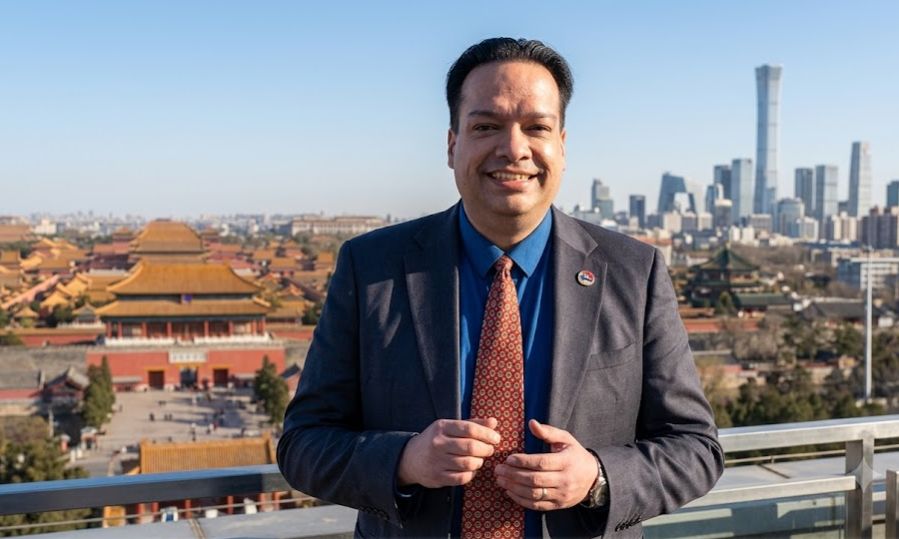
The second major development is the guilty plea by an American media commentator who had spent years living and working in China. According to the U.S. Department of Justice, he admitted to acting as an unregistered agent for the Chinese government.
The case is significant because it sits at the intersection of media, political influence, and intelligence concerns. Federal prosecutors say he worked with Chinese contacts over a period stretching from 2019 to 2025, receiving about $100,000 as well as travel support.
Authorities allege that his role went beyond commentary and into active collection and networking. The reported activity included trying to recruit people in the United States who could supply information useful to contacts in China, including one individual seeking a role in the Trump administration.
According to court filings, the arrangement involved an offer of payment in exchange for regular reports that would feed into policy discussions in Beijing. Prosecutors also say he provided a SIM card during monitored meetings and discussed specific information requests from Chinese contacts.
Why this case matters
At the centre of the case is the Foreign Agents Registration Act, which requires people acting on behalf of foreign governments in the United States to disclose that relationship. The accusation is not merely that he held favourable views toward China or worked for Chinese state media. The issue is the alleged failure to register while engaging in activity directed by or coordinated with a foreign state.
U.S. prosecutors also claim he assisted individuals in Wuhan who were seeking information about American technology and government operations, including contacts linked to cyber espionage matters.
Beijing has rejected the broader allegations and denied engaging in such conduct. Still, from the U.S. side, this case fits into a longer pattern of concern about influence networks, political access, and technology-related collection linked to the Chinese state.
These cases matter because they shape how governments interpret Chinese engagement more generally. When one incident lands, it does not stay isolated. It affects the climate around academia, media, business ties, and official exchanges. Trust, once damaged, is slow to repair.
China’s chip sector is rallying again, but the gap with global leaders remains
The third development is economic, and it is one that has been building for a while. China’s semiconductor sector is seeing renewed enthusiasm from investors, helped by planned major IPOs and a steady policy push toward technological self-reliance.
The gains have been substantial. China’s information technology index has roughly doubled over the past year, adding hundreds of billions of dollars in market value. Even so, the rally still trails the dramatic moves seen in parts of the U.S., Taiwanese, and South Korean chip sectors.
That relative lag is part of the reason some analysts think there may still be room for Chinese semiconductor names to run further, especially if state policy remains supportive and domestic substitution continues.
CXMT and YMTC are the key names to watch
A major catalyst is the planned Shanghai listing of ChangXin Memory Technologies, or CXMT, China’s largest memory chipmaker. The proposed raise is around $4 billion, which would make it the mainland’s biggest IPO since 2022.
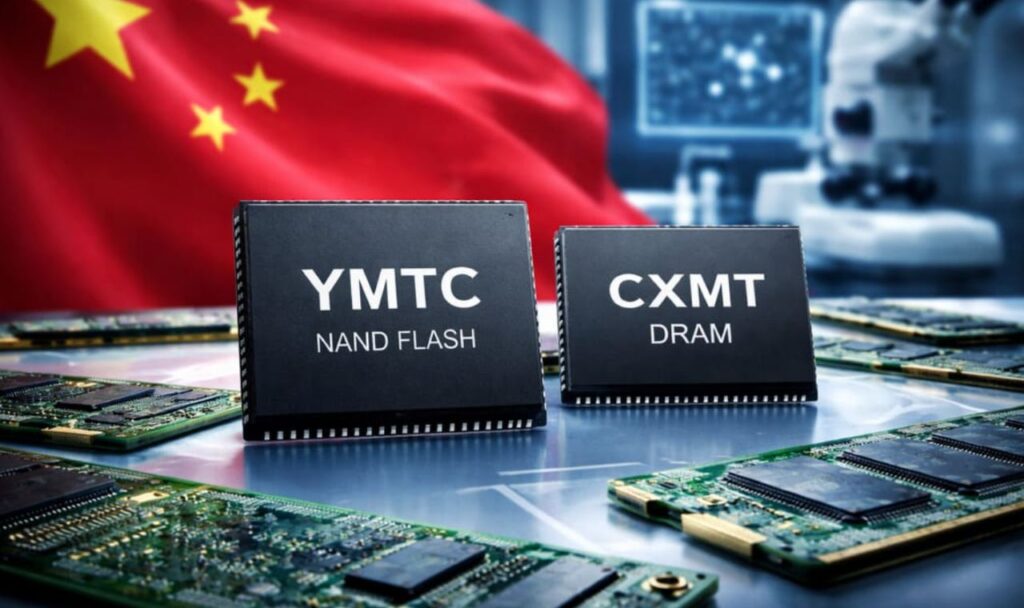
Another heavyweight, Yangtze Memory Technologies Co., or YMTC, is also expected to pursue a public listing later this year.
These offerings are important because they would channel fresh capital into strategically important firms that are trying to expand manufacturing capacity and accelerate research and development. In the short term, some market participants worry that such large offerings can pull money away from other domestic equities. In the longer term, many see them as positive for the sector because they strengthen the industrial base.
Huawei’s latest chip claim generated buzz, but caution is still warranted
Another source of optimism came from Huawei, which recently presented what it describes as a new chip architecture known as the Tile Scaling Law. The idea is that this approach could reduce dependence on some of the most expensive and difficult-to-access semiconductor manufacturing equipment.
Huawei has gone so far as to say the architecture could support production of advanced 1.4 nanometre chips by 2031.
That is the kind of claim that gets attention quickly. It also deserves caution. At this stage, it remains a projection rather than a verified manufacturing breakthrough. There is a large difference between a promising architecture, a commercial process, and sustained mass production at globally competitive yields.
So the excitement is understandable, but this is still a story where reality needs to catch up with ambition.
China’s strategy is becoming clearer
Even with those caveats, the broader direction is obvious. China is trying to move up the semiconductor value chain through a combination of:
- state policy support
- large capital raises
- domestic substitution
- cost-focused innovation
- reduced reliance on foreign tools and inputs
This matters not only for investors but for national strategy. Chips sit at the centre of AI, defence, telecoms, industrial automation, and consumer electronics. Beijing does not need to become the global leader overnight for this effort to matter. It only needs to become less vulnerable.
Still, it is important not to oversell where things stand today. The global front-runners remain the United States, Taiwan, and South Korea. China’s progress is real, but the technological and manufacturing leaders are still ahead.
That broader squeeze between ambition and constraint has been a recurring theme. For more on that, see this piece on China’s fragile recovery narrative and the advanced chip bottleneck.
Beijing bans four New Zealand lawmakers after Taiwan trip
The final development may prove the most politically revealing. China has barred four New Zealand lawmakers from entering mainland China, Hong Kong, and Macau for one year after they travelled to Taiwan in May.

This is reportedly the first time Beijing has imposed this kind of restriction on New Zealand parliamentarians. The move has triggered concern in Wellington and stands out because New Zealand has generally been seen as one of the more stable and less confrontational relationships Beijing has had among the Five Eyes countries.
What happened
The four lawmakers came from across New Zealand’s political spectrum, including major parties on the centre-right, centre-left, libertarian, and nationalist-populist sides. They travelled to Taipei as part of a cross-party parliamentary group formed in 2023 to maintain ties with Taiwan.
During the trip, the delegation met senior Taiwanese political figures and discussed political and economic relations.
In response, the Chinese embassy in New Zealand accused the lawmakers of violating the One China principle and interfering in China’s internal affairs. Beijing also made clear that it had warned against the trip beforehand and framed the ban as a consequence for crossing a red line on Taiwan.
Why this move could backfire
New Zealand Foreign Minister Winston Peters expressed surprise, noting that lawmakers from New Zealand have visited Taiwan for years without facing this type of punishment. Officials in Wellington and Beijing have been instructed to raise the issue and seek an explanation for what appears to be a break from earlier practice.
One of the sanctioned lawmakers rejected the idea of apologising in exchange for the restrictions being removed and said she would not be intimidated for carrying out her parliamentary responsibilities.
That response points to the deeper risk for Beijing. The intent may have been deterrence. The effect may instead be political awakening.
When a country with a relatively steady relationship with China suddenly sees elected representatives punished for an unofficial Taiwan visit, the move can land as disproportionate, even petty. It can shift perceptions among people who otherwise pay little attention to China at all.
In that sense, the decision may have been a diplomatic misstep. Rather than quietly suppressing future contact with Taipei, it may encourage broader scepticism about Beijing’s methods.
This is especially relevant because New Zealand has long maintained the One China policy while still preserving economic and cultural links with Taiwan. That formula had allowed room for unofficial engagement. Beijing’s action now suggests a narrower tolerance for those grey-zone interactions.
A broader pattern on Taiwan diplomacy
This is not an isolated case. Earlier this year, Beijing sanctioned a Japanese lawmaker over support for closer Japan-Taiwan ties. The New Zealand case fits the same pattern: tighten the costs for foreign politicians who engage with Taipei, even unofficially.
The strategy is straightforward. China wants to reinforce internationally that Taiwan is not a normal diplomatic partner and that contact carries consequences.
But democracies often react badly to overt coercion, especially when it targets elected representatives. Instead of reducing ties, such pressure can create sympathy for Taiwan and push countries to think more carefully about how Beijing uses access, punishment, and political leverage.
That same dynamic is visible elsewhere in the region. This related report on Taiwan outreach and shifting leverage offers useful additional context.
What ties these stories together
At first glance, these four developments seem unrelated. One is about North Korea. One is a U.S. legal case. One is about semiconductors. One concerns New Zealand and Taiwan.
They are, however, linked by a common theme: China is trying to consolidate influence while reducing exposure.
That shows up in different ways:
- In North Korea, Beijing is trying to preserve strategic relevance as Pyongyang gains options through Russia.
- In the U.S. influence case, the costs of suspected covert political engagement are becoming clearer and more public.
- In semiconductors, China is pushing hard to shrink dependence on foreign technology and capital constraints.
- In Taiwan, Beijing is signalling that even unofficial foreign political contact will increasingly draw retaliation.
The common denominator is pressure management. China faces a more fragmented international environment, tighter competition with the United States and its partners, and a growing need to secure supply chains, borders, political narratives, and diplomatic red lines at the same time.
That does not mean every move is effective. Some may strengthen China’s hand. Others may create new resistance.
But the direction is clear enough. This is a leadership trying to harden its position across several domains at once.
FAQ
Why is Xi Jinping’s visit to North Korea important?
It is Xi’s first trip to North Korea since 2019 and his first overseas visit of the year. The visit signals that Beijing wants to reinforce ties with Pyongyang while also reminding the region that China remains a central player on the Korean Peninsula, even as North Korea grows closer to Russia.
Is China still trying to pressure North Korea on nuclear weapons?
Officially, China still opposes a nuclear-armed North Korea. In practice, Beijing appears to place greater weight on regional stability than on forcing Pyongyang back into denuclearisation talks, especially amid intensifying competition with the United States.
What is the significance of the U.S. guilty plea involving an American commentator?
The case highlights U.S. concerns about foreign influence operations linked to the Chinese state. Prosecutors say the individual acted on behalf of Chinese interests without registering under U.S. law and tried to gather politically useful information through contacts in the United States.
Why are investors paying more attention to China’s semiconductor sector?
Investor interest has risen because of major planned IPOs from important domestic chipmakers, continued state support, and hopes that China can make progress in reducing dependence on foreign semiconductor technology. Large capital raises by firms like CXMT and potentially YMTC are central to that story.
How credible is Huawei’s claim about future 1.4 nanometre chips?
It is an ambitious claim, but at this stage it remains unverified. A technical proposal or architectural idea is not the same thing as commercially proven manufacturing. The announcement is important, but it should be treated cautiously until there is evidence of practical results.
Why did China ban New Zealand lawmakers after their Taiwan trip?
Beijing said the lawmakers violated the One China principle by engaging politically with Taiwan. The one-year ban appears intended to discourage foreign politicians from making similar visits and to reinforce China’s position that Taiwan-related contacts are a sensitive sovereignty issue.
Could the New Zealand travel ban hurt China diplomatically?
Yes, it could. Because New Zealand has generally maintained a comparatively workable relationship with Beijing, the move may be seen as unnecessarily heavy-handed. Rather than deterring contact with Taiwan, it could strengthen political scepticism toward China.
What is the main takeaway from this China News Update?
The main takeaway is that Beijing is acting on several fronts at once to preserve influence, reduce dependence, and enforce political boundaries. Whether in regional diplomacy, technology, or Taiwan-related pressure, the pattern is one of firmer posture under growing external competition.