
Beijing is attempting to steady a sharp market sell-off, a violent encounter has renewed concern around the Second Thomas Shoal, China’s renewable energy buildout is running into grid constraints, and Xi Jinping is advancing a global AI strategy built around Chinese open models and infrastructure.
These stories look separate on the surface. Together, they show the breadth of the pressures now facing China: market confidence at home, security risks on its periphery, the immense challenge of managing an energy transition, and an increasingly competitive technology contest with the United States.
Table of Contents
- Beijing Steps In as China’s Stock Market Slides
- Physical Violence Returns at the Second Thomas Shoal
- China’s Renewable Energy Expansion Meets the Grid Reality
- Xi’s Global AI Pitch: Open Models, Infrastructure, and Control
- What to Watch Next
- Frequently Asked Questions
Beijing Steps In as China’s Stock Market Slides
China has launched another coordinated effort to shore up domestic equities after a punishing sell-off erased nearly 10 trillion yuan in market value during the month. The scale of the decline raised a familiar concern: that a policy-supported surge in artificial intelligence and semiconductor stocks was beginning to look less like sustainable growth and more like another speculative bubble.
State-owned investment firms China Reform Holdings and China Chengtong Holdings said they had deployed around 60 billion yuan, roughly US$8.9 billion, into domestic shares and exchange-traded funds. Five major insurers and several state-owned enterprises followed with commitments to buy shares, conduct buybacks, and increase dividend payments.
There were also signs of broader official intervention. Twenty-three ETFs favoured by Central Huijin Investment, an arm of China’s sovereign wealth system, drew around 96 billion yuan in net inflows during the previous week. Trading in these so-called National Team ETFs accelerated in the closing minutes of Monday’s session, helping the CSI 300 recover from an intraday loss to finish 1.5% higher.
The recovery came after a deeply damaging week:
- The CSI 300 fell 5.3%, its worst week since October 2022.
- The Shanghai Composite dropped 5.8%.
- The technology-focused Star 50 index plunged nearly 17%.
- Leveraged positions were unwound at the fastest pace since the 2015 and 2016 market crash.
The immediate trigger was weakness in heavily owned AI shares, which then spread through the wider market. But the speed of the decline reflects a longer-running problem. Investors have seen this pattern before.
A Familiar Cycle of Rallies, Crashes, and Intervention
China’s stock market has been marked by dramatic shifts in policy, sentiment, and official support. A debt-fuelled rally in 2014 and 2015 ended in a historic crash, after which authorities imposed unusually forceful measures, including restrictions on selling. Shares rose again during the pandemic, then fell sharply amid technology crackdowns, the property downturn, and worsening growth expectations.
More recently, Beijing’s support for strategic sectors, including advanced chips and artificial intelligence, encouraged a new burst of enthusiasm. Those industries are strategically important. They are also vulnerable to speculative excess when capital chases policy signals more aggressively than underlying earnings.
That history helps explain why confidence in Chinese equity markets remains fragile. Authorities can alter regulations quickly, direct state institutions to purchase shares, or tighten trading rules during periods of stress. Investors also continue to question the quality of corporate disclosures, shareholder protections, and whether political objectives can outweigh returns for minority investors.
State buying can stabilise prices in the short term. It cannot automatically restore confidence in the long term. In some cases, it makes the market even harder to assess because prices may reflect official support as much as investor conviction.
China Securities Regulatory Commission Chairman Wu Qing has attempted to address those concerns. In a meeting with investor representatives in Beijing, he pledged stronger regulation, better transparency among listed firms, investor protection, and a market that is open and fair. Those promises matter, but the key test will be whether they produce durable changes rather than another temporary floor under share prices.
The central question is now straightforward: has Beijing contained the sell-off, or has it merely slowed the deflation of the latest AI-driven market bubble? The answer will depend less on late-session ETF purchases than on earnings, governance, and the wider health of China’s economy. That broader uncertainty remains central to the high-stakes AI race and China’s uneven economic outlook.
Physical Violence Returns at the Second Thomas Shoal

A Philippine marine was injured during a confrontation with the China Coast Guard near the Second Thomas Shoal, ending more than a year of relative calm around one of the South China Sea’s most dangerous flashpoints.
The incident took place near the Sierra Madre, a deteriorating Philippine Navy ship that Manila deliberately grounded on the shoal in 1999. The vessel functions as a small but politically significant military outpost, reinforcing the Philippines’ claim to the feature.
According to the Philippine military, a Chinese rigid-hull inflatable boat carrying eight personnel approached the Sierra Madre, circled it, and recorded images. Two Philippine rubber boats moved to drive it away. Manila said its personnel acted calmly but that China Coast Guard members struck a Filipino sailor in the head with a wooden baton. The sailor received treatment, and a Philippine boat was reportedly damaged.
Beijing gave a sharply different version. The China Coast Guard said it was conducting a routine patrol near what China calls Ren’ai Jiao when Philippine boats approached dangerously, surrounded its vessel, and rammed it. Chinese authorities claimed Philippine personnel attacked first with paddles and long poles, requiring what they described as reciprocal countermeasures.
Both sides released footage intended to support their respective accounts. What is clear is that the confrontation involved physical force, even if firearms were not used. Sticks, paddles, and batons may sound limited compared with conventional military weaponry, but close-range clashes between small vessels can escalate quickly, especially in an area where sovereignty claims are so politically charged.
Why the Sierra Madre Remains a Major Flashpoint
The Second Thomas Shoal lies within the Philippines’ exclusive economic zone, but China claims sovereignty over it as part of its far broader South China Sea claims. A 2016 international arbitration ruling rejected the legal basis for China’s sweeping position, but Beijing has refused to accept the decision.
Confrontations intensified throughout 2023 and 2024 as Chinese vessels sought to obstruct Philippine resupply missions to the Sierra Madre. Water cannons, collisions, boarding actions, damaged boats, and equipment seizures became recurring features of these encounters.
In June 2024, a Filipino sailor lost a thumb in an especially violent clash involving Chinese personnel. A provisional resupply agreement later reduced tensions, but it did not resolve the underlying dispute. The latest incident demonstrates how fragile those arrangements remain.
The timing is also awkward. It occurred just before Chinese Foreign Minister Wang Yi was due in Manila for a China-ASEAN foreign ministers’ meeting. Beijing has emphasised regional stability and cooperation ahead of the gathering, but a renewed confrontation at sea risks overwhelming those diplomatic messages.
The greater danger is not that every encounter will become a major crisis. It is that one miscalculation eventually could. The Philippines is a US treaty ally, so even a relatively small maritime clash carries implications far beyond the shoal itself. China’s increasingly security-focused worldview is also shaping its approach to regional disputes, technology, and economic strategy, as examined in this analysis of Beijing’s security-centered policy direction.
China’s Renewable Energy Expansion Meets the Grid Reality
China’s pipeline of utility-scale solar and wind projects continues to dwarf that of any other country. Yet the rapid expansion is exposing a central weakness: generation capacity is growing faster than parts of the electricity system can absorb and transport the power.
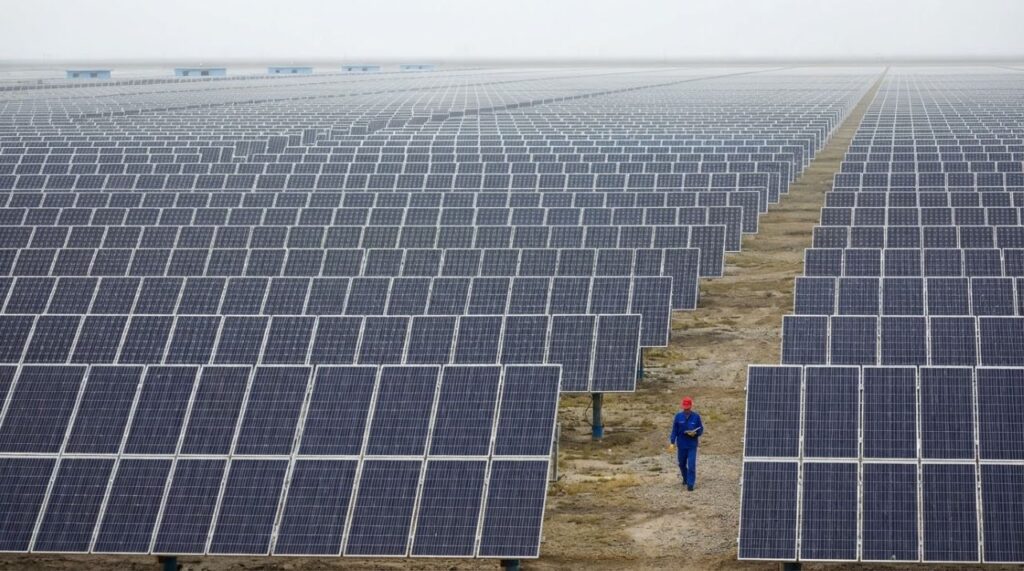
According to Global Energy Monitor, China had about 262 gigawatts of solar capacity and 251 gigawatts of wind capacity under construction in June. Both figures were higher than at the end of 2025, indicating that the country’s renewable buildout remains formidable despite what appeared to be slower official installation figures earlier in the year.
New electricity pricing rules introduced in June 2025 encouraged developers to accelerate projects before the deadline, temporarily bringing some installations forward. But the underlying construction pipeline has remained steady. China added only 60 gigawatts of solar capacity through May, while BloombergNEF expects full-year additions to reach 255 gigawatts as completions accelerate in the second half.
Curtailment Is the Critical Problem
The larger issue is curtailment. This occurs when wind and solar facilities are forced to reduce output because the grid cannot take the electricity when it is produced. Installed capacity does not automatically translate into usable clean power.
The challenge is especially severe in western China, where renewable resources are abundant but major population centres and industrial demand are concentrated far away on the coast and in the east. Building solar arrays and wind farms in remote areas is often easier than building the infrastructure needed to move their power thousands of kilometers at the right time.
Beijing is responding in two ways:
- Constructing long-distance transmission lines to connect western generation with eastern demand centers.
- Encouraging energy-intensive industries to move closer to areas with abundant renewable power.
Both measures are logical. Neither automatically ensures that clean energy gets priority. Existing transmission networks carry approximately twice as much coal-generated electricity as renewable electricity. If grid expansion is not designed around renewable integration, China could end up strengthening the infrastructure of its coal system even while adding world-leading volumes of wind and solar.
That is the contradiction at the centre of the story. China is building renewable capacity at extraordinary speed, but its climate and energy gains will depend on grid management, demand flexibility, storage, and whether fossil generation continues to dominate the dispatch system.
Xi’s Global AI Pitch: Open Models, Infrastructure, and Control
Xi Jinping’s central AI message is that China is prepared to help other countries develop their own artificial intelligence capabilities. This has become a major part of Beijing’s diplomatic strategy, particularly across the Global South.

The pitch is implicitly directed at the United States. Washington has used semiconductor export controls, investment restrictions, and technology alliances to constrain China’s access to advanced computing capabilities. Beijing, by contrast, presents itself as a partner offering countries more technological autonomy.
China’s 2023 Global AI Governance Initiative criticised unnamed states for forming exclusive groups aimed at preventing others from developing AI. The establishment of the World AI Cooperation Organization in Shanghai is the newest attempt to turn that message into a more durable international framework.
Xi also reiterated support for open-source AI. There was no indication that Beijing intends to prevent Chinese companies from releasing open-weight models online. These models allow developers to download, modify, and deploy the underlying model parameters, offering far more control than relying exclusively on closed systems delivered through foreign-owned cloud platforms.
Why Chinese Open Models Are Gaining Ground
Chinese firms have become increasingly influential in the global open-model ecosystem. Their models often combine strong performance with lower operating costs, making them attractive to developers in emerging markets and, in some cases, Western companies as well.
One important advantage has come from distillation, the process through which a smaller or less capable model learns from the outputs of a stronger model. US technology analyst Ben Thompson has argued that Chinese labs have used leading Western models as teachers, particularly as reinforcement learning has become more important. The result can be a lower-cost and faster path to competitive systems.
There is now an additional twist: some Western open-model developers are reportedly using Chinese models to generate training data. In effect, they are distilling models that may themselves have benefited from distillation.
This creates an uncomfortable strategic problem for Washington. Major US frontier labs generally prohibit competitors from using their services for distillation, while Chinese developers face fewer practical constraints. US open-model companies may therefore find themselves at a disadvantage or even dependent on Chinese systems as they try to develop their own products.
The Trump administration is reportedly considering a gradual effort to discourage American businesses from adopting Chinese AI platforms. Rather than an immediate blanket ban, the approach could involve federal procurement restrictions, possible entity-list designations, and warnings over security vulnerabilities, hidden access mechanisms, and Chinese government influence.
China Builds the Physical Infrastructure for AI Competition
Beijing is not relying on software alone. Z.ai, formerly known as Zhipu, has reportedly begun partially operating a one-gigawatt data centre built with Chinese chips. At full scale, the facility could consume as much electricity as roughly 750,000 homes.

The project illustrates the enormous energy demand of frontier AI and China’s determination to keep expanding computing capacity despite US restrictions on advanced Nvidia processors. It also links directly back to the grid story. An economy that wants to scale AI, heavy industry, electric vehicles, and clean power simultaneously needs huge volumes of reliable electricity and better transmission infrastructure.
Xi’s remarks also carried a warning. He called for AI governance systems that can adapt as conditions change and for measures to prevent a loss of control. That phrase can be read in several ways: human control over advanced systems, state control over information, or the Communist Party’s ability to manage the technology industry itself.
China’s AI strategy therefore contains a basic tension. Beijing wants Chinese models to spread internationally, particularly through open ecosystems that can appeal to countries seeking alternatives to US platforms. At the same time, it wants to preserve the ability to intervene whenever technological openness creates risks to political authority, national security, or social stability.
What to Watch Next
The immediate market question is whether state-supported purchases can build lasting confidence or only postpone another sell-off. In the South China Sea, the concern is whether the provisional calm around the Sierra Madre has broken down for good. In energy, China’s record renewable construction will be judged by usable output rather than headline capacity. And in AI, the contest is moving beyond chips alone toward models, data, electricity, international standards, and influence across developing markets.
China News Update is increasingly defined by this overlap between domestic economic management and strategic competition abroad. Markets, maritime disputes, energy systems, and artificial intelligence are no longer separate policy areas. They are becoming parts of the same national contest over resilience, technological capability, and political control.
Frequently Asked Questions
Why did Beijing intervene in China’s stock market?
State-backed investors stepped in after a major sell-off hit Chinese equities, particularly AI and technology shares. The intervention sought to stabilise prices, support confidence, and limit the risk that leveraged selling would spread further through the market.
What happened at the Second Thomas Shoal?
A Philippine marine was injured in a confrontation near the grounded Sierra Madre naval vessel. Manila said China Coast Guard personnel struck the sailor with a wooden baton. Beijing said Philippine boats acted dangerously and attacked first. Both sides released competing accounts and video footage.
What is renewable energy curtailment?
Curtailment occurs when wind or solar plants must reduce output because the power grid cannot absorb, transmit, or use the electricity being generated. It is a major issue in western China, where renewable resources are far from major demand centres.
Why is China promoting open-source AI internationally?
Open-weight AI models allow countries and companies to download, adapt, and run systems with more autonomy than closed cloud-based platforms. Beijing sees this as a way to expand Chinese technology influence and present itself as an alternative to US-led restrictions on advanced AI capabilities.
What is the tension in China’s AI strategy?
China wants its AI models and infrastructure to reach global markets, but it also wants the state to retain control over information, national security, and the technology sector. Promoting openness abroad while preserving tight political authority at home is a difficult balance.