China is beginning the week with a series of very different but deeply consequential pressures. Typhoon Dolphin has battered the eastern coast and disrupted major transport routes. Taiwan is preparing a record defence budget centred on drones and asymmetric warfare. China’s trade figures remain extremely strong in advanced technology, even as weaker domestic demand keeps inflation subdued. And inside the Communist Party system, a shadow market for information on corruption investigations is exposing the limits of political secrecy.
Taken together, these developments underline the uneven nature of China’s current position. The country remains an industrial and technological heavyweight, but it is navigating weather disruption, geopolitical risk, soft household demand, and persistent governance vulnerabilities at the same time.
Table of Contents
- Typhoon Dolphin forces mass evacuations across eastern China
- Taiwan plans record military spending and a vast drone programme
- China’s inflation slows as domestic demand remains weak
- AI investment powers China’s trade boom
- Leaked corruption information exposes weaknesses in party discipline
Typhoon Dolphin forces mass evacuations across eastern China.
More than one million people have been evacuated across eastern China after Typhoon Dolphin struck Zhejiang province, bringing destructive winds, torrential rain, flooding and widespread disruption to transport.
Dolphin made landfall near Yuhuan at around 5:30pm on Sunday with sustained winds of roughly 150 kilometres per hour, comparable to a Category 1 hurricane. It made a second landfall near Wenzhou about an hour later. Authorities issued their highest-level red alert before the storm arrived, reflecting the anticipated scale of the danger.

Although Dolphin had weakened into a tropical storm by Monday morning, that did not remove the central risk. Slow-moving storms can produce prolonged rainfall, and officials warned that heavy rain could continue through Wednesday. Zhejiang was expected to receive between 250 and 500 millimetres of rain in some areas, raising the threat of flooded rivers, landslides and inundated urban districts.
The rain risk extended far beyond Zhejiang. Heavy downpours were forecast across Shanghai, Jiangsu, Anhui, Shandong, Henan, Hubei, Fujian and Jiangxi. This matters because eastern China includes some of the country’s most densely populated cities, most important manufacturing clusters and busiest ports.
Emergency evacuations and shelter operations
Wenzhou relocated more than 900,000 residents and opened over 1,000 emergency shelters. In Taizhou, approximately 390,000 people were moved to safer locations. Shanghai relocated more than 30,000 residents from high-risk areas.
Fujian also took major precautionary measures, suspending 55 passenger ferry routes, halting 115 offshore construction projects and relocating nearly 99,000 people. The scale of these measures demonstrates just how seriously local authorities viewed the typhoon’s potential effects, particularly in low-lying coastal communities and areas exposed to landslides.
Transport networks were hit hard. Around 1,400 flights were cancelled in Shanghai, ferries and cruise services were suspended, and Yangshan port cleared ships from berths while moving more than 500 smaller vessels into sheltered waters. Floodwater also reached streets and ground-floor businesses in Shanghai, including areas of the former French concession. Disneyland, Legoland and several viewing platforms along the Bund were temporarily closed.
Dolphin had already caused damage before reaching China. It intensified monsoon rains in the Philippines, where flooding and landslides killed at least eight people. In Japan’s Okinawa Prefecture, the storm injured several people and cut electricity to tens of thousands of buildings.
The typhoon’s route was unusually extensive. It travelled roughly 6,000 kilometres before reaching China, a lifespan more than three times longer than the average typhoon. That long path allowed it to affect multiple countries and left authorities managing not simply a short-lived coastal landfall but a broad and prolonged weather event.
Taiwan plans to record military spending and a vast drone programme.
In Taiwan, attention is focused on a very different kind of storm. The government is planning to spend a record NT$1.1 trillion, or about US$34.1 billion, on the military in 2027 as it strengthens preparations to deter a possible Chinese invasion.
The proposed budget would exceed 3% of Taiwan’s gross domestic product and represents a substantial increase from the NT$949 billion proposed for 2026. The cabinet is expected to discuss the plan on August 20, though the number may still change because final approval depends on the opposition-controlled legislature.
President William Lai Ching-te has made higher defence expenditure a core priority since taking office. In 2025, he set a target of allocating at least 3% of GDP to Taiwan’s armed forces, following pressure from US President Donald Trump for Taiwan to take on more responsibility for its own defence.
The latest budget discussions arrive during the annual 10-day Han Kuang military exercises. The drills have placed particular emphasis on drone reconnaissance, counter-drone operations and the rapid movement of troops under attack.
For more context on how Taiwan is also preparing for maritime disruption and regional supply risk, see this analysis of Taiwan’s planning for potential blockade scenarios.
The logic behind Taiwan’s hellscape strategy
Taiwan is developing what US military planners have described as a “hellscape” strategy. The underlying idea is straightforward: instead of relying solely on a small number of costly and vulnerable major platforms, Taiwan would deploy large quantities of cheaper, dispersed systems capable of making an invasion extraordinarily costly.
Those systems include:
- Large fleets of aerial and maritime drones
- Mobile anti-ship and land-based missile units
- Unmanned boats for coastal operations
- Artillery integrated into a broader coastal defence network
- Rapid reconnaissance and targeting systems
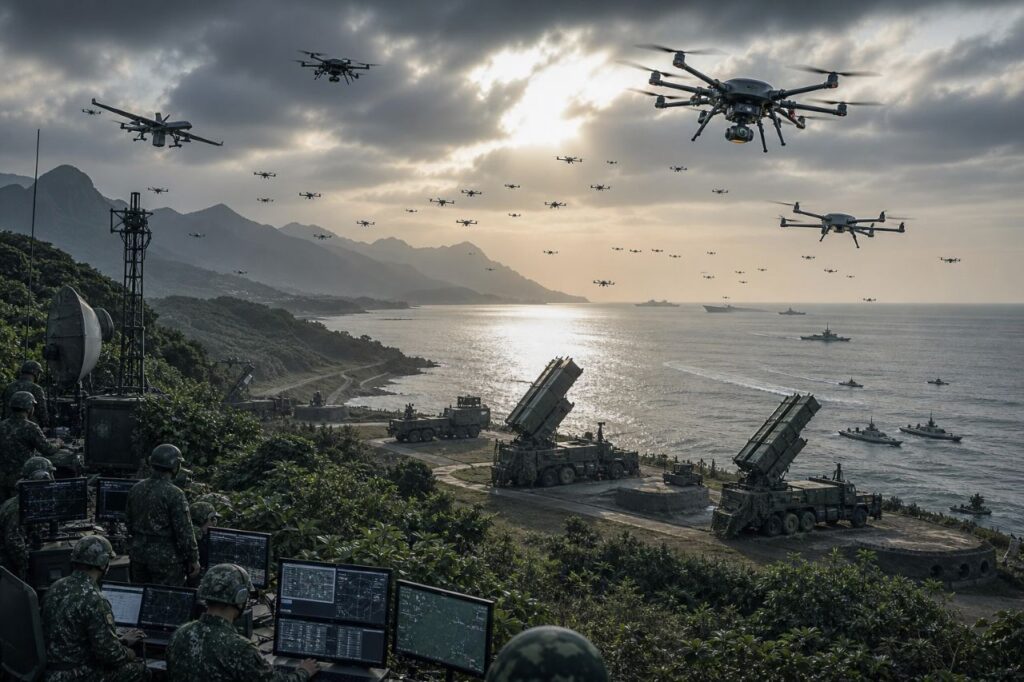
The objective is to identify and strike Chinese forces approaching the island, disrupt logistics and complicate amphibious operations before a landing force can establish control. Taiwan is drawing heavily on lessons from Ukraine, where relatively inexpensive drones have destroyed high-value equipment, disrupted supply lines and helped compensate for weaknesses in conventional military power.
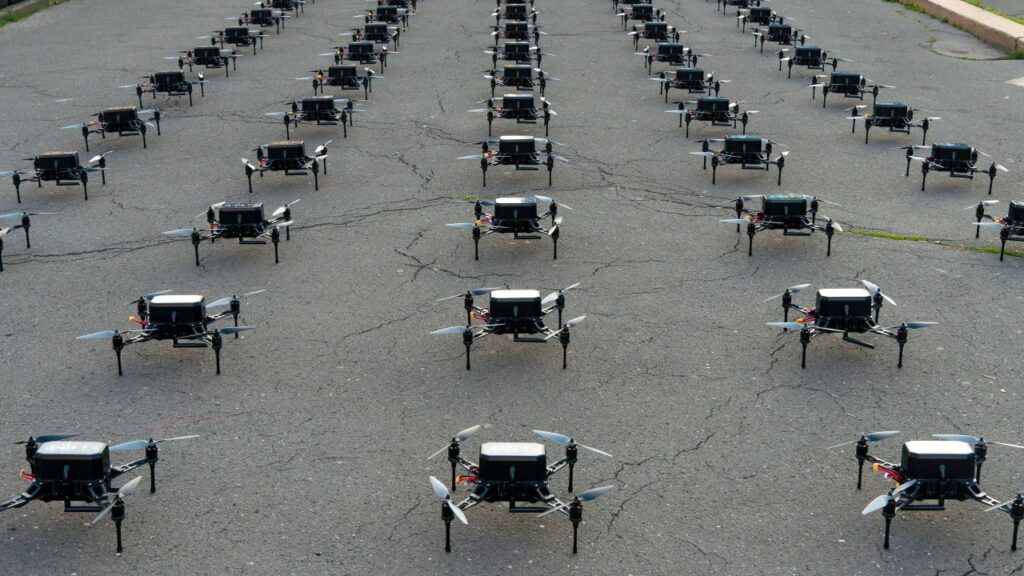
Taiwan aims to acquire more than 210,000 aerial and maritime drones. It also wants domestic manufacturers to produce 100,000 drones per month by 2030, with about half intended for export. The island has already established a Littoral Combat Command that combines drones, mobile missiles and artillery into a coastal defence structure.
During recent exercises, troops used drones to locate simulated enemy units, while President Lai observed prototype attack-drone tests. But the core challenge is not merely acquiring hardware. Defence specialists have stressed that units must be reorganised and trained to operate with far more autonomy.
That means troops need the ability to share intelligence rapidly, make decisions under pressure and move immediately after firing. Remaining in one position for too long makes a unit vulnerable to detection and counterattack. The warfare Taiwan is preparing for would be fast-moving, decentralised and highly dependent on resilient communications.
Domestic production is equally important. In a conflict, China could seek to blockade Taiwan and cut off access to foreign supplies. A locally based drone industry would therefore be a strategic necessity, not just an industrial policy objective.
Taiwan’s drone exports are already expanding sharply. During the first three months of 2026, the island exported US$115 million worth of drones, exceeding its full-year total for 2025. The Czech Republic was the largest destination, though research suggests many of those drones ultimately reached Ukraine.
Political disagreement could still slow the effort. Earlier this year, lawmakers approved a US$24.8 billion special defence package, less than the government had initially sought. Opposition parties have also raised concerns about waste and corruption in drone procurement. Even so, there is broad agreement across Taiwan’s political system that domestic production must increase as China expands its own fleet of warships, missiles and unmanned systems.
China’s inflation slows as domestic demand remains weak.
China’s latest inflation data suggest that cost pressures linked to the Iran war and the associated oil shock are beginning to fade. However, the softer figures also point to a more stubborn problem: consumers remain cautious, and weak domestic demand continues to limit businesses’ ability to raise prices.

The producer price index rose 3.5% in July from a year earlier, down from 4.1% in June and below expectations. It was the first slowdown since producer prices returned to growth in March after more than three years of declines.
Consumer inflation weakened more sharply, slipping to 0.5% from 1% in June. Core inflation, which excludes volatile food and energy costs, eased from 1% to 0.9%.
Lower energy costs played a role, but the larger structural issue is lacklustre household spending. Chinese consumers remain reluctant to spend freely, and manufacturers therefore struggle to pass higher commodity, metals and semiconductor costs on to customers.
This is producing a clear divergence across the economy. Energy producers have benefited from elevated commodity prices, while consumer-facing manufacturers, including clothing companies, have seen profit margins come under pressure. Service sector inflation is also softening. Tourism prices rose 2.2% year on year, down from 4.5% in June as hotel and airline pricing weakened during the summer season.
The data may revive concerns about deflation. China has temporarily moved away from its longest period of falling prices, but the return of inflation is still fragile when demand remains weak and businesses cannot confidently increase prices.
The vulnerability of China’s recovery is closely linked to external energy shocks and technology constraints, as explored in this assessment of China’s fragile recovery narrative.
AI investment powers China’s trade boom
China’s trade performance tells a much stronger story, especially in advanced technology and green manufacturing. Despite typhoon-related port disruption, exports and imports both expanded rapidly in July as global investment in artificial intelligence boosted demand for electronics and advanced manufactured products.

Exports rose 23.9% from a year earlier, exceeding forecasts and marking a second consecutive month of growth above 20%. Imports rose 27.5%, producing a trade surplus of US$112.5 billion.
AI-related electronics and green technologies are the key drivers. The strongest numbers came from sectors tied directly to semiconductors, computing, transport equipment and industrial capacity:
- Semiconductor exports increased 117% year on year.
- Computer shipments rose 67%.
- Automobile exports climbed 60%.
- Ship exports surged 92%.
- General machinery exports grew 31%.
Some of the headline growth reflects higher prices. Global shortages have raised the cost of chips and other electronics, while higher oil and metal prices have increased the value of imports. But the broader pattern is unmistakable: China’s most advanced export industries are expanding rapidly because global investment is pouring into AI infrastructure and the energy transition.
At the same time, weaker exports of labour-intensive goods continue to weigh on employment and household consumption. This is the K-shaped divergence in China’s economy. Advanced technology manufacturers are doing very well, while traditional industries and consumer demand remain far weaker.
The export boom also intensifies trade frictions. China’s surplus with the European Union reached a record US$33.5 billion in July, despite Beijing’s repeated promises to encourage more balanced trade and purchase more from overseas.
Exports are therefore likely to remain China’s main growth engine, with technology sectors continuing to outperform the country’s struggling old economy. But that dependence on overseas demand also leaves growth exposed to tariffs, political disputes and wider global economic volatility. For a wider look at recent pressure on China’s trade engine, read China’s slowing trade momentum amid global disorder.
Leaked corruption information exposes weaknesses in party discipline.
The final development concerns an underground online trade in information about corruption investigations. Shadowy social media accounts are increasingly predicting which officials will face disciplinary scrutiny days or even weeks before formal announcements.

These accounts rarely name targets directly. Instead, they publish officials’ resumes, photographs, homophones or coded messages that allow insiders to infer who may be under investigation. Some account operators charge users from a few dozen yuan to several hundred yuan for access to private chat groups. Others spread sensational or fabricated allegations to drive traffic and advertising revenue.
State media has indicated that many of the tips come from government or party personnel. A Xinhua-affiliated magazine described a covert supply chain in which confidential information passes through several intermediaries before reaching social media platforms.
One reported case involved a party official in Guiyang who allegedly worked with six relatives to operate nine WeChat accounts publishing advance information on promotions and disciplinary investigations.
These leaks matter because China’s political system is highly opaque. Early knowledge of an investigation can give officials time to destroy evidence, transfer assets or flee. Political insiders may position themselves for vacancies, and investors can trade around companies likely to be affected by disciplinary action.
The market consequences can be serious. China Merchants Bank shares dropped sharply in 2022 after authorities announced an investigation into its former president, Tian Huiyu. Research has found that corruption investigations can increase the risk of abrupt declines in the share prices of companies connected to regions where targeted officials previously worked.
The leaks also expose a fundamental contradiction in Xi Jinping’s anti-corruption campaign. The campaign has punished a vast number of officials, but its own disciplinary machinery is not immune to corruption or abuse. More than 7,800 disciplinary inspectors received formal penalties in 2023, the highest reported annual number under Xi.
Authorities disciplined a record 983,000 people in 2025, bringing the number punished since Xi took power in 2012 to more than seven million. State media is now calling for stronger censorship and tougher penalties, but enforcement is difficult. Publishing an official’s publicly available resume is not necessarily illegal, and operators can rapidly move between WeChat, Douyin and other platforms when accounts are closed.
The information market is likely to persist because it serves a basic demand in a system where valuable political developments are often concealed until the final moment. The more opaque the system, the greater the value of credible leaks.
Frequently Asked Questions
How severe was Typhoon Dolphin in eastern China?
Typhoon Dolphin made landfall in Zhejiang with sustained winds of about 150 kilometres per hour. More than one million people were evacuated across eastern China, and authorities warned of prolonged rain, flooding, landslides and transport disruption.
Why is Taiwan investing so heavily in drones?
Taiwan sees drones as a lower-cost way to detect, disrupt and strike an invading force. Its strategy combines aerial and maritime drones with mobile missiles, artillery and unmanned boats to make a cross-strait invasion more costly and unpredictable.
What is driving China’s strong export growth?
Global investment in artificial intelligence, semiconductors, electronics and green technologies is lifting demand for Chinese advanced manufacturing exports. Semiconductors, computers, vehicles, ships and machinery all recorded especially strong growth.
Why does China still face deflation concerns despite positive inflation?
Inflation remains low because household demand is weak. Consumers are cautious, and many manufacturers cannot pass higher costs on to customers, limiting price growth and pressuring profits in consumer-facing sectors.
Why are leaks about corruption investigations significant in China?
Advance information can allow officials to protect assets or destroy evidence, give political insiders an advantage in succession struggles and create opportunities for market speculation. The leaks also reveal continuing vulnerabilities inside the party’s disciplinary system.