
China opened the week with a cluster of developments that cut across security, technology, and the economy. At one end, Beijing and Moscow carried out another joint strategic air patrol near Japan and South Korea. At the other, Japanese policymakers moved further toward a harder economic security posture shaped by concerns over espionage, technology leakage, and China’s grip on critical minerals.
Inside China, the artificial intelligence race is accelerating. Startup DeepSeek is expanding aggressively, adding technical and commercial roles as it pushes beyond model development into practical applications. At the same time, policy advisors in Beijing are warning that the gains from AI and advanced manufacturing are not reaching enough of the broader economy.
Taken together, these stories point to the same underlying reality. Competition with China is no longer confined to military power or export figures. It now runs through supply chains, investment screening, chip access, industrial policy, and whether growth can be spread beyond a handful of favoured sectors.
Table of Contents
- Regional Security: China and Russia Increase Pressure Around Japan and South Korea
- Japan’s Response: Economic Security Moves to the Center
- Why Japan Is Looking Closely at China
- Critical Minerals Become a Strategic Fault Line
- DeepSeek Expands as China’s AI Race Intensifies
- China’s Economy: Advisors Warn of a Deepening Two-Speed Divide
- Who Benefits From AI Growth?
- The Pension Proposal That Reveals the Scale of the Problem
- What This Week’s Developments Say About China’s Direction
- FAQ
Regional Security: China and Russia Increase Pressure Around Japan and South Korea
China and Russia conducted their 11th long-range joint strategic air patrol over the Sea of Japan, the East China Sea, and the western Pacific. The mission triggered military responses from both Japan and South Korea, which scrambled aircraft to track the operation.
According to Japanese defence reporting, the patrol involved a sizeable package of aircraft. That included Chinese H-6 bombers, Russian Tu-95 bombers, Russian Tu-142 patrol planes, Chinese J-16 fighters, and a Russian Su-30. Some of the aircraft passed through the Miyako Strait near Okinawa before returning.
None of this is routine in the ordinary sense, even if it is becoming more familiar. For Tokyo, the issue is not only the number of aircraft but also the pattern. Japanese officials described the patrol as part of an expanding show of force around the country. South Korea also responded after more than 10 Chinese and Russian aircraft entered its air defence identification zone, though they did not cross into sovereign airspace.
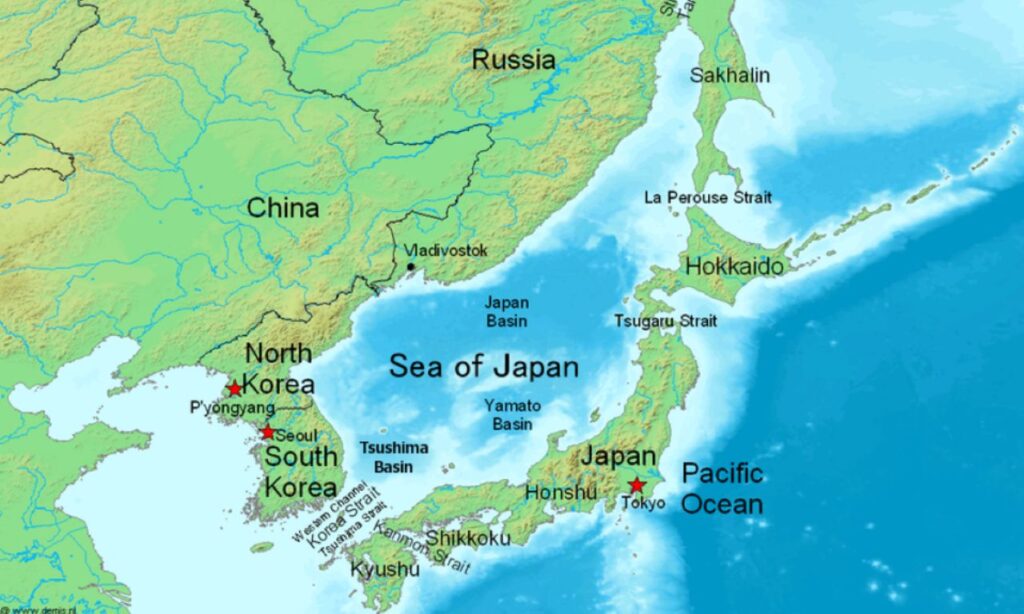
Beijing framed the mission as a demonstration of joint resolve and capacity to preserve regional stability. That kind of language is standard, but the regional message is unmistakable. China and Russia are normalising regular combined operations in contested or sensitive spaces, and they are doing so in ways that force Japan and South Korea to react.
This matters because repeated military activity can gradually reshape the strategic baseline. Even when no shots are fired and no borders are crossed, the burden falls on neighbouring states to intercept, monitor, and adapt. Over time, that wears down readiness, increases risk, and reinforces the sense that the regional security environment is steadily hardening.
Japan’s Response: Economic Security Moves to the Center
If the first story is about military pressure, the second is about how Japan is broadening its definition of national defence.
Tokyo is now pursuing one of its most significant economic security overhauls in years. The basic concern is simple: strategic vulnerability does not begin and end with missiles or naval deployments. It can also emerge through technology theft, foreign investment, cyber intrusion, supply chain dependence, and control over critical raw materials.
A series of recent cases has sharpened that concern.
- Japanese authorities have examined alleged efforts linked to China to acquire industrial secrets.
- Taiwanese prosecutors have alleged that advanced NVIDIA AI chips were diverted to China through Japan.
- Officials have also identified suspected connections between Chinese organisations operating in Japan and illegal fentanyl exports.
- Cybersecurity incidents involving malware tied to China have added to the pressure on policymakers.
None of these issues sits neatly in one policy box. That is exactly why Japan is changing its institutional approach.
Tokyo is launching a new investment screening body modelled on the US Committee on Foreign Investment. The aim is to coordinate reviews across ministries and evaluate whether foreign transactions create national security risks. This is a meaningful step because it moves Japan toward a more centralised and systematic method of scrutinising deals that may once have seemed commercially ordinary.
The move builds on changes to Japan’s Foreign Exchange and Foreign Trade Act. Those revisions expanded the government’s authority to look beyond direct ownership and examine more complex structures, including indirect stakes and deals involving foreign governments or state-backed investors. The net is wider than before, and it extends beyond sectors traditionally labelled sensitive.
That trend has been visible for several years. When Japan reduced the ownership threshold for mandatory government notification from 10 per cent to 1 per cent in 2019, it brought a much larger universe of transactions under review. The current shift suggests Tokyo now sees that lower threshold not as the endpoint but as part of a broader tightening cycle.
Why Japan Is Looking Closely at China
Although Japan’s legal and institutional changes apply in principle to foreign investment more broadly, much of the strategic attention is clearly directed at China.
Japanese policymakers have been increasingly outspoken about two related risks. The first is China’s outsized role in key global supply chains. The second is the legal environment inside China, especially laws that can compel citizens and organisations to cooperate with state intelligence work when required.
From Tokyo’s perspective, those factors create a structural challenge. Economic exchange with China remains important, but it also carries strategic exposure. That is why economic security is no longer treated as a niche issue. It is becoming a core organising principle for policy.
The shift is especially visible in areas such as the following:
- Critical infrastructure protection, including systems whose disruption would have national consequences.
- Supply chain resilience, especially for industrial inputs that cannot be replaced quickly.
- Strategic technology controls, with tighter attention on knowledge transfer and advanced components.
- Foreign investment review, particularly where state influence may be hard to detect at first glance.
In practical terms, Japan is moving away from the old assumption that economic interdependence naturally produces safety. The newer assumption is more cautious: interdependence can also be weaponised.
Critical Minerals Become a Strategic Fault Line
The clearest current example is rare earths and related industrial minerals.
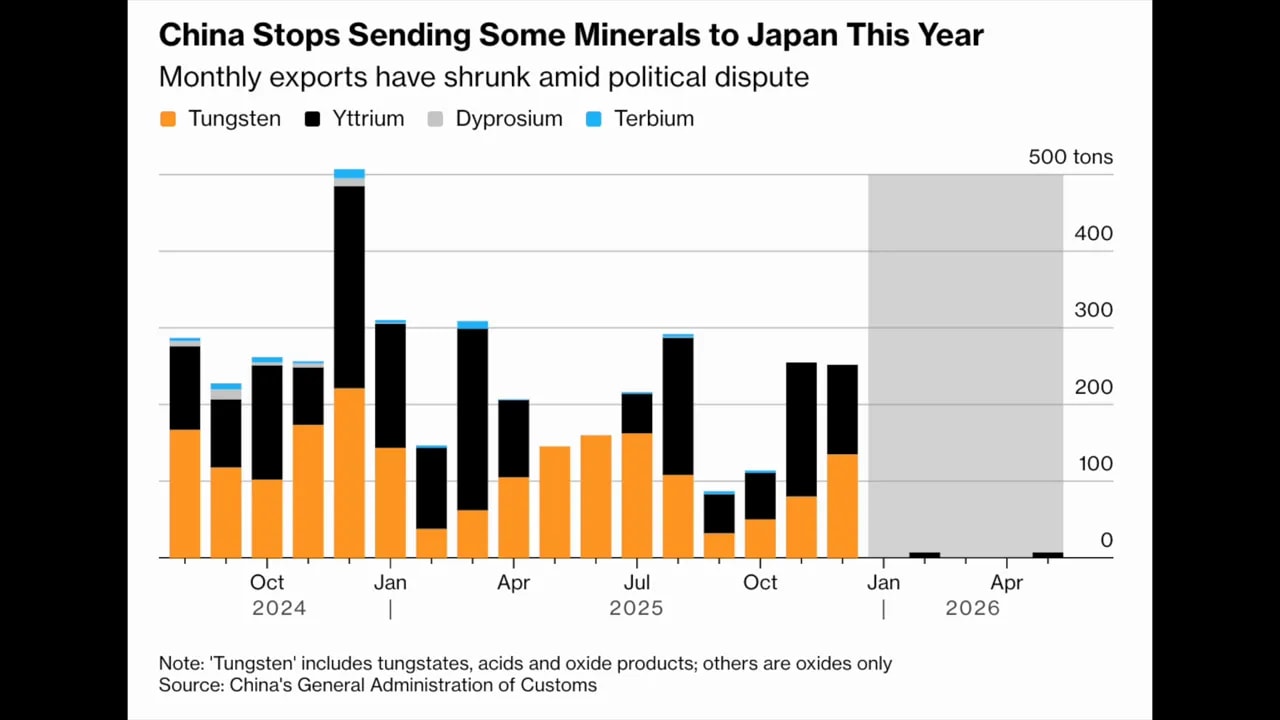
Japanese manufacturers are dealing with growing strain after China sharply reduced exports of several critical materials. Some intermediate forms of tungsten sent to Japan have reportedly dropped to zero this year, while shipments of other rare earth materials used in high-performance magnets have also stopped. Those magnets are essential for electric vehicles, electronics, and military systems.
The restrictions followed worsening political tensions between Beijing and Tokyo. Although China has not formally tied the export controls to specific political remarks, the broader diplomatic context is hard to ignore.
For Japanese industry, this is not an abstract policy concern. It is a direct production issue.
Manufacturers have been forced to rely on inventories while seeking alternatives. Business leaders have warned that if restrictions continue for too long, the damage could become serious, especially for the automotive sector, which represents a large share of Japan’s economy.
Some companies are responding by investing more heavily in recycling. Mitsubishi Materials already sources a large share of its tungsten input from recycled material and is aiming for full recycling by 2030. Sumitomo Electric has also expanded efforts to recover valuable metals from scrap.
That is a rational adaptation, but it is not a quick fix. Japan began diversifying after China’s rare earth embargo in 2010 during an earlier diplomatic dispute. Yet the latest squeeze shows how much dependence remains.
China still dominates this part of the supply chain. It accounts for roughly 60 per cent of global rare earth mining output and more than 90 per cent of refining capacity. That refining dominance is particularly important because it means leverage exists not only at the extraction stage but at the processing stage too. Even countries that can access raw materials elsewhere often still depend on Chinese refining.
For Japan, that creates a strategic dilemma. It can pursue dialogue with Beijing, but diplomatic engagement does not cancel out material vulnerability. And with bilateral relations cooler this year, even a high-level political meeting later in the year is no certainty.
The larger takeaway is that economic security now carries the same strategic weight as conventional defence planning. The battlefield may be different, but the consequences are real.
DeepSeek Expands as China’s AI Race Intensifies
On the technology front, Chinese AI startup DeepSeek is undertaking a major recruitment drive. The company is expanding across all departments, with plans to significantly increase staffing in many core teams.

This is important not only because of the hiring itself but also because of what it suggests about the company’s direction. DeepSeek appears to be moving beyond pure frontier model research toward commercialisation and applied AI products.
The roles being advertised point in that direction:
- AI product managers
- Operations specialists
- Industry experts in law, medicine, and language
- Infrastructure engineers focused on clusters, networking, and data systems
That mix tells a story. DeepSeek is not only trying to build stronger models. It is also building the operational and domain expertise needed to deploy them in specific sectors.
The infrastructure hiring is also notable. Engineers working on AI computing clusters and data systems are essential for training and serving advanced models at scale. In other words, this is not just a software story. It is also a compute story.
DeepSeek has reportedly been working with Huawei to optimise models for Ascend AI chips. That reflects a larger national push to reduce dependence on NVIDIA hardware as US export controls continue to constrain China’s access to leading-edge chips.
The timing fits the broader AI scramble in China. DeepSeek is competing against a crowded field that includes ByteDance, Xiaomi, Zhipu AI, and Moonshot AI, all of them seeking top engineering talent. Reports that DeepSeek is also pursuing outside funding for the first time suggest the company may be preparing for a larger commercial phase that will require more capital, broader partnerships, and faster product rollout.
China’s AI sector therefore sits at an interesting intersection. It is one of the most dynamic parts of the economy, one of the biggest beneficiaries of policy support, and one of the clearest examples of how external pressure can reshape domestic industrial strategy.
China’s Economy: Advisors Warn of a Deepening Two-Speed Divide
The final and perhaps most economically important development comes from warnings by government advisors that China’s growth model is becoming increasingly unbalanced.
The concern is not that high tech sectors are doing badly. It is almost the opposite. AI, semiconductors, advanced manufacturing, and parts of the export economy are receiving investment, subsidies, and policy attention. But much of the rest of the economy is lagging behind.
That is the two-speed economy problem. One lane is racing ahead. The other is stuck.
At the China Macroeconomy Forum in Beijing, current and former policy advisors argued that officials need to do much more to boost domestic demand. Consumer spending remains weak. Investment momentum has softened. Economists expect overall annual growth to slow from 5 per cent in the first quarter to roughly 4.6 per cent in the second.
Behind these numbers sits a more difficult issue: deflationary pressure.
A central bank advisor warned that a country trapped in persistent deflation will struggle to sustain genuine technological innovation. The reasoning is straightforward. If prices and profits are too weak across the economy, companies may invest less, carry more stress, and find it harder to support long-term innovation even if a few headline sectors appear healthy.
The comparison offered was telling. Japan’s long deflationary period was presented as a warning, while South Korea was cited as an example of how stronger corporate profitability can support globally competitive technology firms.

China’s current pattern is often described as K-shaped. Sectors tied to AI, chips, and exports benefit from global demand and heavy state backing. Meanwhile, households remain cautious, and consumer confidence is still notably weak.
That imbalance matters for more than fairness. It affects whether growth can be self-reinforcing. If household demand stays subdued, then even strong gains in high-tech sectors may not be enough to carry the entire economy.
Who Benefits From AI Growth?
One of the sharper questions raised by economists in Beijing was whether the gains from AI can be distributed more broadly across society.
That debate is common in many advanced economies, but it has been less visible in China’s public economic discussion. The issue is not simply whether AI creates wealth. It is who captures that wealth, how concentrated it becomes, and whether the benefits spill over into wages, consumption, and social stability.
If the dividends from AI remain concentrated in a narrow group of firms, investors, and highly skilled technical workers, then the broader economy may continue to feel stagnant even while policymakers celebrate breakthroughs in frontier technology.
That tension is becoming harder to ignore. High-profile innovation can coexist with weak household sentiment for a while, but not indefinitely.
The Pension Proposal That Reveals the Scale of the Problem
Perhaps the most striking policy suggestion came from a former central bank advisor who renewed his call for stronger household-focused stimulus.

His proposal was to raise China’s basic monthly pension for rural residents and unemployed urban citizens from a little over 200 yuan to 1,000 yuan. The size of that increase matters not only as a stimulus but also as a reminder of how low current support remains for many people outside the country’s more prosperous urban and industrial centres.
Put plainly, the current baseline is extremely small. For a vast population in rural China, retirement support has amounted to little more than about one US dollar per day. The proposed increase would still be modest by international standards, but it would be a significant shift in domestic terms.
The economic logic is straightforward:
- Higher household support could lift consumption.
- Stronger consumption could reduce dependence on investment and exports.
- A better social safety net could lower precautionary savings and encourage spending.
- More balanced demand could help ease the split between booming strategic sectors and weaker everyday economic activity.
In other words, this is not merely a welfare proposal. It is also an attempt to rebalance the growth model.
What This Week’s Developments Say About China’s Direction
These stories may look separate at first glance, but they are tightly connected.
The joint China-Russia air patrol underlines the worsening security environment in East Asia. Japan’s tougher investment screening and supply chain strategy show that governments increasingly see economics as part of national defence. DeepSeek’s hiring push reflects how intensely China is trying to build domestic AI capability under technology constraints. And the warnings from Chinese advisors reveal a larger vulnerability: the sectors receiving the most strategic attention are not automatically lifting the rest of the economy.
That combination is what makes this moment significant. China is trying to advance in high-value technologies while managing geopolitical friction abroad and economic imbalance at home. Its neighbours are responding by hardening their own policies. The result is a region where military signalling, industrial competition, and domestic economic reform are increasingly intertwined.
For anyone following China News Update closely, the bigger pattern is hard to miss. Security competition is moving into boardrooms, chip supply chains, pension systems, and mineral processing plants. The language may differ from one story to the next, but the strategic stakes are converging.
FAQ
Why did Japan and South Korea scramble jets?
They responded to a joint China-Russia strategic air patrol that passed through sensitive regional areas, including zones near Japan and South Korea. While no sovereign airspace was violated, both countries treated the operation as serious enough to intercept and monitor.
What is Japan’s new investment screening body meant to do?
It is designed to review foreign investments for national security risks, similar to the US CFIUS model. The body will coordinate across ministries and examine whether deals could expose Japan to espionage, strategic dependency, or technology leakage.
Why are rare earths and tungsten such a big issue for Japan?
These materials are essential for electric vehicles, electronics, magnets, and some defence applications. Because China dominates both production and refining, any export restriction can disrupt Japanese manufacturing and expose major supply chain vulnerabilities.
What does DeepSeek’s hiring surge suggest?
It suggests the company is expanding from advanced model research into commercial deployment. The mix of roles in product, operations, industry specialisation, and infrastructure points to a broader push to build usable AI systems at scale.
What is meant by China’s two-speed economy?
It refers to the gap between fast-growing sectors such as AI, semiconductors, and advanced manufacturing and weaker parts of the economy where consumer confidence, household spending, and broad-based demand remain subdued.
Why are Chinese advisors worried about deflation?
Persistent deflation can weaken profits, discourage investment, and make sustained innovation harder. Even if a few strategic industries are booming, a deflationary environment can undercut long-term economic vitality.
Why is the proposed pension increase significant?
It highlights how limited current support is for many rural residents and unemployed urban citizens. Raising those payments could help boost consumption, strengthen social support, and reduce the economy’s dependence on high-tech growth alone.
The latest China news update shows a region being pulled deeper into strategic competition on multiple fronts at once. Air patrols, investment controls, chip hiring, and pension reform may sound like separate topics, but they all feed into the same larger contest over resilience, leverage, and long-term economic power.