
Japan and South Korea Scramble Fighters as China-Russia Bomber Patrol Escalates Western Pacific Tensions
Breaking: China News Update Alert — June 28, 2026
Tokyo and Seoul Respond to Coordinated H-6 and Tu-95 Flights in Latest Show of Beijing-Moscow Military Alignment
The Incident: A Coordinated Challenge to Regional Security
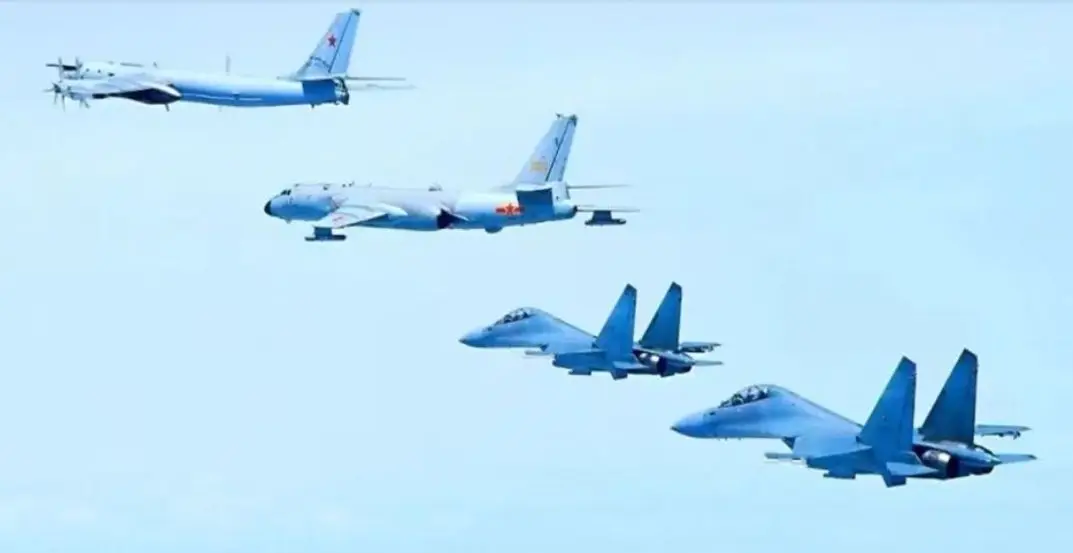
In the most significant military development in East Asia today, Japan and South Korea scrambled fighter jets to intercept a joint China-Russia bomber patrol operating over the western Pacific Ocean. The coordinated flights, involving Chinese H-6 and Russian Tu-95 strategic bombers, mark the latest escalation in a pattern of increasingly assertive military activity that is reshaping the security landscape of the Indo-Pacific region.
Tokyo’s defence ministry confirmed tracking two separate bomber formations during the patrol, which penetrated deep into the western Pacific airspace that both Japan and South Korea consider within their respective air defence identification zones (ADIZ). The Japanese Air Self-Defence Force (JASDF) and Republic of Korea Air Force (ROKAF) both launched interceptor aircraft in response, though neither side reported direct confrontations or airspace violations.
The H-6, China’s licensed production variant of the Soviet-era Tu-16 Badger, remains Beijing’s primary long-range strike platform despite its Cold War origins. Continuously modernised with new avionics, cruise missile capability, and electronic warfare systems, the H-6K and H-6N variants now serve as both a nuclear delivery platform and a conventional standoff weapon carrier. The Russian Tu-95MS Bear, a turboprop-powered strategic bomber dating to the 1950s, similarly persists through continuous modernisation, carrying Kh-101/102 cruise missiles with ranges exceeding 2,500 kilometres.
That these two legacy platforms – symbols of communist military aviation heritage – are now operating in tandem signals something far more consequential than a routine training exercise.
The Strategic Context: A Partnership Forged in Opposition
Today’s patrol did not emerge in a vacuum. It represents the operational maturation of a China-Russia military relationship that has deepened dramatically since Moscow’s full-scale invasion of Ukraine in February 2022. With Russia isolated and under comprehensive Western sanctions, Beijing has exploited Moscow’s vulnerability to extract unprecedented defence cooperation concessions while maintaining plausible deniability regarding direct military support for Russia’s war effort.
The bomber patrol format itself follows a template established in 2019, when China and Russia first conducted joint long-range aviation missions in the Asia-Pacific. What began as tentative, single-day exercises has evolved into increasingly complex, multi-day operations involving larger formations, expanded operating areas, and more sophisticated coordination. The 2024 patrols saw bombers approach Alaska’s ADIZ, prompting North American Aerospace Defence Command (NORAD) interceptions. Today’s western Pacific patrol represents a southern vector expansion of this operational envelope.
This military convergence occurs against a backdrop of stalled U.S.-China diplomacy. The recent Trump-Xi summit in Beijing — held just weeks ago on May 15 — produced modest outcomes that analysts have characterised as underwhelming. With institutional communication channels between Washington and Beijing shrinking, and the personal Trump-Xi relationship now described as potentially “the weakest link” in bilateral ties, Beijing appears to be signalling through military means what it cannot achieve diplomatically.
Regional Implications: Testing Alliance Cohesion
The patrol’s timing and geography carry deliberate messaging value. By operating in the western Pacific — the maritime space between Japan’s Ryukyu island chain and South Korea’s southern coast — the China-Russia formation directly challenged the operational response capabilities of two critical U.S. treaty allies simultaneously.
Japan’s response demonstrated the continued vigilance of the JASDF's Southwest Air Defence Sector, which has borne the brunt of increased Chinese air activity around the Senkaku Islands and through the Miyako Strait. South Korea’s participation, meanwhile, highlights Seoul’s growing recognition that its security concerns extend beyond the Korean Peninsula to encompass broader regional stability.
Yet the incident also exposes potential alliance friction points. Tokyo and Seoul maintain historically strained bilateral relations, and their coordinated response — while they both reacted independently — does not necessarily indicate integrated command and control. Washington’s extended deterrence commitments to both capitals depend on credible demonstration that U.S. forces can support simultaneous operations across two geographically separated theatres, even as the U.S. military faces its own readiness challenges and Pacific Fleet deployment pressures.
For defence planners and financial analysts monitoring regional stability indicators, today’s patrol should register as an escalation in operational tempo rather than a singular event. The pattern matters: 2026 has already witnessed Xi Jinping’s first visit to North Korea in years, where military cooperation agreements were discussed; Chinese naval exercises around Taiwan have increased in frequency and scale; and now this expanded bomber patrol activity.
Market and Defense Implications
For financial markets and geopolitical risk analysts, the patrol carries several immediate considerations. Defence sector equities across Japan, South Korea, and the United States typically experience volatility following such incidents, particularly companies involved in missile defence, air superiority platforms, and maritime surveillance. The incident may accelerate already-advancing procurement timelines for Japan’s standoff missile capabilities and South Korea’s indigenous fighter programme.
Energy markets should also monitor developments closely. Any sustained military tension in the western Pacific threatens commercial shipping lanes that carry approximately one-third of global seaborne trade, including critical liquefied natural gas shipments to Northeast Asian economies. Insurance premiums for regional maritime routes may tick upward if military activity continues expanding.
From a defence economics perspective, the patrol illustrates asymmetric cost strategies at work. Each JASDF and ROKAF scramble consumes flight hours, fuel, maintenance resources, and pilot fatigue on platforms that are expensive to operate and increasingly aged. China’s H-6 fleet, while numerically limited in true strategic aviation capability, can generate these provocations at a relatively lower marginal cost, forcing adversaries to expend resources on response.
Looking Forward: The New Normal?
The critical question for policymakers is whether today’s patrol represents an established pattern or a deliberate escalation probe. If the former, regional militaries must budget and plan for sustained higher operational tempos across multiple domains — air, maritime, space, and cyber — requiring investments in automation, distributed sensing, and allied interoperability that current procurement cycles may not accommodate.
If the latter, the patrol may signal Beijing’s assessment that the post-summit diplomatic window has closed and that military pressure serves Chinese interests more effectively than negotiation. Moscow’s participation, meanwhile, demonstrates Russia’s continued strategic value to Beijing despite its degraded conventional capabilities — and Russia’s own interest in demonstrating global reach despite its Ukraine quagmire.
For the general public, the key takeaway is that great power competition in the Indo-Pacific is not abstract or distant. It manifests in concrete military operations that require allied responses, consume taxpayer resources, and carry escalation risks that can affect everything from supply chain reliability to regional travel and investment decisions.
Today’s China-Russia bomber patrol is one data point in a larger trend. But it is a significant one — a visible, unambiguous demonstration that two major powers are coordinating military operations against U.S. allies in one of the world’s most consequential strategic theatres. The fighters that scrambled from Japanese and South Korean bases this morning were not responding to a hypothetical threat. They were responding to the new reality of contested airspace in an era of renewed great power rivalry.
Keywords: China-Russia bomber patrol, H-6 Tu-95 joint operation, Japan-South Korea fighter scramble, Western Pacific military tensions, U.S. alliance response, Indo-Pacific security, China-Russia military cooperation, strategic bomber patrol, East Asia defence, great power competition, breaking news China military, geopolitical risk Asia-Pacific, Trump-Xi summit aftermath, regional stability analysis.