
China is facing a convergence of pressures this week, from severe flooding and storm risk to labour market strain, sensitive political signalling, and the death of one of the country’s most closely followed economists.
The developments are different on the surface, but they point to a common theme. Beijing is dealing with mounting stress across governance, the economy, and social stability, while trying to project control at every level.
Table of Contents
- Flooding crisis deepens across multiple provinces
- China’s slowdown is driving workers into the gig economy
- Beijing releases house church pastor Ezra Jin
- Former official receives death sentence for massive bribery case
- The death of Gao Shanwen raises difficult questions
- What these developments suggest
- FAQ
Flooding crisis deepens across multiple provinces
Severe flooding, landslides, and an unusually powerful tornado have caused deaths and widespread disruption across several Chinese provinces, with officials warning that more destructive weather may still be on the way.
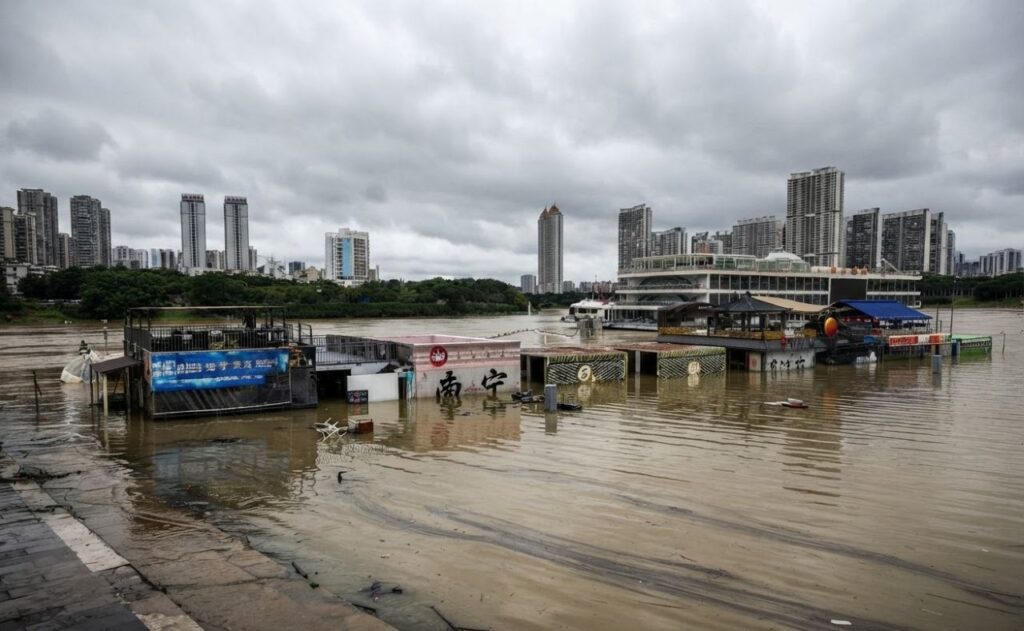
The immediate damage has stretched across Guangxi, Hubei, and Gansu after the remnants of Tropical Storm Mun moved inland and triggered flooding, overflowing rivers, and landslides. Authorities have reported significant casualties and major economic losses, with local infrastructure under serious pressure.
One of the most striking incidents was the tornado in the Hubei province. Inland central China does experience severe weather, but a tornado of this apparent strength remains highly unusual. It reportedly tore through Ezhou and Huanggang, killing at least 11 people, injuring hundreds, and leaving another person missing.
In Gansu, a landslide buried people in a mountain valley, with rescue teams recovering multiple victims and continuing search efforts for those still unaccounted for.
Guangxi has been among the hardest-hit areas. Since early July, torrential rain has forced tens of thousands of people to evacuate. Flood alerts were raised to the highest level across several cities after a reservoir dam near Nanning was breached. Power outages affected tens of thousands of households as rivers spilled over and public infrastructure was damaged.
Beijing’s response has been politically notable as well as operationally urgent. Xi Jinping ordered what state media described as an all-out disaster response, calling on officials to fully implement flood control measures and warning against complacency or wishful thinking. Li Qiang also directed emergency agencies to step up relief operations.
That language matters. It suggests concern not just about the weather itself, but about whether local authorities have actually been carrying out previous central instructions. A Politburo meeting only a week earlier had already called for stricter flood control and stronger prevention of mass casualties. The latest directive appears to be a reminder that implementation, not just messaging, is under scrutiny.
The pressure is not limited to immediate safety risks. Flooding is now threatening agricultural production in multiple regions. Meteorological authorities have warned that rice, corn, and vegetable crops face severe waterlogging, while orchards and aquaculture operations are also vulnerable. Damage has already been reported in neighbouring provinces such as Guizhou and Yunnan.
There have also been unusual secondary hazards. In Guangxi, floodwaters reportedly inundated a snake farm, allowing reptiles, including reports of venomous cobras, to escape into surrounding communities. That detail may sound bizarre, but it captures the broader reality of these disaster events in China. Once infrastructure and containment systems fail, the knock-on effects can become highly unpredictable.
The concern now is that the situation may worsen. Forecasters expect Super Typhoon Bavi to approach China’s eastern coast, potentially bringing another round of heavy rainfall and destructive winds. Climate officials are also forecasting above-average rainfall across large parts of southern and northern China through July and August. In other words, this may be the start of a longer and more damaging flood season rather than a one-off emergency.
For related pressure on supply chains and macro conditions, the wider picture in this analysis of debt strain, inflation, and external disruption is worth keeping in mind. Weather shocks do not hit in isolation.
China’s slowdown is driving workers into the gig economy
China’s economic slowdown is pushing more people into flexible and insecure work, and the composition of that workforce is changing in a way that should worry policymakers.
Gig work in China was once understood mainly as a fallback for migrant labourers or lower-income workers. That is no longer the case. Increasingly, university graduates, white-collar employees, and former tech workers are turning to ride-hailing, delivery, and other forms of platform work simply because more stable jobs are hard to find.
One example is a Beijing resident who moved into ride-hailing after losing his software testing role. His comment was bleak but revealing: those who once used taxis now have to drive them. That line captures a much larger labour market shift. Middle-class status in urban China is becoming more fragile, and the path back into professional work is far from assured.
Research cited in the report estimates that around 320 million people could be engaged in flexible employment this year, up sharply from 280 million the year before. If that estimate is broadly accurate, this would mean roughly 44 percent of China’s workforce is participating in some form of informal or semi-formal employment.

There are several forces driving this shift:
- The prolonged property downturn has erased large numbers of construction-related jobs.
- Manufacturers are reducing labour needs through automation and cost-cutting.
- Artificial intelligence is beginning to displace some white-collar work.
- Weak consumer demand is limiting hiring across the broader economy.
This last point is critical. China’s official unemployment rate has remained comparatively stable, but that can conceal a deterioration in job quality. Even minimal gig work is often counted as employment. So the headline rate may not fully capture underemployment, earnings pressure, or the weakening of household confidence.
And confidence matters. When workers feel that their incomes are unstable, they save defensively. They postpone major purchases. They become less willing to spend. That feeds directly back into the weak consumption problem Beijing is already struggling to solve.
The social security implications are also serious. Most platform workers are not consistently integrated into China’s formal social insurance system. That raises obvious concerns around healthcare, pensions, and retirement security. Official data showed that by the end of 2024, only a fraction of gig workers had enrolled in the urban pension system. Many migrant workers rely on basic schemes that pay extremely low benefits.
This creates a structural problem for a country with an ageing population and an underfunded welfare system. Central government transfers to support social insurance have risen dramatically over the past decade, but the rapid expansion of flexible labor makes the financing challenge more difficult, not less.
At the same time, competition inside the gig economy itself is intensifying. Several cities, including Shenzhen, have warned that ride-hailing markets are becoming oversaturated. Too many drivers are chasing too few fares. Analysts note that delivery wages have increased modestly in some places, but ride-hailing earnings have come under downward pressure as more workers pile in.
That means the gig economy is functioning as a labour market shock absorber, but a weak one. It provides immediate income, yes, but often with lower pay, higher insecurity, and weaker long-term protections.
Bringing these workers into a more comprehensive social security system will be essential if Beijing hopes to reduce precautionary savings and support domestic consumption. Without that, China risks getting stuck in a loop where labor insecurity suppresses spending, weak spending suppresses hiring, and weak hiring pushes still more workers into unstable work.
That broader tension also appears in other recent economic reporting, including this piece on economic stress signals and gig worker reforms.
Beijing releases house church pastor Ezra Jin
In a politically sensitive move, China has released prominent house church pastor Ezra Jin and allowed him to travel to the United States after months in detention.

Jin, also known as Jin Mingri, had been detained since October 2025 alongside members of Beijing’s unregistered Zion Church. His arrest came amid a continuing crackdown on underground Protestant congregations that operate outside state-approved religious structures.
He arrived in Los Angeles over the weekend, and the timing of the release has immediately raised questions because of reported direct appeals from Donald Trump during his visit to Beijing in May.
Beijing has not publicly explained the decision, and neither side has disclosed whether any concessions or understandings accompanied it. That ambiguity is typical in cases like this. China has, on previous occasions, released prominent detainees during periods of diplomatic engagement, particularly when doing so serves a broader political objective.
According to accounts circulating among Chinese Christian leaders overseas, Jin was unexpectedly removed from prison in the middle of the night and initially believed he was being transferred to another detention facility. Instead, officials handed him his passport and informed him that he would be sent to the United States to reunite with family.
There are reports that the move was carried out under Xi Jinping’s personal instructions, though, as with many politically sensitive stories in China, transparency is limited and details remain difficult to independently verify.
What is clearer is that Jin’s release does not mark any broader easing in religious policy. Other Zion Church pastors reportedly remain in custody, including Franklin Wang Lin, who has faced additional charges beyond earlier allegations tied to business activity.
So the significance of this case is twofold:
- It reinforces that Beijing remains willing to use high-profile detainees as instruments of diplomacy.
- It also reinforces that the underlying crackdown on independent religious organisations has not changed.
The message is not liberalisation. The message is selective flexibility where the leadership sees an advantage.
Former official receives death sentence for massive bribery case
A Chinese court has sentenced former senior official Yang Yulin to death for accepting more than 2.21 billion yuan in bribes, underlining the severity with which Xi Jinping’s anti-corruption campaign continues to operate in major cases.
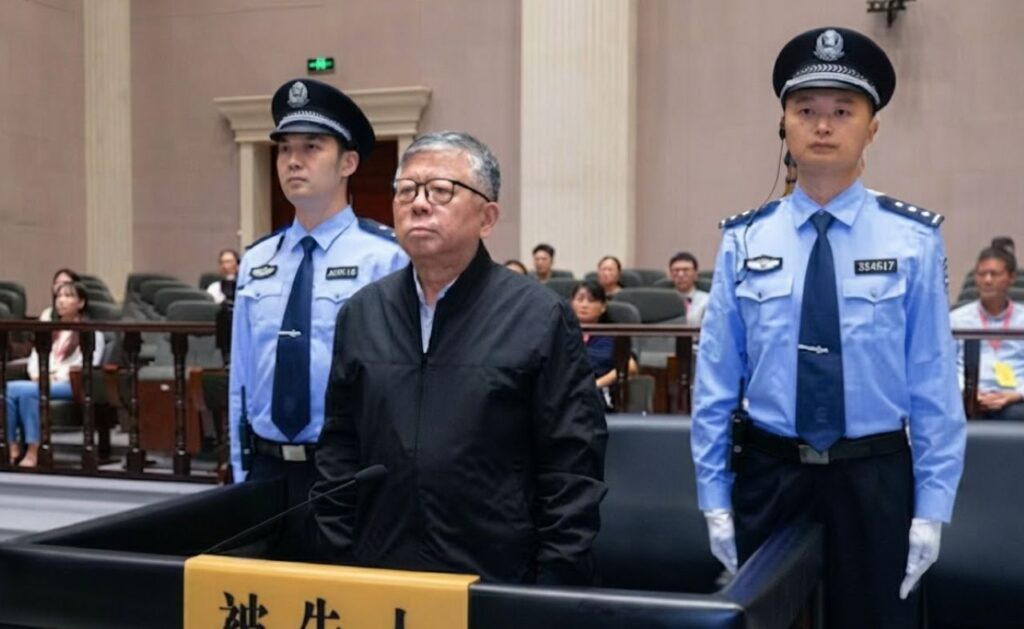
Yang, a former vice director of an economic development zone in Nanjing, was convicted of taking bribes over a ten-year period from 2013 to 2023. State media also said he was found guilty of embezzlement, abuse of power, and money laundering.
The court described the crimes as exceptionally grave and said they had caused enormous financial losses. That framing was used to justify the death sentence.
Capital punishment in corruption cases is relatively uncommon, but not unheard of, especially when authorities want to send a sharp signal. Since 2021, some high-profile corruption defendants, including former executives linked to state financial institutions, have received the harshest possible penalties.
This latest sentence fits within Xi’s long-running effort to present the party as relentlessly committed to internal discipline. Around the Communist Party anniversary celebrations, Xi again emphasised the need to remove those who damage the party’s integrity and authority.
That political framing is central. Anti-corruption in China is not only about financial crime. It is also about organisational control, loyalty, and maintaining the credibility of the party-state system. Harsh sentencing in especially prominent cases serves both legal and political functions.
The death of Gao Shanwen raises difficult questions
The final development is the death of Gao Shanwen, the influential economist whose public criticism of China’s official economic narrative made him one of the country’s most closely watched and controversial financial voices.

Chinese media reported that Gao died at the age of 54 following an illness. Social media messages suggested he had been battling cancer. Official records indicate he was born in 1971.
Gao drew international attention after challenging the credibility of China’s official GDP figures during a speech in Washington in late 2024. While authorities were reporting growth close to 5 percent, Gao argued that actual average growth was likely closer to 2 percent.
That was not a minor technical disagreement. In the Chinese political system, publicly questioning headline economic data cuts close to the legitimacy of the leadership’s broader narrative. Reports later indicated that he was investigated and disciplined.
He also became widely known for a brutally concise description of post-pandemic China as a society of energetic old people, lifeless young people, and despairing middle-aged people. The line spread because it captured something that many in China have been feeling: weak prospects, stagnant mobility, and declining confidence across different generations.
Some of his previous speeches were later censored online, including earlier remarks arguing that China’s rise had relied heavily on cooperation with the United States and warning that deteriorating relations with Washington could trap younger generations in prolonged stagnation.
After news of his death broke, tributes appeared on Chinese social media describing him as someone who dared to speak plainly. That response says a great deal. In a tightly managed information environment, there is often a premium on blunt realism, especially when official narratives feel increasingly detached from lived economic experience.
It is important to stay factual here. There has been speculation online about the circumstances of Gao’s death, but there is no confirmed evidence supporting anything beyond the reported illness. What can be said with confidence is that his death removes one of the very few establishment economists who had both the stature and the willingness to publicly challenge the official line.
Gao spent much of his career near the centre of China’s financial and policy world. After joining the People’s Bank of China in the mid-1990s, he went on to serve as chief economist at major securities research institutions, including Everbright and later SDIC Securities. He left the firm in late 2025, closing a career that made him one of the country’s most prominent economic analysts.
His death comes at a time when honest discussion about the Chinese economy is especially sensitive. That sensitivity reflects the broader problem. When confidence is weak, data is disputed, and policy space is narrowing, the room for candid diagnosis tends to shrink just when it is needed most.
For more on the intersection of growth scepticism, security politics, and Beijing’s wider policy direction, this analysis of China’s growth questions and security worldview adds useful context.
What these developments suggest
Taken together, these stories are not random. They point to a system managing multiple layers of pressure at once.
- Natural disasters are testing local governance capacity and central oversight.
- Economic slowdown is reshaping the labour market in ways that threaten consumption and social stability.
- Selective prisoner releases show how domestic repression and foreign diplomacy can intersect.
- Harsh anti-corruption penalties reinforce internal discipline and political signalling.
- The death of a prominent dissenting economist highlights how narrow the space for candid economic debate has become.
None of this means the system is on the verge of collapse. But it does mean the burden on the leadership is growing. China’s challenge is no longer simply to maintain growth. It is to manage shocks, preserve confidence, and hold together a more stressed and more complicated social contract.
FAQ
How serious is the current flooding situation in China?
It is serious and multi-regional. Flooding, landslides, and a rare inland tornado have caused deaths, forced mass evacuations, damaged infrastructure, cut power, and threatened agricultural output. Forecasts for more heavy rain and an approaching typhoon suggest the risk may remain elevated for weeks.
Why is the growth of the gig economy such a concern for Beijing?
Gig work provides short-term employment, but it often comes with lower pay, less stability, and weaker social insurance coverage. That can depress consumer spending, increase precautionary savings, and complicate efforts to fund pensions and healthcare in an ageing society.
Does the release of Pastor Ezra Jin signal a softer approach to religion in China?
No clear evidence suggests a broader policy shift. The more likely interpretation is that this was a selective decision made under specific diplomatic circumstances, while the wider crackdown on unregistered religious groups continues.
How unusual is a death sentence in a Chinese corruption case?
It is relatively uncommon but still possible in especially severe or politically significant cases. When authorities impose such penalties, it usually reflects both the scale of the crime and a desire to send a strong political message about discipline and deterrence.
Why was Gao Shanwen so significant?
Gao stood out because he publicly questioned official growth figures and offered unusually frank assessments of China’s economic malaise. As a well-connected establishment economist, that made his comments especially notable and politically sensitive.
What is the main takeaway from this week’s developments?
The main takeaway is that China is confronting overlapping pressures in governance, economics, and social stability. The leadership is still projecting control, but the underlying stresses are becoming harder to ignore.
That is the core picture for now. The weather emergency is immediate, but the economic and political stories may prove even more consequential over time. In each case, the real issue is not just the headline event, but what it reveals about the system beneath it.