
Several important China developments landed at once, spanning finance, technology, domestic governance, aviation security, and regional geopolitics. Taken together, they show a country that is larger, more capable, and more assertive than it was a decade ago, but also one facing deeper scrutiny, tighter external constraints, and mounting internal pressure points.
Open-source China: This China News Update breaks the latest developments into five clear sections: the World Bank’s planned end to lending to China, Meituan’s ambitious new open-source AI model, the continued growth of Communist Party membership despite population decline, the extraordinary light aircraft crash into central Beijing, and the sharp deterioration in China-Japan relations.
Table of Contents
- World Bank to Phase Out Lending to China by 2031
- Meituan’s LongCat 2.0 and the Push for a Domestic AI Stack
- Party Membership Keeps Growing Even as the Population Shrinks
- Beijing Aircraft Crash Raises Serious Airspace Security Questions
- China and Japan Enter a Sharper Phase of Confrontation
- Why These Developments Matter Together
- FAQ
- Final Take
World Bank to Phase Out Lending to China by 2031
The World Bank is preparing to end its lending relationship with China by 2031, closing the chapter on more than four decades in which China borrowed from one of the world’s leading development institutions.

Under the proposal now heading to the board, lending to China would be capped at no more than US$2 billion between now and 2031, after which it would stop entirely. In practical terms, this is less a sudden break than the formal recognition of a long-running trend. Annual lending has already fallen dramatically, dropping from roughly US$2.4 billion in 2017 to about US$750 million in 2025.
The logic behind the move is straightforward. China is no longer a poor country in the way it was when it first joined the World Bank in 1980. It received its first loan in 1981 to support higher education in science and engineering, and for years it borrowed through the bank's low-income channels before moving into middle-income status at the end of the 1990s. Today, China is the world’s second-largest economy and is itself an official creditor to many other countries.
That shift has fuelled years of political pressure, especially from Washington. US administrations from both parties, along with lawmakers across the political spectrum, have argued that development financing should be reserved for poorer countries, not for a major power with vast state resources and global lending ambitions of its own.
Beijing appears to be accepting the change publicly, at least in broad terms. Chinese officials have signalled that they still want a close relationship with the World Bank, but with cooperation centred on development knowledge, global challenges, and support for lower-income countries rather than China itself taking loans.
There are two ways to read this story.
- First, it is a marker of China’s rise. A country that once needed development loans is now being treated as a system-shaping economic power.
- Second, many will ask why this did not happen earlier. For critics, the surprising part is not that the lending is ending, but that it continued for so long.
It also fits a broader pattern of international institutions slowly recalibrating their approach to China as growth slows, geopolitical tensions rise, and the line between developing economy and strategic rival becomes harder to ignore. That broader context is also visible in related coverage on China’s fragile recovery narrative and tightening tech constraints.
Meituan’s LongCat 2.0 and the Push for a Domestic AI Stack
China’s AI race has increasingly become a hardware story, and that is why Meituan’s announcement matters.

The company has unveiled LongCat 2.0, an open-source large language model that it says was trained entirely on domestically produced AI chips. If that claim holds up under scrutiny, it would represent a significant milestone for China’s effort to build advanced AI systems without relying on Nvidia’s highest-end accelerators.
The headline numbers are large. Meituan says the model has 1.6 trillion total parameters, with around 48 billion activated per token through a mixture-of-experts architecture. It also says pre-training used more than 35 trillion tokens and ran over vast accelerated computing time on large domestic AI ASIC clusters rather than Nvidia GPU systems.
That last point is the real story.
US export controls have sharply limited Chinese access to the most advanced American AI chips. As a result, Chinese firms have had to improvise. That means leaning harder on domestic suppliers such as Huawei and other local chip designers, building much larger clusters to compensate for weaker individual chip performance, and putting serious effort into software optimisation and infrastructure stability.
Meituan says it had to build its own scalable and reliable software layer because China’s domestic chip ecosystem still trails Nvidia in several important ways:
- raw performance at the cutting edge
- software maturity
- developer tooling
- ecosystem support
That all sounds plausible. It also explains why this announcement deserves caution as much as attention.
Meituan has not identified the chip supplier behind the training system. That omission immediately raises questions. If the claim is meant to demonstrate a breakthrough for China’s self-reliant AI hardware ecosystem, not naming the hardware leaves a major hole in the story.
There is also the issue of verification. Reported benchmark performance and grand engineering claims tend to attract headlines quickly, but genuine significance depends on what comes next. Analysts will want to see independent testing, better access to the model weights, clear technical documentation, and evidence that developers actually adopt the platform in meaningful numbers.
Without that, the launch risks becoming another splashy AI announcement that says more about strategic messaging than durable technical progress.
Still, even with those caveats, LongCat 2.0 matters because it highlights where the Chinese AI sector is heading. Instead of waiting for access to the best foreign chips to return, companies are being pushed into a different path:
- use what domestic hardware is available
- scale out with bigger chip clusters
- compensate with software efficiency
- build local alternatives across the full stack
That does not necessarily close the gap with the leading US systems. But it may narrow it enough for China to remain competitive in important commercial and strategic applications.
The pressure on this sector is part of a wider story about export controls, AI bottlenecks, and the limits of China’s recovery narrative, which is explored further in this related piece on AI chip constraints and uneven economic signals.
Party Membership Keeps Growing Even as the Population Shrinks
China’s population is declining, but the Communist Party is still expanding.
According to newly released official figures, party membership surpassed 101 million for the first time by the end of 2025, reaching 101.286 million members. That was an increase of just over one million from the year before, or roughly 1 percent growth.
During the year, the party recruited more than 2 million new members. The recruitment profile is especially notable. About 84 percent of new recruits were 35 or younger. Nearly half were women, and just over 10 percent came from ethnic minority groups.
Modernisation: Official messaging around the new numbers emphasises stronger grassroots organisation, especially in rural areas. The argument is that a denser and more tightly integrated party network improves governance capacity and helps advance economic development, rural revitalisation, and broader modernisation goals.
That is the official framing. But the figures also support a more critical interpretation.
As the country’s total population falls, the party’s share of the population is rising. That suggests the organisation is deepening its social reach even as the national demographic base weakens. Some of this is likely ideological and institutional by design. Some of it may also reflect the practical incentives attached to party membership.
For many people, joining the party can mean access to career opportunities, status, networks, and long-term advantages inside a system where institutional alignment still matters deeply.
The harder question is whether this trend helps or hurts China’s economic future.
On one hand, a broader and younger party network may improve local implementation and state coordination. On the other hand, if expanding bureaucratic structures absorb too much talent and reinforce administrative density at a time when the economy needs greater efficiency, innovation, and productivity gains, then the expansion could come with real costs.
This demographic and institutional tension is becoming harder to ignore. China is confronting population decline, youth employment pressure, and structural economic adjustment all at once. In that environment, a growing party apparatus can be read either as a source of governance resilience or as a sign that the state system is becoming heavier just as growth requires more flexibility.
That demographic strain is part of a larger pattern covered in related reporting on China’s demographic decline and rising strategic pressure.
Beijing Aircraft Crash Raises Serious Airspace Security Questions
One of the most startling incidents in recent Chinese aviation history continues to raise unanswered questions.
New details indicate that the light aircraft that crashed into Beijing’s tallest skyscraper last week came dangerously close to a commercial airliner before striking the 109-storey CITIC Tower. Flight tracking data suggests the small plane crossed the approach path of a Hainan Airlines Airbus A330 heading into Beijing Capital International Airport.

The two aircraft reportedly came within about 1,500 feet of each other, less than 500 metres, forcing the airliner to abort its landing. At least one other aircraft may also have had to go around as the light plane passed through one of the capital’s busiest arrival corridors.
That alone would make this a major aviation incident. But the location and political context make it far more serious.
The crash killed the pilot and injured 13 people on the ground. The aircraft was identified as a two-seat plane manufactured in China. Somehow it was able to cross central Beijing, a city with some of the strictest airspace controls in the world, before crashing only a few kilometres from Zhongnanhai, the heavily guarded leadership compound at the core of Chinese political power.
Several days later, public explanation remains thin. Authorities have released only basic facts, while images and footage have reportedly been scrubbed quickly from Chinese social media. That information vacuum has intensified scrutiny rather than calming it.
The central issue is not just how a crash happened. It is how a small aircraft appears to have entered extremely restricted airspace in the first place.
Defence analysts have drawn comparisons to historic incidents that exposed weaknesses in supposedly formidable air defence systems. The symbolism matters. Beijing projects control, especially over the capital’s physical and political security environment. A breach of this kind inevitably prompts questions about detection, interception, communication, and command response.
The fallout is already spreading beyond the crash site.
Flight schools around the country say training flights have been suspended indefinitely while regulators carry out nationwide inspections. Industry operators have reportedly been told not to discuss the matter publicly. The incident is also expected to accelerate tighter regulation of China’s low-altitude economy, which includes drones and small aircraft.
Likely policy responses may include:
- expanded geofencing
- mandatory flight registration and tracking
- remote immobilization capability for aircraft
- closer monitoring of low-altitude routes and operators
At this stage, the cause remains uncertain. Pilot error is one possibility. Mechanical failure is another. But without a credible official explanation of how the aircraft entered such sensitive airspace and came so close to a passenger jet, speculation will continue.
centre. What is already clear is that this has become more than an accident story. It is now a security story, a regulatory story, and a test of how much transparency authorities are willing to provide when an incident cuts close to the political center.
China and Japan Enter a Sharper Phase of Confrontation
Relations between China and Japan have worsened significantly, and the latest moves from Beijing suggest a more coordinated pressure campaign than anything seen in recent years.
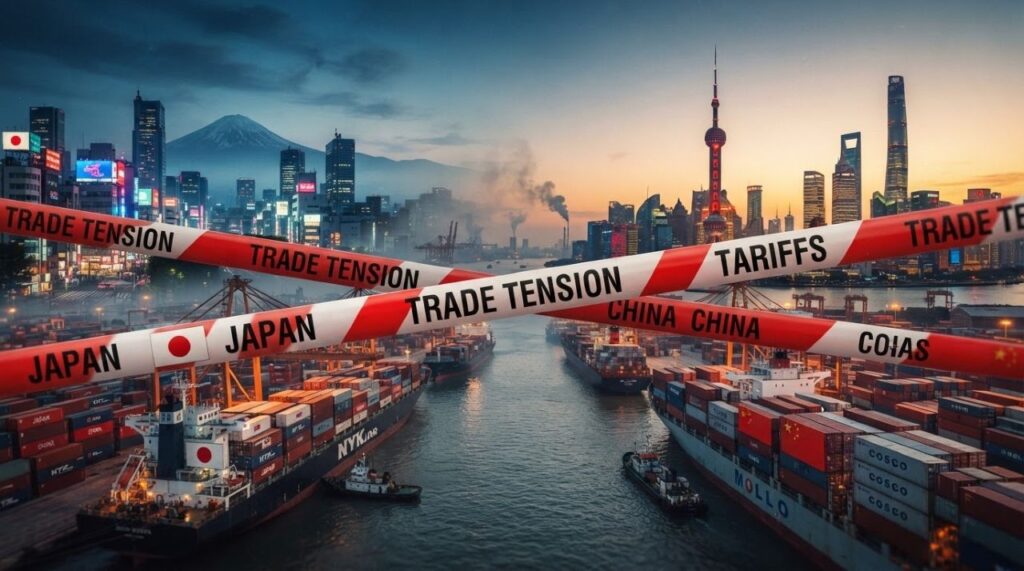
The new measures span economics, military signalling, and diplomatic pressure.
On the economic front, China’s Ministry of Commerce has added 20 Japanese entities to an export control list and another 20 to a watch list. Those targeted include defence research bodies and military-linked subsidiaries connected to some of Japan’s biggest industrial firms, including Mitsubishi Heavy Industries, Mitsubishi Electric, Kawasaki Heavy Industries, and Japan Steel.
Organisations: The restrictions bar Chinese companies from supplying dual-use goods to listed entities. In theory, Beijing says the measures are narrowly aimed at military-related organisations and should not affect normal trade. In practice, many analysts believe the licensing environment will function as something close to a broad cutoff, especially where rare earth inputs are concerned.
Defence that matters because China retains major leverage in critical minerals. Rare earths are essential for advanced electronics, electric vehicles, semiconductors, and defence manufacturing. Beijing has already shown a growing willingness to use export restrictions as a geopolitical tool in disputes with other major powers. Japan now appears to be facing similar pressure.
The military picture has also become more tense.
Japan recently scrambled fighters after joint Chinese and Russian bomber activity near southwestern Japan. Around the same time, Tokyo protested Chinese Coast Guard operations inside Japan’s exclusive economic zone near Yonaguni Island, an area where Beijing’s maritime claims are rejected by Japan.
Signalling: These are not isolated irritants. They fit a broader trend in Northeast Asia in which economic coercion, grey-zone activity, and military signalling increasingly reinforce one another.
Many observers trace the current downturn in relations back to comments last November by Japan’s prime minister suggesting that Japan could assist in Taiwan’s defence if China were to invade. Since then, China has reportedly reduced flights and academic exchanges with Japan, maintained restrictions on Japanese seafood, and increased pressure on Japanese business interests.
Additional friction comes from Tokyo’s changing security posture. Japan has been strengthening defence ties with the United States and regional partners, including the Philippines. It is also tightening investment screening and broadening its economic security agenda. From Beijing’s perspective, those moves look less like ordinary hedging and more like structured alignment against Chinese power.
The result is a relationship entering a more adversarial phase. Beijing appears increasingly prepared to combine trade tools, critical mineral dominance, diplomatic messaging, and military activity in a single strategy. Tokyo, for its part, looks increasingly willing to absorb the pressure while deepening cooperation with allies.
That is a worrying combination. It raises the odds of further retaliation, miscalculation, and a longer period of strategic friction between Asia’s two largest powers.
Why These Developments Matter Together
Each of these stories is important on its own, but the bigger picture matters even more.
organisationalorganisationalorganisationalorganisationalorganisationalThe World Bank story shows how China is being recategorised internationally. The AI story shows how external pressure is reshaping China’s technology path. The party membership story points to a state that is still extending organisational reach even as demographic headwinds intensify. The Beijing aviation incident exposes possible vulnerabilities in one of the most tightly controlled political spaces in the world. And the Japan story reveals a willingness to use economic and military tools in tandem.
FAQ
Why is the World Bank ending lending to China?
The main reason is that China is no longer seen as needing development financing in the way poorer countries do. It is now the world’s second largest economy and has the ability to fund its own development. Political pressure from the United States also helped push the issue.
Why is Meituan’s LongCat 2.0 attracting so much attention?
Because Meituan says the model was trained entirely on Chinese-made AI chips. If true, that would be an important sign that Chinese firms can continue building advanced AI systems despite US export controls on top-end American hardware.
Why does rising party membership matter if China’s population is shrinking?
It suggests the Communist Party is expanding its reach even as the country’s demographic base weakens. That may strengthen governance capacity, but it also raises questions about whether the state bureaucracy is becoming heavier at a time when China needs greater economic efficiency.
Why is the Beijing light aircraft crash considered so serious?
It was not just a crash. The aircraft reportedly entered highly restricted central Beijing airspace, came dangerously close to a commercial airliner, and crashed near extremely sensitive political locations. That combination raises major security and regulatory questions.
What is driving the deterioration in China-Japan relations?
Tensions are being driven by multiple factors, including Japan’s comments on Taiwan, tighter security cooperation with the United States and regional partners, Chinese export controls affecting Japanese entities, maritime disputes, and joint Chinese-Russian military activity near Japan.
Are China’s rare earth controls now a geopolitical tool?
Defence, defence, defence, defence, defence. Yes, that appears increasingly clear. Rare earth restrictions are no longer just a trade issue. They are being used as leverage in broader strategic disputes because these materials are critical for defence, electronics, EVs, and semiconductors.
Final Take
The latest headlines do not point in one single direction, but they do point to one consistent reality: China is becoming more consequential and more constrained at the same time.
Organisations' global status is rising, yet their access to top technology is tightening. Its political organisations are expanding, yet its population is shrinking. Its security systems project strength, yet a single aircraft incident has exposed uncomfortable questions. Its diplomacy talks about stability, yet regional coercive tools are becoming more visible.
That is the landscape shaping the next phase of the China story, and it is why this China News Update matters well beyond any one headline.