China’s economy is increasingly trapped by the very model that made it powerful. For decades, Beijing could rely on a familiar formula: households saved, banks channelled that money into factories and strategic industries, and the resulting products were sold to the rest of the world.
It produced astonishing growth. It also produced far too much stuff, too little domestic consumption, and a currency that remains structurally cheap even as Xi Jinping reportedly dislikes what a weak yuan represents.
That contradiction sits at the heart of several developments now unfolding across the Chinese world: the pressure from exports and capital controls, a sudden wobble in Macau’s casino economy, Taiwan’s effort to demonstrate that an invasion would be horrendously costly, and the rapid expansion of Chinese artificial intelligence across African markets.
These may look like disconnected stories. They are not. Each reflects a broader reality: China has built formidable industrial, financial and technological capacity, but turning that capacity into stable, sustainable influence is proving rather more complicated.
Key Takeaways
- The yuan’s relative weakness reflects China’s high savings, state-directed investment and dependence on exports, not merely short-term currency management.
- Macau’s casino slowdown exposes its reliance on wealthy mainland gamblers at a time of tighter capital controls and weaker Chinese asset markets.
- Taiwan’s Han Kuang drills focus on surviving blockade, communications disruption and a larger invading force through decentralised, asymmetric defence.
- Chinese open-weight AI models are gaining ground in Africa by offering lower costs, local customisation and support built on existing Chinese digital infrastructure.
Table of Contents
- China’s cheap yuan is not an accident
- Macau’s casinos are discovering the limits of China’s wealth effect
- Taiwan is preparing for a blockade, not just an invasion
- Chinese AI is winning African markets by being cheaper and more usable
- The broader picture: capacity is not the same as stability
China’s cheap yuan is not an accident.
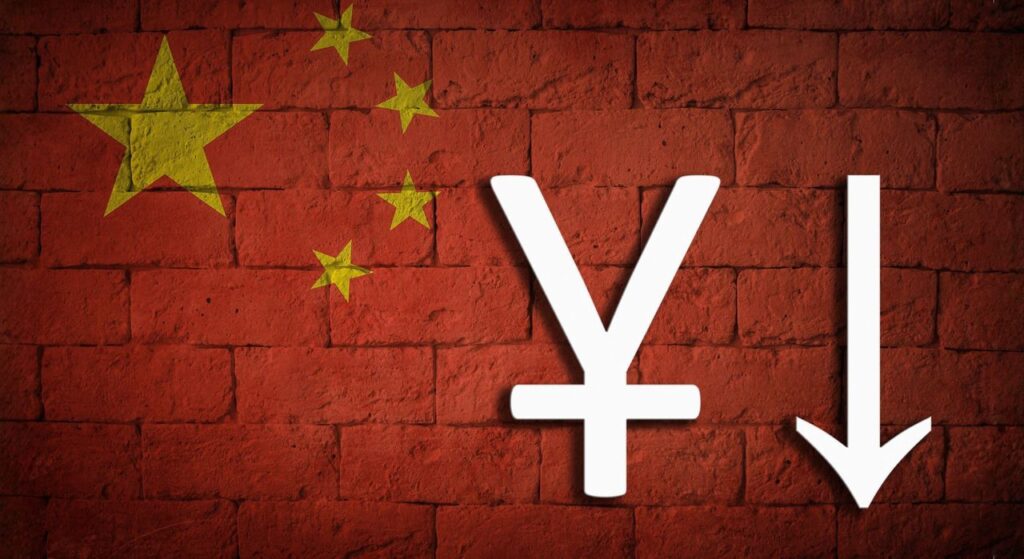
Xi Jinping reportedly sees a weak currency as something of a national embarrassment. A soft yuan signals vulnerability, diminished prestige and a lack of confidence in China’s standing as a major power. The problem, of course, is that the yuan’s relative cheapness is not simply the product of a few exchange-rate decisions made in Beijing. It is embedded in the country’s economic architecture.
Mark Sobel, a former senior US Treasury official and former US representative at the International Monetary Fund, estimates that the yuan may be undervalued by between 20% and 30%. Even after recent gains against the dollar, its inflation-adjusted value remains roughly 15% below where it stood in 2022.
This matters because exchange rates do not exist in a vacuum. China’s inflation has remained close to zero while US inflation has hovered around 3%. So even when the nominal exchange rate barely moves, Chinese goods become relatively cheaper over time. That is excellent news for exporters. It is less excellent for governments in Washington, Brussels and elsewhere that are already worried about a second China shock.
The underlying system is fairly straightforward, if deeply dysfunctional. Chinese households save extraordinary amounts because the social safety net remains limited. Families save for retirement, healthcare, education, unemployment and emergencies because they cannot safely assume the state will cover them. Those savings then flow through state-controlled banks into state-owned enterprises, local-government projects and politically favoured industries.
That includes sectors Beijing sees as strategically essential: artificial intelligence, semiconductors, electric vehicles and advanced manufacturing. The result is not merely investment. It is relentless investment, even when the commercial case is dubious and demand is plainly inadequate.
Factories keep producing. Local governments keep building. Companies keep expanding capacity to protect employment, retain market share and satisfy growth targets. Then they cut prices and accept collapsing margins in order to survive. Chinese officials have increasingly described this destructive race as involution: a sort of economically ruinous treadmill where everyone works harder, earns less and cannot afford to stop.
Meanwhile, domestic demand remains weak. Consumer confidence is fragile, the property downturn has dragged on for more than half a decade, and near-zero inflation reveals an economy struggling to generate healthy demand. If households are not buying enough at home, the surplus has to go somewhere. It goes abroad.
China’s manufacturing trade surplus alone is now estimated to exceed 10% of GDP. That is not a small imbalance. It is a giant flashing warning sign for trading partners, particularly as Chinese producers move aggressively into vehicles, batteries, solar equipment, machinery and other sectors that governments consider economically and strategically sensitive.
A slightly stronger yuan might soften some of the pressure. Beijing has room to permit gradual appreciation without instantly crushing exports, particularly given the scale of its surplus. But this would not solve the actual problem. China remains dependent on high savings, state-directed investment and foreign demand rather than a consumer-led model. A stronger currency can change the optics. It cannot magically persuade households to spend, repair property-sector confidence or make unprofitable investment projects profitable.
That is why China’s export dependence has become such a central strategic issue. As explored in this analysis of Beijing’s growing concerns over export-led growth, officials themselves have begun acknowledging that the model is unsustainable. The trouble is that changing it requires reforms. Beijing has repeatedly avoided stronger household income, a more reliable welfare state and fewer resources funnelled into politically preferred supply.
Macau’s casinos are discovering the limits of China’s wealth effect.

Macau was supposed to be one of the cleaner post-pandemic recovery stories. The world’s largest gambling hub reopened, mainland tourists returned, and gaming revenue grew for 16 consecutive months. Then June and July delivered an unpleasant surprise: gaming revenue contracted sharply.
The Football World Cup diverted some gambling expenditure, but the declines were unusually severe even for a tournament period. That suggests the problem is larger than a temporary shift in entertainment spending. Macau’s casino model depends heavily on premium gamblers, and those gamblers are now being squeezed by exactly the sorts of financial pressures Beijing has spent years creating.
China has intensified its campaign against capital outflows. Authorities have tightened scrutiny of offshore trusts, targeted illegal cross-border securities trading and restricted certain outbound investments by mainland residents, including flows to Hong Kong and Macau. For Beijing, these measures are about financial security and control. For wealthy Chinese gamblers, they make moving money around more difficult, more expensive and more risky.
The broader wealth effect has also deteriorated. The MSCI China Index has fallen about 7% this year, reducing the sense of paper wealth that helped drive the premium gambling boom in 2025. Citigroup surveys found double-digit declines in both the number of VIP and premium gamblers and their spending during June and July.
Casinos have reacted in the traditional way: throw incentives at the problem. More complimentary hotel rooms, meals, concert tickets, rebates and commissions are being offered to attract high rollers. But this is hardly a painless fix. Incentives inflate costs precisely as demand weakens. Las Vegas Sands and MGM Resorts have reported significant margin declines in Macau, while Wynn Resorts managed only a slight improvement.
Combined casino profits are expected to have fallen 7% in the second quarter, reaching their lowest level since 2023. Macau casino stocks have fallen around 20% this year, while forecasts for annual gaming-revenue growth have been cut from 7% at the start of the year to just 3%.
Even that growth rate would leave Macau’s gaming revenue 13% below its 2019 pre-pandemic level. For a city whose economy and public finances rely so heavily on casinos, that is not a minor inconvenience. It is a reminder that Macau remains dangerously dependent on a narrow stream of high-spending mainland wealth.
There are reasons not to declare disaster quite yet. Gaming activity strengthened in the second half of July, and August is traditionally a stronger month. Pent-up demand after the football tournament could still generate a rebound. But the larger vulnerability is obvious: Macau’s prosperity is tethered to Chinese consumer confidence, asset prices and the ability of wealthy mainland residents to move money. None of those things look especially secure.
Taiwan is preparing for a blockade, not just an invasion.
While China’s economic problems grind away in the background, military pressure around Taiwan continues to intensify. Taiwan has begun 10 days of Han Kuang military and civil-defence exercises designed around a brutally practical question: could the island keep functioning and fighting if China attempted an invasion or blockade?
The exercises mobilise around 20,000 reservists and test everything from countering disinformation to repelling amphibious landings, safeguarding critical infrastructure and operating through communications blackouts. The premise is not that Taiwan can mirror China’s much larger military force. It is that Taiwan can make any assault slow, chaotic, costly and politically unbearable.
China deployed 21 military aircraft and nine warships around Taiwan in a joint combat-readiness patrol immediately before the drills began. Taipei described it as China’s 20th such operation this year. These regular deployments are part of the pressure campaign: normalising a military presence around the island while rehearsing elements of coercion and encirclement.
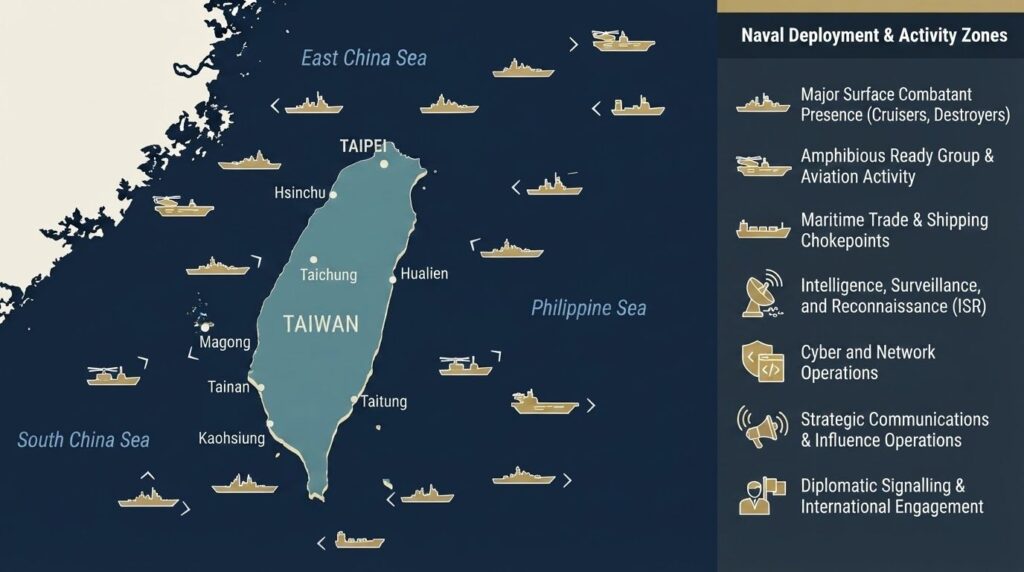
The most important focus of this year’s exercises is the possibility of a blockade. Taiwan depends on access to energy and other essential imports, which makes a maritime quarantine or restricted-access operation potentially devastating even without a full amphibious landing. Taiwan’s navy and coast guard will practise escorting vessels through restricted waters in an effort to maintain those lifelines.
Digital resilience is also being tested. Mobile internet services will be deliberately slowed for 30-minute periods in selected areas, including key technology hubs, to simulate disruption to subsea communications cables. Taiwan Semiconductor Manufacturing Company has said the exercise should not affect its operations, but the broader lesson is unavoidable: the island is preparing for a conflict in which cables, ports, power infrastructure and information networks are targets from the opening hours.
Taiwan’s newly established Littoral Operations Command is participating for the first time. Its role is to stop Chinese forces reaching the coastline through anti-ship missiles, naval mines and drones. Drone warfare, unsurprisingly, is central to the plan. Taiwan hopes inexpensive systems can distract or exhaust China’s sophisticated precision weapons, exposing warships and other high-value assets to Taiwanese missiles.
The other crucial shift is decentralised command. Units are being trained to understand their broader mission and act independently if contact with senior commanders is lost. It is an unglamorous idea, but it is one of the most important. A force that requires flawless communications and constant central direction is vulnerable to paralysis. A force that can improvise under pressure is much harder to defeat quickly.
Washington continues to supply Taiwan with weapons and training, but its long-standing ambiguity over direct intervention remains. Recent comments from President Donald Trump have reinforced Taiwan’s belief that it must be capable of holding out on its own. The objective is not a neat, conventional victory. It is deterrence through resilience: deny Beijing a rapid win and make the costs of escalation intolerable.
For more on the wider intersection of Taiwan risk, Chinese technology policy and weakening economic indicators, see this examination of Beijing’s electricity-driven AI strategy and growing Taiwan uncertainty.
Chinese AI is winning African markets by being cheaper and more usable.
China’s geopolitical competition with the United States is not only being fought with ships, chips and tariffs. It is also being fought through the much less glamorous but arguably more consequential business of helping companies build affordable tools.

Across Uganda, Kenya, Nigeria and Ghana, developers are using Chinese AI models for agricultural support, education platforms, legal databases, financial tools and business software. Alibaba’s models have proven particularly useful for handling African languages, enabling locally built services to provide weather forecasts, crop advice and other information in regional dialects.
The key attraction is cost. Many Chinese open-weight models can be downloaded, modified and run on private servers without recurring access fees. That is a fundamentally different offer from leading proprietary American systems, where customers typically pay subscriptions or usage-based charges for access to closed models.
For businesses operating with limited computing infrastructure and constrained budgets, absolute frontier performance is not always the point. A company needs a model that can reliably perform a specific task and do so cheaply enough to operate at scale. Chinese systems can reportedly be up to 90% less expensive once computing infrastructure and usage costs are included.
One Kenyan legal-technology company built a customised database from around one million legal documents for approximately US$25,000. Its developer estimated that building an equivalent service using a proprietary American system might have cost more than US$1 million. That is not a marginal pricing difference. It is the difference between a commercially viable business and an idea that never gets beyond a pitch deck.
The adoption figures underline the speed of this shift. Chinese models now account for around half of AI use on OpenRouter, up from less than a quarter a year earlier. They also make up 19 of the 25 most downloaded open models on Hugging Face. China is reinforcing that momentum through free computing resources, engineering support and direct outreach to African developers.

Huawei and other Chinese companies have a structural advantage here. They are building on two decades of investment in African telecommunications networks, data centres, mobile infrastructure and government computing systems. Chinese smartphones are widely used across the continent and increasingly arrive with Chinese AI tools already installed. Beijing is not beginning from scratch; it already has relationships, infrastructure and distribution.
There is also an explicit soft-power element. Kenya, Ethiopia, South Africa and seven other African countries have signed AI cooperation agreements with China. Chinese officials present their models as an affordable alternative to a world where advanced technology is concentrated in a handful of wealthy countries and expensive American firms.
That message has obvious appeal. It also comes with obvious risks. Developers have raised concerns about political bias, censorship, cybersecurity and the potential links between Chinese technology firms and the Beijing state. Chinese models have sometimes produced answers that reflect official Chinese narratives on politically sensitive questions.
Yet dependence on foreign AI is a risk regardless of whose flag is attached to it. Cloud-based systems can be withdrawn, restricted or repriced because of corporate decisions or government pressure. Downloadable Chinese models provide more local control, but geopolitical concerns may deter international banks and other regulated businesses from adopting them.
American companies retain major advantages in premium applications. ChatGPT and Claude remain popular, while US models are often preferred for demanding coding work and precision business automation. American cloud providers can also profit when African companies run Chinese models on their infrastructure. This is not a winner-takes-all contest. African businesses and governments appear increasingly likely to mix Chinese affordability and customisation with American technical performance.
The broader picture: capacity is not the same as stability.
China’s strength is not in doubt. It can mobilise capital, build industrial capacity at breathtaking speed, deploy military pressure and export sophisticated technology at prices competitors struggle to match. But the same system generates ugly trade-offs.
Cheap exports can provoke protectionism. Capital controls can undermine Macau’s premium gambling economy. Military pressure can make Taiwan more determined to build asymmetric defences. Affordable AI can build influence abroad, while concerns over censorship and political dependency limit trust.
That is the central tension in China’s current trajectory. Beijing has become extraordinarily capable at producing scale. It has been far less successful at creating the domestic demand, institutional confidence and international reassurance needed to make that scale sustainable. The weak yuan, the casino slump, Taiwan’s defence drills and the AI contest in Africa are all different versions of the same story: China’s model still delivers power, but increasingly at a cost it cannot easily ignore.
Frequently Asked Questions
Why is the yuan considered undervalued?
Former US Treasury official Mark Sobel estimates that the yuan may be undervalued by 20% to 30%. China’s high savings rate, state-directed investment, weak domestic consumption and export-heavy growth model all create persistent pressure for a relatively cheap currency.
Why are Macau casino revenues under pressure?
Macau is suffering from weaker spending by VIP and premium gamblers, tighter Chinese restrictions on capital outflows and a weaker wealth effect from falling Chinese equity markets. Casinos are also spending more on incentives, which is weighing on profits.
What are Taiwan’s Han Kuang exercises designed to test?
The exercises test Taiwan’s ability to continue operating during an invasion or blockade. They include reservist mobilisation, coastal defence, ship escorts, communications disruptions, critical infrastructure protection, drone operations and decentralised military command.
Why are Chinese AI models gaining traction in Africa?
Chinese models are attractive because many can be downloaded, customised and operated at far lower cost than closed proprietary systems. Existing Chinese investment in African telecoms, data centres and smartphones also gives Chinese technology firms a significant distribution advantage.