
Photo by Toby Yang on Unsplash
Table of Contents
- China wants to complete its core transport network by 2030
- The shift from scale to weak links
- DeepSeek’s alleged chip shopping spree exposes China’s AI bottleneck
- Huawei may be closing the gap, but not quickly enough
- Tencent’s gaming weakness shows the limits of domestic demand
- Chinese games are increasingly dependent on overseas markets
- China’s desert battle is a different kind of infrastructure project
- China’s next challenge is proving that investment still works
- Frequently asked questions
China is preparing to finish 95% of its core national transport network by 2030. On paper, it is another monumentally ambitious infrastructure campaign from a country that already operates the world’s longest high-speed rail network, nearly 200,000 kilometres of expressways, hundreds of civilian airports and thousands of major coastal berths.
But this is no longer the China of the early 2000s, when an additional bridge, railway or industrial park could plausibly be sold as an obvious productivity gain. The country is now attempting to build more infrastructure while growth has slowed, local government finances are strained and the easy connections between its most economically productive regions have already largely been made.
That dilemma runs through several of China’s biggest current stories. Beijing wants more transport capacity. Its AI firms want vastly more advanced computing power. Tencent is struggling with weak domestic demand while Chinese games thrive abroad. And in Inner Mongolia, long-term environmental restoration projects are trying to stop deserts from swallowing land, communities and eventually the Yellow River itself.
These developments may seem disconnected. They are not. Together, they show a country still capable of mobilising enormous resources but increasingly forced to ask a more awkward question: where can investment still generate sustainable returns?
China wants to complete its core transport network by 2030.
Beijing’s national transport plan is already 91% complete and reaches more than 80% of China’s counties and 90% of its population. The remaining phase is intended to lift completion to 95% by 2030 through a network organised around six axes, seven corridors and eight routes.
The six axes connect China’s major economic clusters: the Yangtze River Delta centred on Shanghai; the Greater Bay Area around Guangdong, Shenzhen and Hong Kong; the Beijing-Tianjin-Hebei region; and the Chengdu-Chongqing hub in the southwest.
The seven corridors are about connecting inland and western regions to coastal ports, neighbouring countries and international markets. Their flagship project is the 134-kilometre Pinglu Canal, linking Nanning in Guangxi to the Gulf of Tonkin. The canal is designed to give southwestern China a faster route to Southeast Asia and global shipping lanes.
Then there are the eight routes aimed at improving transport links in border regions, including Tibet, Xinjiang, Inner Mongolia and Heilongjiang. These are economic projects, certainly, but they also carry a clear strategic logic. Better links make it easier to move goods, people and state capacity into areas that Beijing considers geopolitically sensitive.
Other projects include a sea-crossing railway between Shanghai and Ningbo, bridges across the Pearl River estuary, further Yangtze crossings, and an expanded shiplock at the Three Gorges Dam. The Three Gorges project alone is expected to lift annual shipping capacity to 336 million tonnes.
China is also planning to modernise and digitalise another 80,000 kilometres of roads, railways and related infrastructure. The emphasis is supposedly shifting toward efficiency, resilience and lower-carbon performance rather than merely building the biggest possible thing and then congratulating oneself for having built the biggest possible thing.
The shift from scale to weak links
There is a reason Chinese officials are now stressing “weak links” and coordination. China’s transport system is already enormous:
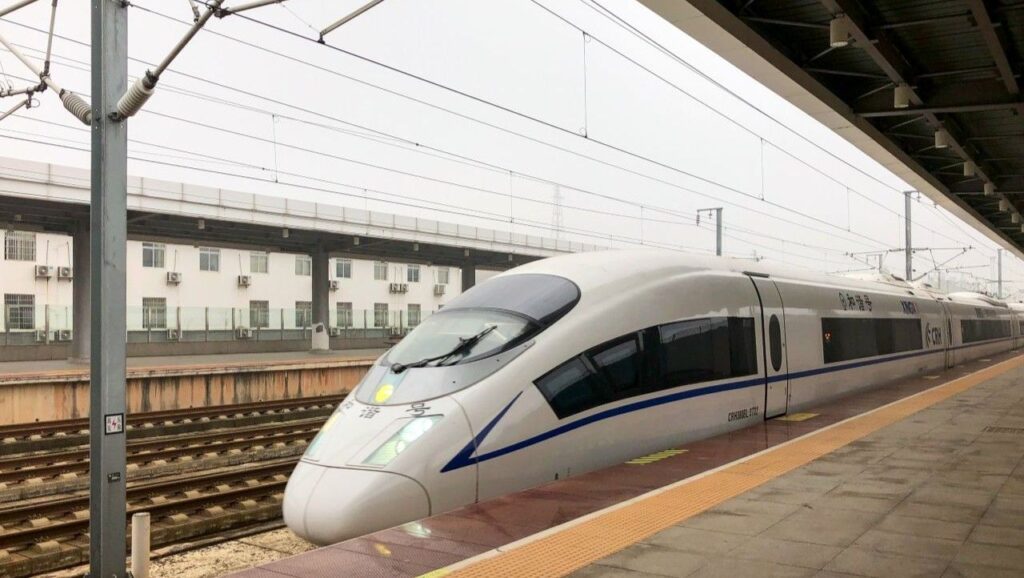
- About 50,000 kilometres of high-speed rail.
- About 199,000 kilometres of expressways.
- Roughly 270 civilian airports.
- More than 3,000 large coastal berths.
The problem is not whether China can build infrastructure. It obviously can. The problem is whether the next round of infrastructure will create enough economic value to justify its cost.
That is a far less glamorous question than unveiling a new bridge. It is also the one that matters.
Michael Pettis, a finance professor at Peking University, has argued that the continuing rush into transport infrastructure should be understood partly as an investment-allocation problem. In this view, Beijing has repeatedly redirected investment when a previous model became too debt-heavy or too saturated: from property to manufacturing, and then increasingly toward infrastructure and other strategic sectors.
China’s old property model is under immense pressure. Manufacturing investment has produced widespread overcapacity concerns. Infrastructure, meanwhile, faces diminishing returns in a country where the most commercially valuable routes are already connected. The more mature the network becomes, the harder it is to identify a new project that is not merely politically useful, regionally symbolic or dependent on optimistic assumptions about future demand.
This does not mean every new railway or canal is irrational. Some bottlenecks remain real, and better links to Southeast Asia or inland regions can have strategic and commercial value. But infrastructure spending is not automatically productive simply because it involves infrastructure. A high-speed railway to a thinly populated city, for example, may be impressive. It may also struggle to cover operating costs for years.
That broader pressure is visible elsewhere in China’s economy. China’s uneven recovery and intensifying technology squeeze make the search for new, sustainable growth engines even more urgent.
DeepSeek’s alleged chip shopping spree exposes China’s AI bottleneck.
China’s infrastructure ambitions are physical. Its AI ambitions are increasingly constrained by something much smaller: advanced chips.

An unverified document purportedly recording a lengthy conversation between DeepSeek founder Liang Wenfeng and investors has stirred major debate across China’s technology sector. Neither Liang nor DeepSeek has authenticated the document, so its claims must be treated with caution. Still, the account is revealing because it maps neatly onto the fundamental problem facing Chinese AI companies: access to computing power.
The alleged comments suggest that DeepSeek’s most serious disadvantage relative to the United States is not talent, model design or engineering capability. It is access to advanced processors.
DeepSeek reportedly has around 20,000 NVIDIA H-series-equivalent chips, many acquired recently, and is seeking to buy as many NVIDIA processors as possible at prices it considers acceptable. The company has reportedly raised 50 billion yuan and may seek to spend as much as 20 billion yuan on computing hardware during the year.
That is a fairly blunt expression of the AI arms race. Advanced AI is not just about clever researchers in a room with whiteboards. It requires huge quantities of compute, vast amounts of electricity, specialised hardware and a sophisticated software environment capable of making all of it work efficiently.
One especially contentious reported comment referred to “non-compliant cards,” a phrase whose exact meaning is unclear but which could imply chips obtained outside standard export-control channels. The timing is awkward, to put it mildly. US authorities have been investigating whether Chinese AI companies are accessing restricted American processors improperly.
The alleged remarks contain an uncomfortable contradiction for NVIDIA. DeepSeek may want enormous quantities of American chips in the short term, while simultaneously working to reduce dependence on them in the long term.
Huawei may be closing the gap, but not quickly enough.
DeepSeek is reportedly set to receive 16,000 of Huawei’s new 950 processors. Yet the claimed assessment is that these chips offer computing capacity roughly equivalent to just 4,000 NVIDIA B-series processors for DeepSeek’s purposes. If accurate, that would make Huawei useful, strategically important and still insufficient for training the company’s next-generation model at the scale it wants.

The reported shorthand for China’s hardware gap is “four times plus two years”: roughly four Huawei chips required to match one NVIDIA processor, with China’s technology about two years behind.
That sort of estimate should not be treated as divine scripture. Chip comparisons depend heavily on the task, energy use, networking, software optimisation and the specific hardware being compared. But the strategic point is clear enough. China’s domestic alternatives are improving, but catching up with the world’s leading AI hardware ecosystem is an extremely expensive and technically difficult undertaking.
The software side may be more fluid. NVIDIA’s great advantage has never been just its chips; it has also been CUDA, the software ecosystem that has made NVIDIA hardware unusually convenient for researchers and developers. DeepSeek reportedly believes this moat is weakening as AI tools become capable of writing more of the code needed to support hardware platforms. The company has also developed its own high-level compiler and reportedly used NVIDIA hardware for its V3 model while relying less heavily on NVIDIA’s wider software stack.
If that assessment is even partly right, China’s path to hardware independence may run through software adaptation rather than a sudden miracle in chip fabrication. Huawei’s systems do not have to become identical to NVIDIA’s products. They need to become good enough, affordable enough and easy enough to use that Chinese firms can build around them.
Still, “good enough” is doing a lot of work here. The largest and most advanced model-training efforts require immense compute capacity. It is hard to pursue artificial general intelligence while accepting a permanent hardware disadvantage. That is why advanced chips remain one of the most consequential pressure points in the US-China technology confrontation.
For a broader look at China’s AI-driven markets and the policy environment around them, see this update on Hong Kong’s AI listing boom and China’s changing investment landscape.
Tencent’s gaming weakness shows the limits of domestic demand.
China’s technological ambitions have also collided with a much more ordinary problem: consumers are not spending as freely as investors would like.

Tencent Holdings recently suffered its largest one-day decline in more than a year, with its Hong Kong-listed shares falling 7.1%. The sell-off followed market concerns that the company’s mobile gaming revenue weakened during the June quarter.
Bernstein estimated that Tencent’s mobile gaming revenue declined 2.6% year-on-year. Billings from its three biggest games, Honour of Kings, Peacekeeper Elite and PUBG Mobile, may have fallen by 13%.
That is not a trivial concern. Gaming is a central part of Tencent’s business, and the company’s wider operations are exposed to the softness of China’s domestic economy. Advertising is affected by weaker corporate confidence and consumer spending. Gaming revenue depends on a massive domestic user base that is still growing only slowly. AI investment, meanwhile, requires significant capital before it delivers clear commercial returns.
Some investors are also shifting toward companies perceived as more direct beneficiaries of the AI investment cycle. Tencent may have formidable AI ambitions, including the possibility of commercialising AI agents through WeChat, but investors want to know how and when those ambitions become revenue rather than another enormous line item on the spending sheet.
Hong Kong-listed technology shares have another vulnerability. During periods of stress, they do not receive the same level of support as mainland-listed stocks from state-backed “national team” investors. That can make downturns sharper and sentiment more fickle.
Chinese games are increasingly dependent on overseas markets.
Tencent’s domestic difficulties contrast with the broader international performance of China’s gaming industry. Overseas revenue from Chinese-developed games rose 30.2% to US$12.4 billion in the first half of 2026, the strongest growth rate in at least five years.
The United States remained the largest foreign market, accounting for 32.3% of overseas revenue. Japan contributed 14%, South Korea 7.5%, and Germany, Britain and France together accounted for roughly 10%.
Strategy games generated almost 47% of revenue among the 100 highest-grossing Chinese mobile titles overseas. This matters because it shows that Chinese developers are not simply exporting cheap, interchangeable mobile games. They are building products that can compete in some of the most commercially valuable global categories.
China’s domestic gaming market did expand, with revenue rising 12.2% to 188.5 billion yuan. But the player base grew just 0.82%, reaching 684 million. In other words, revenue is being extracted from a market that is increasingly mature rather than from a rapidly growing pool of new users.
This is the recurring pattern: domestic growth is weaker and more constrained, while external markets offer the more dynamic opportunity. It is true for games, and it increasingly shapes China’s approach to manufacturing, trade and technology as well.
China’s desert battle is a different kind of infrastructure project.
Not all investment takes the form of railways, chip clusters or data centres. In Inner Mongolia’s Ulan Buh Desert, the work is slower, harsher and much less likely to generate a triumphant investor presentation.

Workers such as 63-year-old Zhang Wenguo install drip-irrigation pipes under the punishing July sun to keep newly planted vegetation alive. Restoration teams construct straw barriers, plant drought-resistant trees and sand willows, maintain irrigation systems and protect seedlings from extreme conditions.
The Ulan Buh Desert covers around 10,000 square kilometres. At its eastern edge, shifting dunes come within one kilometre of the Yellow River. Historically, nearly 100 million tonnes of sand entered the river from the desert each year.
Desertification is not a marginal issue for China. Official figures classified 2.57 million square kilometres — more than one-quarter of the country’s territory — as desertified land in 2019. In Wuhai, desert expansion swallowed nearly one-third of the Uda district between the early 1960s and the end of the century.
There has been real progress. In July 2025, authorities completed a 1,856-kilometre belt of forests and grasslands around three deserts to prevent their potential "handshake", the feared merging of desert areas. The Society of Entrepreneurs and Ecology Foundation’s 100 Million Trees Project has also supported planting and maintenance since 2014.
By the end of 2025, the programme had planted 106 million trees and shrubs and restored approximately 324,000 acres. Forest coverage reportedly rose from 2.96% to 8.42%, while grassland vegetation coverage increased from below 15% to 23.18%.
But this is not a fairy tale in which the desert is defeated and everyone goes home. Annual rainfall is below 200 millimetres, while evaporation can reach 3,000 millimetres. The objective is not to eliminate the desert. It is to stabilise dunes, restore degraded grasslands and help soil retain water.
That makes it a useful metaphor for China’s wider economic challenges. The country can mobilise resources on a huge scale. But some problems cannot be solved by sheer construction volume. They demand maintenance, patience, coordination and a willingness to accept that progress is fragile.
China’s next challenge is proving that investment still works.
China is not running out of projects. It has transport corridors to complete, canals to dig, chip ecosystems to build, games to export and deserts to stabilise. The issue is whether these efforts can produce durable returns without worsening debt, overcapacity or dependence on external markets.
The transport programme may strengthen regional connectivity and strategic resilience. Domestic AI hardware may steadily improve. Chinese gaming firms may continue expanding abroad. Desert restoration may protect land and water for generations. None of this is impossible.
But Beijing’s old growth formula was built on deploying capital quickly and at scale. The next phase will require something much harder: deciding where not to deploy it.
Frequently asked questions
What is China’s 2030 transport network target?
China aims to complete 95% of its core national transport network by 2030. The system is organised around six major axes, seven corridors and eight routes, with a stated focus on fixing bottlenecks, modernising existing assets and improving connections to border regions and international markets.
Why is China still investing heavily in infrastructure?
Officials argue that further investment is needed for resilience, regional coordination and strategic connectivity. Critics, however, question whether new projects can generate sufficient economic returns when China already has extensive transport infrastructure, slowing growth and rising debt pressures.
Why do advanced chips matter so much to Chinese AI firms?
Training and operating leading AI models requires enormous computing capacity. Chinese companies can develop models and software, but access to top-tier processors remains a major constraint because US export controls limit the availability of the most advanced American chips.
Why are Chinese game companies focusing on overseas markets?
China’s domestic game market is large but mature, with player growth remaining slow. Overseas revenue from Chinese-developed games has been growing much faster, particularly in the United States, Japan, South Korea and Europe.