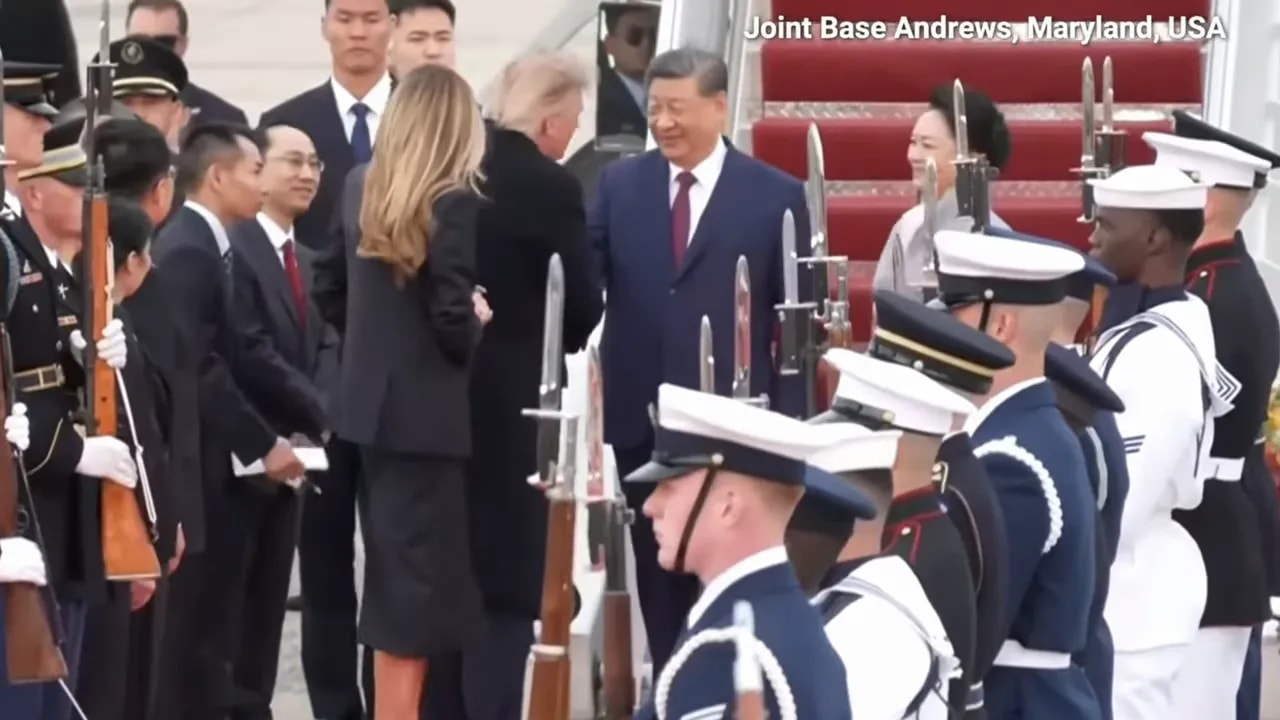
For all the talk of a US-China "truce", the relationship currently resembles two men politely shaking hands while each quietly checks whether the other has brought a knife.
Beijing and Washington are still speaking. They are still trading. They are even preparing for what could be a politically significant Xi Jinping visit to Washington in September. But beneath the diplomatic wallpaper, the friction is becoming harder to conceal.
The latest developments reveal a familiar but increasingly precarious pattern. Washington is pressing China over rare earths, forced-labour concerns, advanced technology, and the global spread of Chinese artificial intelligence. Beijing is protesting American restrictions, purchasing strategic quantities of US soybeans, and attempting to keep export markets open as domestic demand remains dismal.
In short: China needs the global economy, the global economy needs China, and neither side is particularly happy about it.
Table of Contents
- A managed confrontation, not a genuine truce
- The Chinese economy is still leaning on exports
- Beijing quietly admits its price wars are becoming an international problem
- China’s AI push is becoming a geopolitical problem of its own
- China’s problems are becoming increasingly connected
- FAQ
A managed confrontation, not a genuine truce
A 30 July call involving Chinese Vice Premier He Lifeng, US Treasury Secretary Scott Bessent, and US Trade Representative Jamieson Greer underlined just how strained the supposed understanding between Donald Trump and Xi Jinping has become.
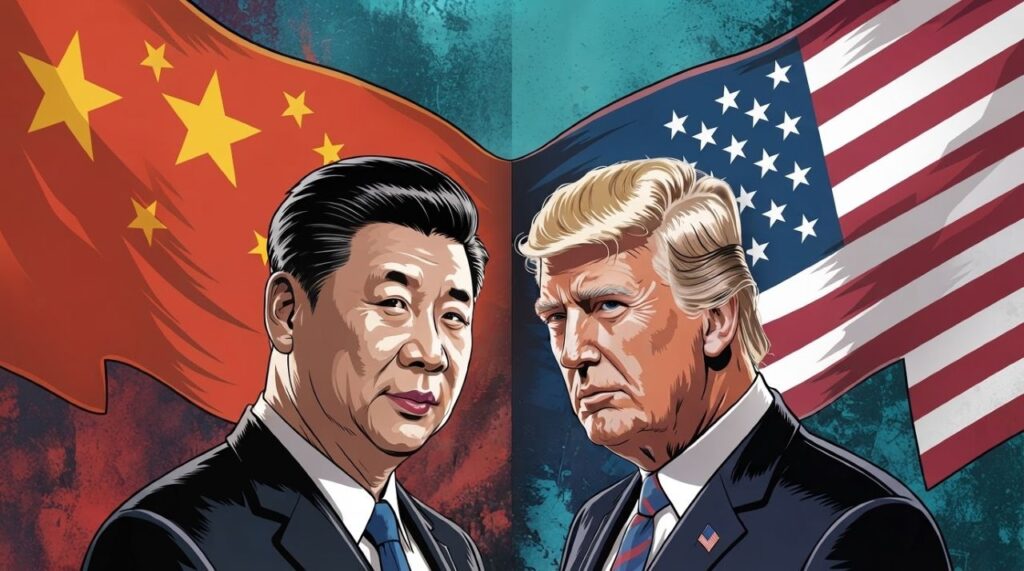
Washington’s complaint is straightforward enough. It believes Beijing has not fully delivered on commitments concerning rare-earth exports. China, meanwhile, argues that continuing American trade and technology restrictions violate the spirit of the leaders’ agreement. Both are, in their own way, trying to have it both ways: preserve the benefits of stability while retaining the pressure points that make stability so difficult.
The official language after the call was predictably soothing. Both governments described it as “candid, in-depth and constructive", which in diplomatic terms generally means that everyone was annoyed but nobody threw a chair. They agreed to improve communication, manage concerns, and stabilise economic ties.
Then, almost immediately, Washington added another 43 Chinese entities to its Uyghur Forced Labour Prevention Act list. The move restricts those companies’ access to the US market and was condemned by China’s Ministry of Commerce as economic coercion. Beijing rejects allegations of forced labour and wider human-rights abuses in Xinjiang and promised unspecified action to defend the affected firms.
For now, however, the Chinese response has been mostly rhetorical. That restraint matters. Beijing clearly does not want to blow up the possibility of Xi’s September visit, particularly at a time when China’s economy is struggling to generate durable momentum at home.
There were also signals of attempted de-escalation. Chinese state-owned trading companies reportedly bought between 14 and 16 cargoes of American soybeans, roughly one million metric tonnes, for October delivery. It is a conspicuously large order and an obvious political gesture. Soybeans are not merely soybeans in the US-China relationship; they are an agricultural peace offering with a shipping schedule.
The purchase gives Trump something useful to point to in farm-country America while offering Beijing a relatively inexpensive way to demonstrate goodwill. A Chinese business delegation also met with the US-China Business Council in Washington, another reminder that commercial interest in cooperation remains far stronger than the political atmosphere might suggest.
US Secretary of State Marco Rubio has described China as a strategic competitor seeking greater global power, but he also acknowledged a basic reality: direct communication between the world’s two largest economies and military powers is indispensable. An economic or military confrontation would be catastrophic not just for both countries, but for everyone caught in the blast radius.
This is controlled confrontation. Washington applies pressure through sanctions, entity lists, and export controls. Beijing retains leverage through rare earths and access to its enormous industrial base. Yet both governments have plenty of reason to keep the temperature below boiling point.
The Chinese economy is still leaning on exports.
That need for stability becomes even clearer when looking at China’s economic data. The country’s export-orientated manufacturing sector continued to expand in July, but at a noticeably weaker pace than expected.
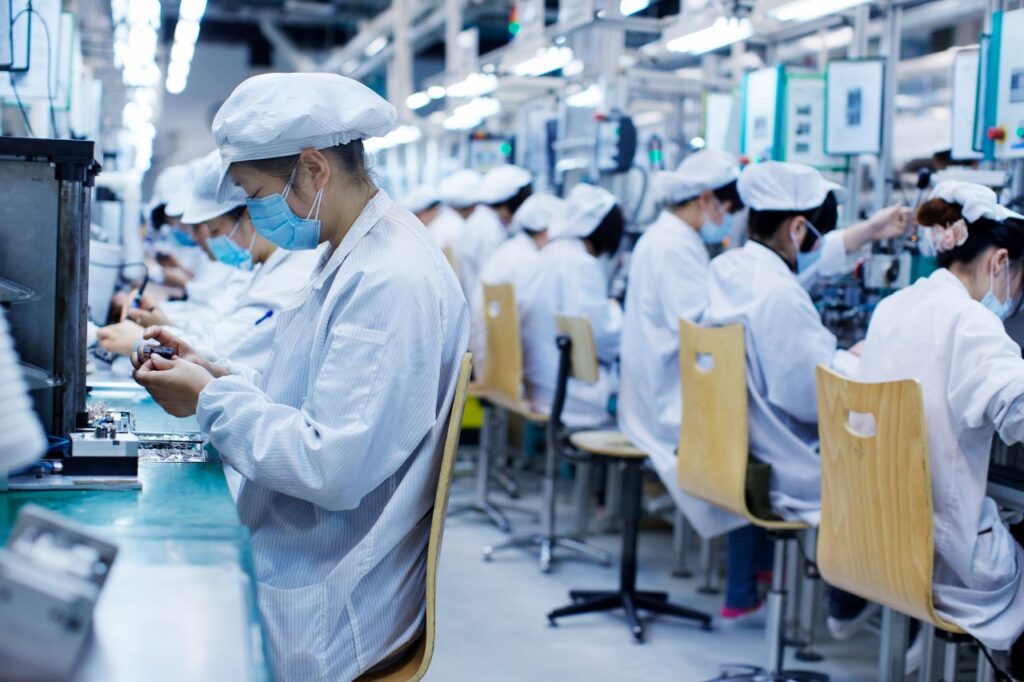
The RatingDog China Manufacturing Purchasing Managers’ Index fell from 51.7 in June to 50.9 in July, missing the median forecast of 52. A reading above 50 still indicates expansion, so manufacturing did grow for an eighth consecutive month. But calling this good news would be a bit like celebrating that the lifeboat has not yet sunk.
Purchasing activity declined and input inventories accumulated, both signs that firms may be becoming more cautious about future demand. The private survey is particularly relevant because it places greater weight on smaller and export-orientated companies—the very firms most exposed to shifts in overseas demand, tariffs, and supply-chain restrictions.
The official data was worse. China’s official manufacturing gauge contracted for the first time in five months, while construction activity fell to its lowest point since the beginning of the pandemic. Extreme heat, flooding, and heavy rainfall disrupted activity across key regions, certainly. But blaming the weakness entirely on the weather would be generous to the point of fantasy.
Domestic demand fell sharply. Local government finances remain under pressure. The property sector continues to struggle. And the political leadership has yet to offer the kind of large-scale, consumption-focused stimulus that might meaningfully change the picture.
China’s year-on-year economic growth slowed to 4.3% in the second quarter, the weakest quarterly result in more than three years. First-half growth of 4.7% remained within Beijing’s annual target range of 4.5% to 5%, but the direction of travel is not especially comforting. Even if Beijing can technically hit its target, the quality and balance of that growth remain deeply questionable.
The divergence between the official and private manufacturing surveys is especially revealing. Export-dependent factories, particularly in eastern China, appear to be performing better than businesses more exposed to China’s domestic economy. This is the underlying problem Beijing has spent years attempting to solve without really solving: the country still finds it far easier to produce goods for foreign markets than to build a consumer economy capable of absorbing what it produces.
Trade tensions make this dependency more dangerous. The United States is tightening technology restrictions; other governments are reassessing their exposure to Chinese imports; and the European Union and others have become more willing to investigate subsidies, dumping, and market distortions.
Beijing has promised “pragmatic and effective” policies when needed. But the most recent Politburo meeting produced no major new stimulus. Markets are still waiting for serious support for household consumption, private investment, and the battered property sector. China has, once again, identified the problem. The more difficult question is whether it is willing to absorb the political and financial cost of fixing it.
For further context on China’s weak consumer demand, services slowdown, and the contradictions in its export-led model, see this analysis of why Beijing has acknowledged that export-led growth is unsustainable.
Beijing quietly admits its price wars are becoming an international problem.
Then there is the issue Chinese officials call “involution”—a rather elegant word for a rather ugly phenomenon. The rest of the world usually calls it overcapacity, destructive price competition, or dumping.

China’s State Administration for Market Regulation has launched a one-year campaign to strengthen overseas antitrust compliance among Chinese companies. The policy will focus on outbound investment, cross-border mergers and acquisitions, and exports. It includes revised guidance on major foreign competition regimes, case studies, and risk assessments that companies should incorporate into investment and contracting decisions.
On its face, this is a technical compliance initiative. In practice, it is an acknowledgement that business practices tolerated or even encouraged within China can create serious trouble abroad.
The regulator explicitly warned against the “externalisation of involution”: the export of China’s extreme domestic price competition and excess industrial capacity into foreign markets. That is significant because it comes shortly after Beijing had firmly rejected the argument that overcapacity was a problem in the first place. Apparently, there is no overcapacity—except perhaps when it becomes so obvious that foreign regulators start reaching for anti-dumping duties.
Chinese companies operating in brutally competitive sectors are reportedly finding increasingly creative ways to cut costs without openly cutting prices. These methods include:
- Extending payment terms to shift financial pressure onto suppliers.
- Squeezing supplier margins and demanding rebates.
- Tightening control over distribution channels.
- Quietly reducing product quality or downgrading specifications.
None of this is particularly mysterious. When companies face too much capacity, weak demand, and pressure to preserve market share, something has to give. Often it is the supplier. Sometimes it is product quality. Increasingly, it may be foreign competitors and foreign industries.
Beijing’s concern is not merely that this behaviour damages margins at home. It is that Chinese companies may carry these practices overseas, triggering antitrust investigations, trade restrictions, and dumping cases precisely when China needs access to foreign markets more than ever.
The contradiction is hard to miss. China’s growth model still depends heavily on exports, but the scale of its industrial system means that those exports can generate political backlash almost everywhere they land. This is why the argument over “overcapacity” is no longer a semantic dispute. It is becoming a central fault line in China’s economic relationship with the rest of the world.
China’s AI push is becoming a geopolitical problem of its own.
China’s artificial-intelligence companies are also moving quickly, and their strategy is increasingly clear: if they cannot always lead on raw frontier capability, they can compete on price, accessibility, and global deployment.
DeepSeek’s new V4 Flash model was reportedly the cheapest prominent model to operate in benchmark testing. One research estimate put its operating cost at more than 100 times lower than Anthropic’s Claude Opus 5. Such comparisons should always be treated carefully, as benchmark methods and workloads can vary enormously, but the broader point stands: Chinese AI developers are trying to make capable systems radically cheaper to use.
Alibaba has also unveiled Qwen 3.8 Max, a 2.4-trillion-parameter model that it says matches or surpasses Anthropic’s Claude Opus 5 on some benchmarks. Bloomberg reported that the model outperformed Moonshot AI’s newly released Kimi K3 in several tests. Alibaba’s launch materials presented Qwen not simply as a chatbot but as an industrial tool, capable of supporting engineering, semiconductor design, and scientific research.
This is important because the AI contest is no longer only about who produces the cleverest conversational model. It is increasingly about which countries build systems cheap enough, open enough, and practical enough to become embedded across businesses, governments, and developing economies.

There is, however, a substantial caveat. China’s AI advances continue to depend heavily on American hardware. Moonshot reportedly has an arrangement to access approximately 20,000 Nvidia Hopper chips through Alibaba, representing a significant portion of the computing capacity used to develop its Kimi models. A person familiar with the company’s procurement strategy also said it had a channel for accessing newer Nvidia Blackwell processors through Southeast Asia.
Whether such chips are being legally rented, purchased through intermediaries, or obtained in breach of US export controls remains unclear. What is clear is that Washington’s restrictions have not eliminated Chinese access to advanced computing; they have made that access more opaque, more expensive, and more geopolitically contentious.
The dispute over AI “distillation” is similarly escalating. Distillation is a technique through which a smaller model learns from the outputs of a more capable one. US officials and technology companies have accused some Chinese developers of conducting this process at an industrial scale without authorisation, effectively turning it into a mechanism for extracting the value of American frontier models.
Chinese officials reject that framing. Li Yan, of the China Institutes of Contemporary International Relations, argued in the Communist Party journal Qiushi that distillation is an established industry technique and that Washington is transforming it into a politically charged allegation of intellectual-property theft. The article called for opposition to “AI hegemony” and for cooperative global governance.
That argument will not reassure Washington. The White House has yet to issue comprehensive guidance on the use of Chinese open-weight or open-source models, even as their adoption grows among American companies. Congressional committees have sought information from DoorDash over its assessment and deployment of Chinese AI, while Cursor and Airbnb have reportedly received similar enquiries.
The policy dilemma is becoming painfully obvious. Banning Chinese models entirely may be difficult, commercially costly, and technically impractical. Ignoring them may allow cheaper Chinese systems to become entrenched in international digital infrastructure. And waiting until that happens before developing a coherent policy would be very on-brand for Washington, but not especially wise.
China’s advantage may not be that it develops the best model in every category. Its advantage may be that it can make good-enough models cheap, widely available, and strategically sticky. If that happens, the AI race becomes less about a leaderboard and more about who owns the world’s default digital plumbing.
That broader issue is explored further in this report on AI model-theft allegations and the changing US-China technology relationship.
China’s problems are becoming increasingly connected
These developments are not separate stories. They are all versions of the same story.
China needs exports because domestic demand remains weak. But reliance on exports intensifies accusations of overcapacity and dumping. Beijing needs foreign technology and access to advanced chips to compete in AI, yet its strategic rivalry with Washington makes those supplies less secure. It wants a stable economic relationship with the United States, but it also wants to preserve the industrial policies, technology ambitions, and geopolitical leverage that make that stability difficult.
Meanwhile, Washington wants to contain China’s strategic rise without triggering a rupture that would damage American firms, farmers, consumers, and allies. This is not an easy balancing act. It is, in fact, a gigantic structural contradiction with tariff schedules attached.
The most likely near-term outcome remains neither reconciliation nor total decoupling. It is a tense, transactional relationship: soybean purchases here, entity-list additions there, diplomatic calls, export controls, business delegations, sanctions, and the occasional burst of reassuring language.
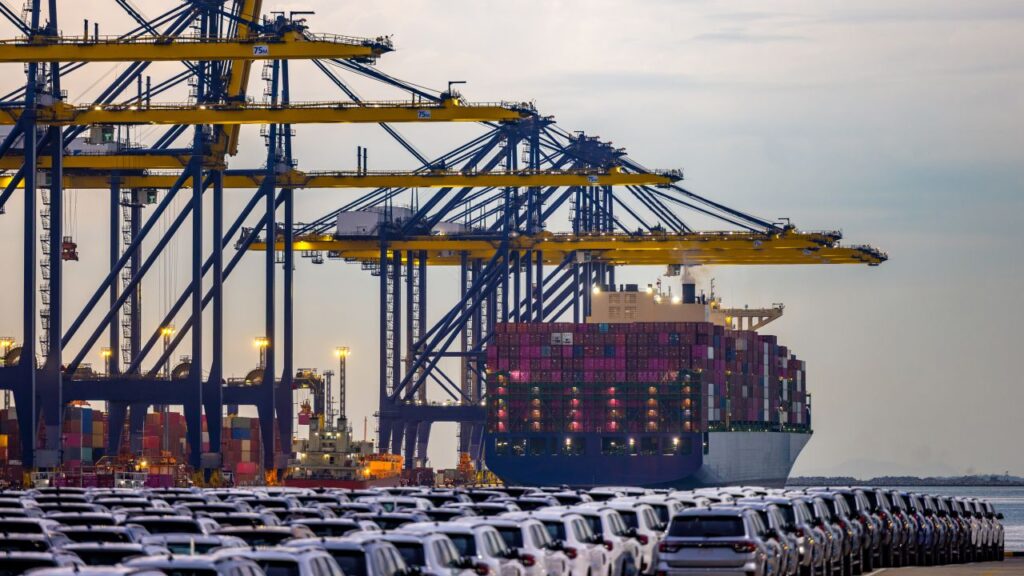
But managed confrontation only works for as long as both sides remain convinced that confrontation can be managed. With China’s domestic economy softening, its companies pushing ever harder into foreign markets, and AI becoming another arena of strategic competition, the margin for error is getting narrower.
FAQ
Why are US-China relations still tense despite an economic truce?
The two governments remain divided over rare-earth exports, US trade restrictions, human-rights sanctions, technology controls, and China’s industrial policies. The truce appears designed to prevent escalation rather than resolve these underlying disputes.
What does China’s manufacturing data suggest?
Manufacturing is still expanding in parts of the economy, especially among export-oriented businesses, but momentum has weakened. Official data also points to contraction, while soft domestic demand, local government strain, and property-sector weakness remain major drags.
What does “externalisation of involution” mean?
It refers to Chinese firms exporting the consequences of intense domestic competition—such as aggressive price cutting, excess capacity, supplier pressure, and potentially lower-quality products—into overseas markets.
Why is cheap Chinese AI a concern for Washington?
Even if US firms maintain an advantage in frontier-model performance, Chinese companies could gain influence by offering capable models at far lower cost and with easier access. That could encourage global adoption of Chinese AI systems across commercial and public digital infrastructure.