Photo by Lilian Do Khac on Unsplash
Four developments illustrate the increasingly difficult balance facing China and its neighbours: security vulnerabilities embedded in global supply chains, a sharper strategic divide between Beijing and Tokyo, China’s vast push into advanced manufacturing, and a Hong Kong recovery being reshaped around mainland capital and integration.
These are not isolated stories. They reflect the same larger trend. Economic interdependence is no longer automatically treated as a source of stability. It is increasingly viewed through the lens of security, resilience, technological competition and political leverage.
Table of Contents
- Chinese Components Raise Questions for Western Military Supply Chains
- Japan’s China Policy Moves From Engagement to Economic Security
- China Dominates Humanoid Robot Shipments
- The CR450 and the Cost of Advanced Manufacturing
- Hong Kong’s Recovery Is Real, but It Is Different
- The Northern Metropolis and Hong Kong’s Mainland Turn
- What These Developments Have in Common
Chinese Components Raise Questions for Western Military Supply Chains
A camera installed on a British naval drone reportedly transmitted data to an internet address in China, exposing the challenge Western defence industries face when trying to remove Chinese-made components from sensitive systems.

Britain’s Ministry of Defence said the signal originated from a component inside the camera fitted to a K-3 Scout unmanned naval vessel, manufactured by Kraken Technology. The issue was identified during a routine cyber-vulnerability assessment. Officials said their investigation found no evidence that Ministry of Defence data or systems had been accessed, compromised or sent externally.
Kraken Technology said the potential vulnerability had been identified and closed. Yet the episode matters well beyond one drone or one camera. The company recently secured a US$49 million contract to provide drones to US Special Operations Command, underlining the extent to which unmanned systems are becoming central to Western defence planning.
The underlying problem is supply-chain visibility. A finished drone may be assembled in Britain, Germany or the United States, but its smaller parts can come through several layers of suppliers. Tracking the origin and software behaviour of every electrical component is extremely difficult.
China holds a major position in the production of essential drone parts, including:
- Brushless motors
- Cameras and sensors
- Antennas
- Batteries
- Other low-cost electronic components
Chinese manufacturers can often offer these products at prices that Western competitors struggle to match. The chief executive of German land-drone maker AXE Robotics has noted that a German electric motor can cost between five and ten times more than a Chinese equivalent.
AXE has shifted much of its supply chain to Europe and the United States, accepting higher costs in exchange for reliability and greater strategic independence. That is likely to become a broader defence industry calculation: lower upfront costs may create much greater risks if the components are difficult to inspect, replace or source during a crisis.
The concern has intensified because unmanned naval vessels are now playing a much more significant role in warfare. Ukraine has used drone boats against Russian ships, while the United States has deployed unmanned systems in combat and rescue operations. At the same time, Beijing has shown it is prepared to restrict exports of strategically important products, from drone components to critical minerals.
Western governments therefore face two linked risks. First, imported components may create cybersecurity vulnerabilities. Second, reliance on Chinese suppliers can expose military production to sudden export controls. The first is a technical problem. The second is a geopolitical one. Both are becoming harder to ignore.
Japan’s China Policy Moves From Engagement to Economic Security
For decades, Japan’s relationship with the People’s Republic of China was defined by what became known as hot economics and cold politics. Diplomatic disputes, historical grievances and security concerns continued, but trade, investment and industrial cooperation expanded.

That formula is breaking down. The relationship increasingly looks more like cooling economics and colder politics.
Japan began trading with China through an unofficial mechanism as early as 1962, a decade before diplomatic normalisation in 1972. After relations were formally established, Tokyo became an important source of industrial assistance during China’s reform and opening period in the 1970s and 1980s.
Even after the 1989 Tiananmen Square crackdown, Japan resisted efforts to isolate Beijing completely. The prevailing belief was that engagement would support reform, openness and China’s integration into the international system.
That assumption has weakened substantially. The latest deterioration followed Japanese Prime Minister Sanae Takaichi’s remarks in late 2025 suggesting that Japan could deploy its Self-Defence Forces in a Taiwan contingency. Beijing responded with sustained economic pressure, including tighter controls around critical minerals and restrictions targeting Japanese defence and dual-use technology companies.
These measures are particularly significant because China controls nearly 90% of global rare-earth refining capacity. Japanese companies have already reported supply disruptions. The arrests of Japanese employees accused of illegally exporting rare-earth magnets have added to concerns among businesses operating in China.
Tokyo is now preparing for a future in which economic dependence on China is treated as a strategic weakness rather than an unavoidable fact of geography. Takaichi’s updated Free and Open Indo-Pacific strategy places greater emphasis on economic security, resilient supply chains and cooperation with like-minded countries.
There is also a generational dimension. Older Japanese political figures often saw engagement with China partly through the prism of Japan’s wartime history and Beijing’s decision to renounce reparations. Many of these influential Chinese hands are leaving politics. They are being replaced by younger conservatives who believe Japan’s historical responsibility has largely been addressed and who favour stronger ties with Taiwan.
Takaichi and her predecessor, Shigeru Ishiba, both visited Taiwan before becoming prime minister. Such visits reflect a political environment in which Japan is less willing to compartmentalise Taiwan, economic security and its China policy.
Japan was once among Beijing’s strongest advocates for international integration. Today, economic coercion, rare-earth dependence, regional security tensions and worsening political relations are pushing Tokyo towards a more distinct and more confrontational era. For further context on the broader Japan-China deterioration and its economic implications, see this analysis of Japan-China tensions and strategic change.
China Dominates Humanoid Robot Shipments
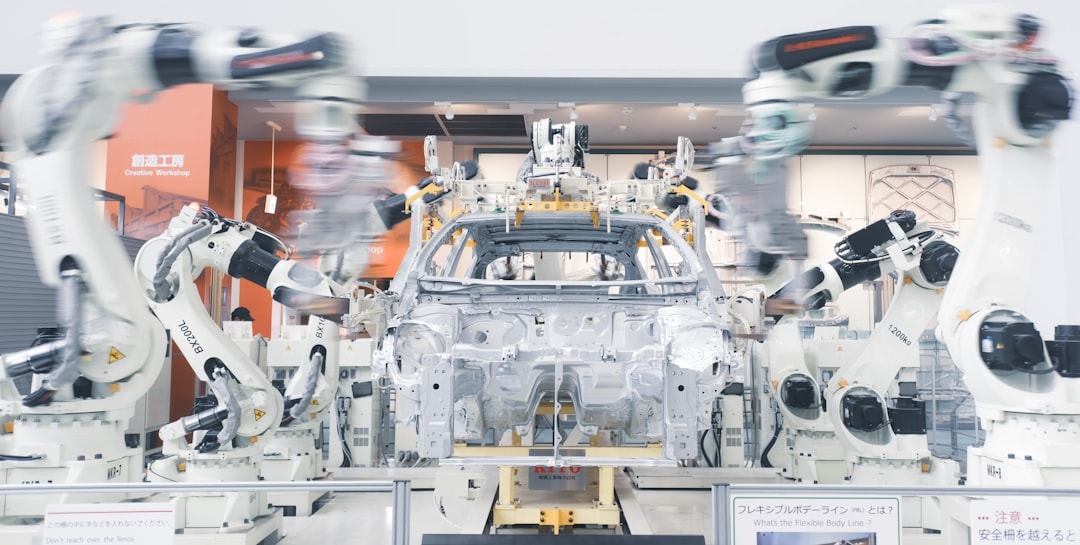
China is strengthening its position in advanced manufacturing, particularly in humanoid robotics. New figures from Smart Analytics Global indicate that Chinese manufacturers accounted for more than 97% of global humanoid robot shipments in the first half of 2026.

Worldwide shipments reached approximately 19,100 units, more than triple the roughly 5,100 units recorded during the same period a year earlier. Shanghai-based AG Bot led the market after shipping 8,400 robots, representing about 44% of the global total. Hangzhou-based Unitree Robotics followed with 5,900 units.
Both companies shipped substantially more robots than major American developers, including Tesla, Figure AI and Agility Robotics.
The numbers matter because the industry appears to be moving, at least gradually, beyond research laboratories and high-profile demonstrations. Industrial and commercial applications accounted for more than 70% of first-half shipments, compared with roughly half a year earlier.
Smart Analytics Global expects worldwide humanoid robot shipments to reach around 60,000 units this year and 500,000 units by 2030. That forecast is ambitious, but the direction is clear: China is seeking to turn its manufacturing scale, component supply chains and state support into leadership in a new category of industrial technology.
Government funding and policies encouraging commercial adoption have helped. But the security debate surrounding Chinese technology is also widening. In July, the United States banned imports of new Chinese humanoid and quadruped robots, citing cybersecurity and national-security concerns.
This returns to the earlier drone story. As connected machines enter factories, warehouses, ports, logistics networks and public spaces, the question is not simply who can produce them fastest or cheapest. It is also who controls the hardware, software, data and maintenance ecosystem around them.
The CR450 and the Cost of Advanced Manufacturing
China’s ambition to commercialise advanced technology at scale is also evident in rail. Prototypes of the CR450 bullet train have completed a mandatory 600,000-kilometre operational assessment, moving the project closer to certification and commercial deployment.
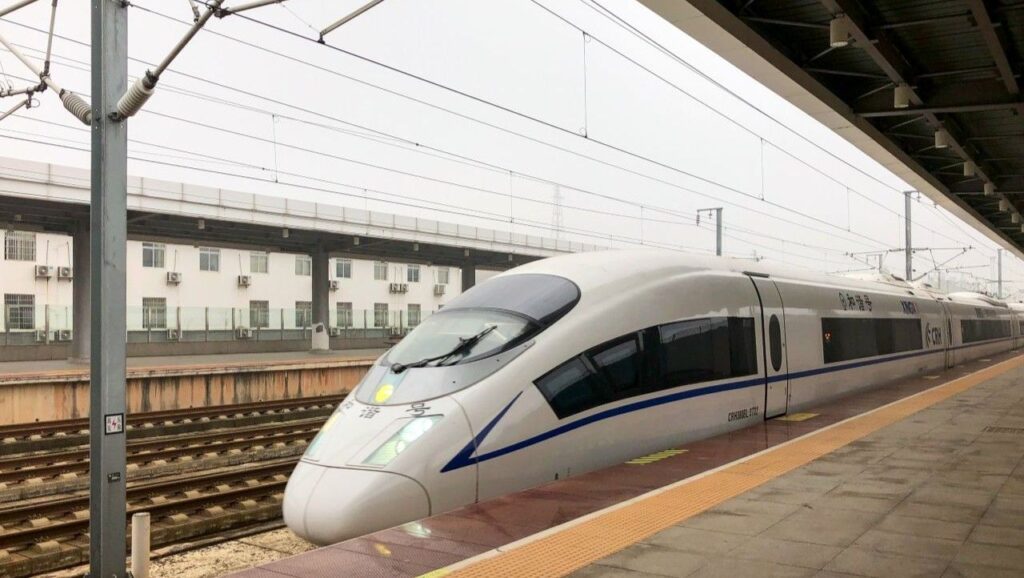
The CR450 is designed to operate at approximately 400 kilometres per hour, faster than China’s existing high-speed trains. The prototypes must now be dismantled and inspected for defects before manufacturer CRRC can seek approval for mass production.
Maximum-speed operations are expected after the Chengdu-Chongqing High-Speed Railway opens in 2026. The trains could eventually be deployed on routes including Beijing-Shanghai and Chongqing-Xiamen, although tunnels, station stops and other operating conditions will initially limit where the train can run at its full design speed.
If deployed widely, the CR450 could make rail more competitive with domestic aviation on major corridors. It would further demonstrate China’s capacity to build and deploy large infrastructure projects quickly.
But there is a major economic qualification. China’s advanced manufacturing drive is heavily dependent on enormous subsidies. This has contributed to debt accumulation and overcapacity, while household consumption remains weak. Manufacturing increasingly depends on foreign markets to absorb output.
Faster trains and expanding robot shipments are impressive achievements. Yet they cannot be separated from the financial model supporting them. The question is whether the gains from technological scale can outweigh the costs created by subsidies, debt and pressure to export surplus production.
China’s wider economic balancing act is also visible in infrastructure spending, consumer prices and the rapid push into AI-linked markets. This recent China News Update roundup examines those connected pressures across rail investment, drone regulation, food prices and Hong Kong’s AI listing boom.
Hong Kong’s Recovery Is Real, but It Is Different
Hong Kong is experiencing a renewed influx of international professionals, supported by stronger capital markets, low taxes and rapid expansion in artificial intelligence. It is a meaningful reversal after a difficult period in which strict pandemic controls and concern over Beijing’s influence prompted tens of thousands of residents to leave.
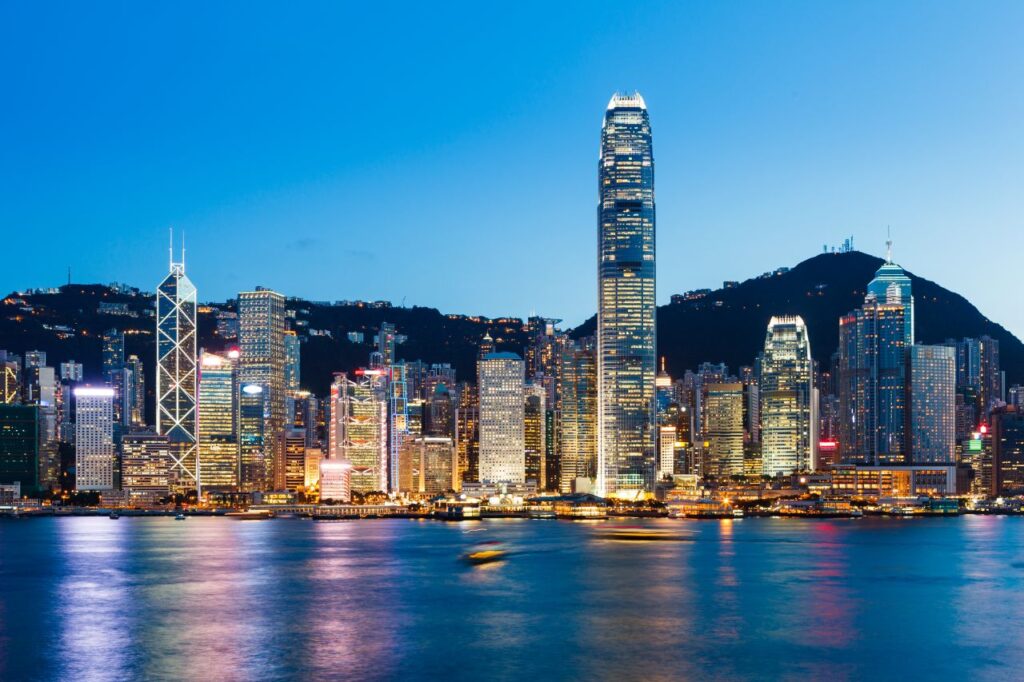
Bankers, lawyers and other skilled professionals were among those departing, weakening Hong Kong’s standing as an international business hub. That trend is now partially reversing.
Hong Kong approved 31,278 employment visas for foreign nationals last year, more than double the level recorded five years earlier. Foreign visa approvals in financial services rose 17% to their highest level since 2022.
The recovery is being supported by a stronger initial public offering market and proposed tax concessions for private-equity and hedge-fund managers. Hong Kong’s largest new listing in seven years recently raised US$6.8 billion, pushing total IPO proceeds towards a six-year high. Global banks are rebuilding senior headcount, while competition with Singapore for firms and talent is intensifying.
The recovery is visible outside financial markets as well:
- Occupancy at the Henderson office tower rose to 90%, after vacancy had previously reached 40%.
- Rents in Mid-Levels East rose 14% year on year in June.
- Rents on the Peak increased 13%.
- International school enrolment rose by about 10% over three years, while available places increased by less than 5%.
Yet this is not simply a return to the Hong Kong of the past. Almost three quarters of more than 410,000 approvals under the city’s talent schemes over the past three years went to mainland Chinese applicants. Foreign professionals without Mandarin or Cantonese increasingly need specialised expertise or senior corporate roles.
Hong Kong is also becoming an important offshore base for Chinese AI firms. Alibaba, Tencent and smaller companies are expanding data centre capacity to test models and access international markets beyond mainland China’s more restricted internet environment. Wholesale data-centre prices have risen by as much as 90% since the beginning of 2026, reaching up to US$180 per kilowatt. Chinese companies reportedly account for around 90% of recent leasing activity.
Hong Kong retains significant advantages: financial infrastructure, low taxation, global connectivity and more data freedom than the mainland. But the city’s revival is becoming increasingly dependent on Chinese capital, Chinese firms, Chinese talent and continued geopolitical stability.
The Northern Metropolis and Hong Kong’s Mainland Turn
The most consequential expression of Hong Kong’s new direction may be the Northern Metropolis. The project is intended to revive the economy, ease the housing shortage and integrate Hong Kong more deeply with mainland China.
It will transform 30,000 hectares of the New Territories, roughly one third of Hong Kong’s land area, into four hubs focused on technology, commerce, professional services and ecotourism. Much of this area currently consists of villages, fish farms, wetlands and industrial sites.
First announced in 2021, the development is expected eventually to accommodate 2.5 million people, including 1.1 million already living in the area. Authorities hope the additional housing will relieve affordability pressures and encourage people and businesses to move closer to Shenzhen.
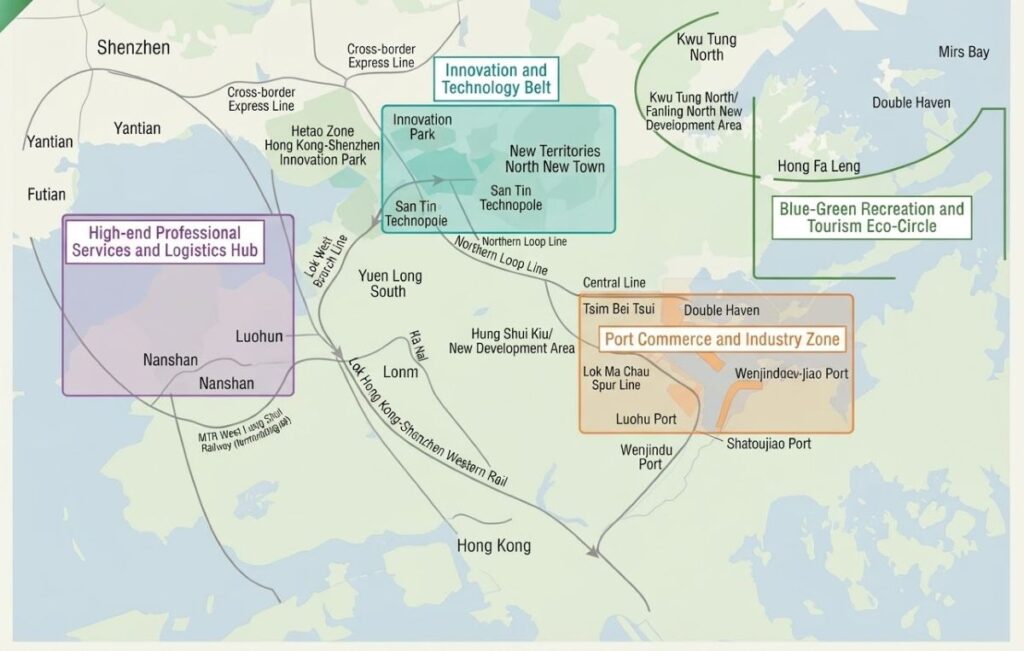
The project sits within Beijing’s Greater Bay Area strategy, which aims to integrate Hong Kong, Macau and nine Guangdong cities into an economic region capable of competing with other global technology centres. Supporters argue that closer connections with Shenzhen could help Hong Kong diversify beyond finance, property and trade.
However, the financial and social risks are substantial. S&P Global Ratings estimated that the project could cost more than HK$360 billion over the next six years, far above the government’s HK$224 billion projection. Its first land tender attracted only two bids, raising doubts about private-sector enthusiasm.
Hong Kong will also face fierce competition from Shenzhen and other mainland technology centres with lower costs. Previous attempts to create new innovation industries have produced mixed outcomes, while the HK$580 billion Lantau Tomorrow Vision reclamation project was shelved indefinitely in 2024.
For local communities, the consequences are immediate. Villages are being cleared, and long-term residents are leaving inexpensive homes. Some residents have called for greater compensation, though many acknowledge that their capacity to resist is limited.
The Northern Metropolis is therefore more than a housing and infrastructure plan. It represents a profound reorientation of Hong Kong. The city is moving away from its historic urban centre facing the ocean and the world and increasingly towards the mainland border and Shenzhen.
Hong Kong may gain new investment, housing, technology links and economic opportunities from that shift. But it will also become a different kind of city, one increasingly shaped by mainland China’s economic priorities and political direction.
What These Developments Have in Common
From naval drones and rare-earth magnets to humanoid robots, high-speed trains and the redevelopment of Hong Kong, the common issue is strategic dependence.
China’s manufacturing power delivers lower costs, rapid scaling and increasingly sophisticated products. Yet those same strengths generate concern among countries that fear supply disruptions, cyber vulnerabilities or political leverage. Japan is reducing dependence. The United States is restricting certain Chinese robotics imports. Western defence companies are searching for alternatives to Chinese components.
Meanwhile, Hong Kong is rebuilding momentum not by returning to its previous model, but by becoming more deeply intertwined with mainland Chinese capital, technology and people.
China’s influence is expanding through production capacity, infrastructure, technology and market scale. The challenge for Beijing, its trading partners and neighbouring economies is that these gains now come with growing security, financial and geopolitical costs.
Frequently Asked Questions
Why did the British naval drone camera send data to China?
A component inside the camera transmitted data to an internet address in China during a cyber-vulnerability assessment. Britain’s Ministry of Defence said it found no evidence that sensitive data or systems had been compromised, and the manufacturer said the vulnerability was closed.
Why is Japan trying to reduce its reliance on China?
Japan is increasingly concerned about economic coercion, rare-earth supply disruptions, Taiwan-related security risks and dependence on Chinese supply chains. Its policy is placing more emphasis on economic security and resilient supply chains.
How dominant is China in humanoid robotics?
Chinese manufacturers accounted for more than 97% of global humanoid robot shipments in the first half of 2026, according to Smart Analytics Global. AG Bot and Unitree Robotics were the leading suppliers.
What is the CR450 train?
The CR450 is China’s next-generation high-speed train, designed to operate at approximately 400 kilometres per hour. Its prototypes have completed a 600,000-kilometre operational assessment and are moving towards certification.
What is changing in Hong Kong’s economy?
Hong Kong is seeing stronger IPO activity, rising demand for financial professionals and rapid growth in AI-related data centre leasing. However, its recovery is increasingly based on mainland Chinese capital, companies and talent rather than the internationalised model that previously defined the city.