Four developments underline the pressure points shaping China’s trajectory right now: a fragile effort to stabilise US-China relations, a potentially significant advance in Chinese artificial intelligence, an export boom masking acute pain in the domestic auto market, and a steadily more restrictive environment for foreign reporting.
None of these stories stands fully alone. Technology competition is now central to the relationship between Beijing and Washington. China’s export dependence is becoming more pronounced as demand weakens at home. And reporting clearly on China’s economy, demographics, trade frictions and strategic ambitions is becoming harder precisely as those issues matter more to the rest of the world.
Table of Contents
- Xi Jinping’s US Visit Remains on Track
- Moonshot’s Kimi K3 Signals a Faster Chinese AI Catch-Up
- China’s Car Exports Break Records as the Home Market Deteriorates
- Foreign Reporting in China Enters a “New Abnormal”
- What to Watch Next
- Frequently Asked Questions
Xi Jinping’s US Visit Remains on Track
General Secretary Xi Jinping’s planned September visit to the United States appears to remain on schedule, despite President Donald Trump’s recent allegation that Beijing interfered in the 2020 US election.
Secretary of State Marco Rubio said that Chinese teams were continuing to prepare for the trip and that he had heard nothing indicating a change of plans. Rubio was speaking ahead of an ASEAN foreign ministers' meeting in Manila, where a meeting with Chinese Foreign Minister Wang Yi was also possible.
The visit is intended to stabilise an exceptionally difficult bilateral relationship and preserve the trade truce reached last year. That objective matters because the relationship is already developing fresh points of friction, including disputes involving journalist visas and artificial intelligence.
Trump’s allegation concerned the purported theft of 220 million American voter files. The claim has been challenged by some commentators, though the underlying issue remains politically charged. Asked whether China would face consequences, Trump said Washington would speak with Beijing and see what followed.
This is the reality of major-power diplomacy. Even where the rhetoric is hostile and accusations are serious, neither side has much choice but to maintain channels of communication. As Rubio put it, there will always be irritants. The question is whether the two governments can prevent those irritants from overwhelming the broader relationship.
The timing of the planned visit is especially notable. US-China tensions now span trade, advanced technology, national security, Taiwan, the South China Sea, supply chains and influence across the developing world. A successful meeting would not resolve those structural issues, but it could reduce the risk of a sharper deterioration.
Moonshot’s Kimi K3 Signals a Faster Chinese AI Catch-Up
China’s artificial intelligence industry has received a substantial boost with the release of Moonshot AI’s Kimi K3, an open-weight model in the three-trillion-parameter class. Moonshot describes it as the first open-weight model of this scale, built for advanced coding, reasoning and long-duration knowledge work.
The release came shortly before Shanghai’s World Artificial Intelligence Conference, ensuring that it attracted maximum attention. More importantly, early assessments suggest that the distance between leading Chinese models and the American AI frontier may be shrinking faster than many had anticipated.
Kimi K3 reportedly achieved a score of 57 on the Artificial Analysis Intelligence Index, placing it alongside OpenAI’s GPT 5.5 and Anthropic’s Claude Opus 4.8. It remains behind the highest-end proprietary models, particularly in overall user experience, but the performance gap appears to have narrowed considerably.
Chinese open models were once generally viewed as six to nine months behind the leading American systems. Berkeley professor Ian Stoica, who also co-founded the AI ranking platform Arena, has suggested the gap may now be closer to two or three months.
Why an open-weight model matters
Raw benchmark results are only part of the story. K3’s open-weight structure could prove strategically important because it gives developers greater ability to host, adapt and customise the model independently.
That flexibility may matter for organisations looking to control long-term costs, protect sensitive data or tailor AI systems to specialised workflows. K3 is not necessarily a cheap model at the point of use. Estimates suggest it is Moonshot’s most expensive offering and priced roughly in line with some mid-tier Anthropic products. But independent hosting and customisation can change the economics over time.
The competitive implications are clear. Businesses are increasingly using routing services that assign different AI tasks to the cheapest model capable of doing the job well. A powerful Chinese option could compete for coding, agentic tasks and other workloads that might otherwise have gone to more expensive American systems.
This dynamic has already rattled markets. K3 contributed to a technology sell-off reminiscent of the reaction to DeepSeek, as investors again questioned whether the enormous capital expenditure of US AI companies will produce adequate returns if Chinese laboratories can release highly competitive alternatives.
Chinese models are influencing US research too
The influence is not only commercial. Thinking Machines Lab, founded by former OpenAI executive Mira Murati, disclosed that its Inkling model drew architectural inspiration from DeepSeek V3 and used synthetic data generated by Moonshot’s earlier Kimi K2.5 during initial post-training.
That is a meaningful development. The global AI ecosystem is not neatly divided into isolated national blocs. Ideas, techniques, architectures and model outputs can spread quickly, even as governments attempt to control access to advanced chips and other critical inputs.
K3 also presents Washington with a policy dilemma. US firms such as OpenAI and Anthropic have reportedly delayed launches while undergoing government safety reviews. Safety review is clearly important, but if scrutiny substantially slows American releases while Chinese firms continue advancing quickly, efforts designed to preserve a technological lead could create additional room for competitors to close the gap.
The United States likely remains ahead at the absolute frontier. Still, Kimi K3 is another warning against complacency. China’s open-model ecosystem is becoming a fundamental force in global AI, even as Beijing faces wider constraints in the advanced technology supply chain. For a broader look at the uneven nature of China’s technological rise, see this analysis of China’s real strengths and constraints in technology.
China’s Car Exports Break Records as the Home Market Deteriorates
China exported 1.06 million vehicles in June, a record monthly figure and a 71.2 percent increase from a year earlier. The scale of that increase puts the country on track to export more than 10 million vehicles in 2026, up from 7.1 million last year and more than twice the 4.9 million exported in 2023.
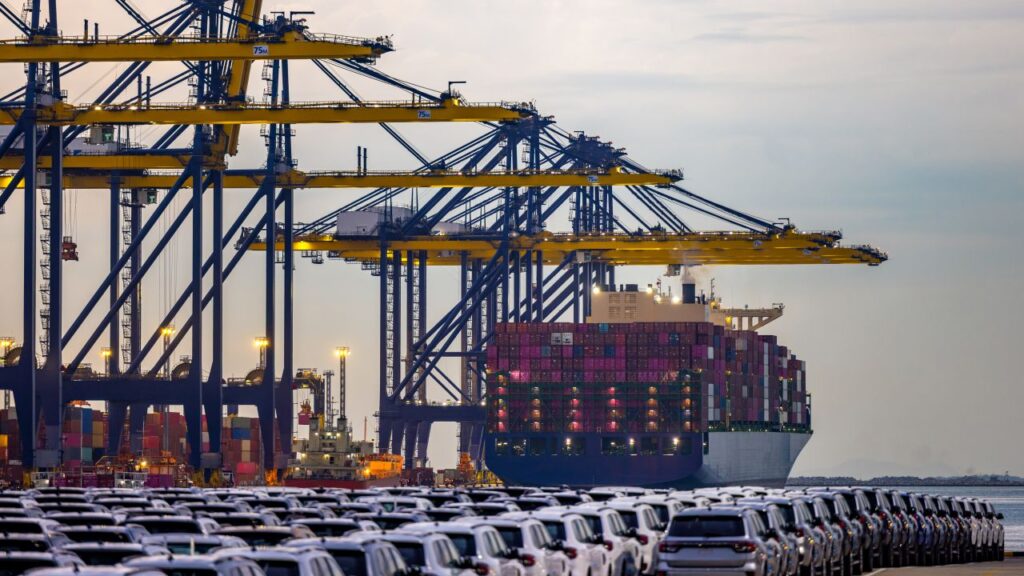
Global demand for electric vehicles is a central driver. Chinese officials have characterised the shift toward lower-carbon transport as a major source of demand for China’s so-called green products. Yet the export story is also a story about domestic distress.
China’s auto industry is facing relentless price competition, diminished margins, weakening consumer demand and the phase-out of electric-vehicle subsidies. Data cited from Yitai showed new-car retail sales falling more than 20 percent in the first five months of the year, reaching 8.15 million vehicles.
per centUsed-car sales, meanwhile, rose 2.3 percent to 8.1 million. For the first time, second-hand purchases were nearly level with new-car sales. That is a striking marker of pressure in the world’s largest vehicle market.
Foreign markets offer better margins
For Chinese automakers, export markets are not simply a growth opportunity. They are increasingly a route out of an extraordinarily crowded and unprofitable home market.
Overseas prices can be dramatically higher. BYD recently launched its Denza Z electric sports car in Europe before introducing it in China. The model sells for roughly US$100,000 in China, while UK pricing ranges from about US$191,000 to US$231,000.
That gap reflects shipping costs, certification requirements, import tariffs and significantly less intense competition abroad. Other Chinese-made electric vehicles are also commanding prices two to three times higher overseas than at home.
The point is important: some manufacturers now find foreign markets so valuable that they are releasing China-made vehicles abroad before launching them domestically. It speaks to both the scale of China’s industrial capability and the depth of the industry’s domestic overcapacity problem.
Record exports should therefore not be mistaken for broad financial health. Huawei-backed automaker Seres recently warned that it expected a first-half net loss of up to 2.5 billion yuan, illustrating the immense costs of developing new EVs while competing in a prolonged price war.
Governments in Europe and North America are responding with greater scrutiny, tariff discussions and other trade barriers, concerned about the effect of China’s expanding automotive production on domestic manufacturers. This external pushback is likely to become more significant as Chinese firms rely more heavily on foreign buyers. Related pressures in China’s auto sector are also explored in this report on the structural slowdown in China’s EV market.
Foreign Reporting in China Enters a “New Abnormal”
Foreign correspondents in China report that surveillance, intimidation and official obstruction have become routine. More concerning still, subjects that were once relatively ordinary, including economic performance and demographics, are increasingly treated as politically sensitive.
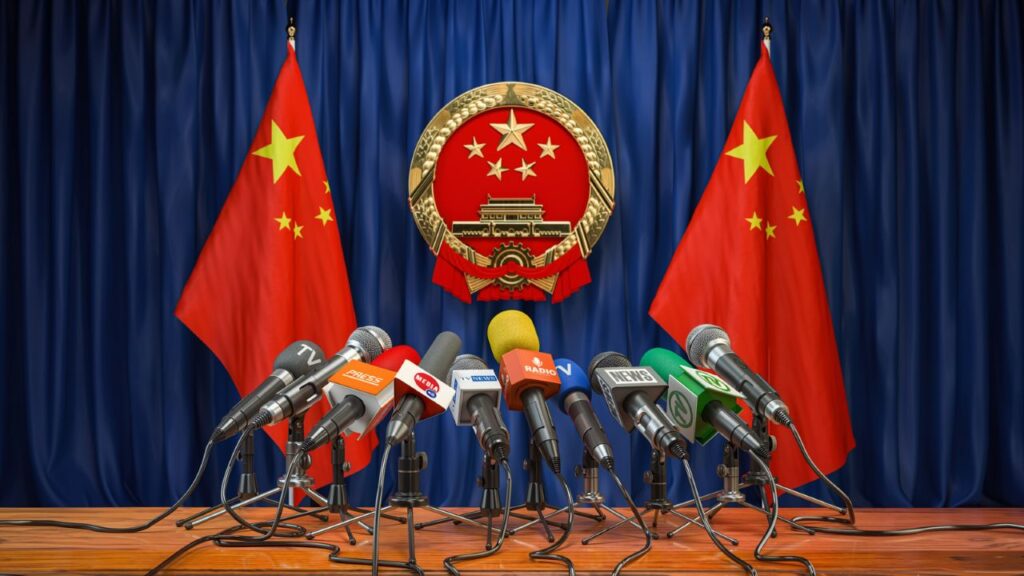
The Foreign Correspondents’ Club of China’s 2025 Media Freedoms Report found that 94 per cent of surveyed journalists believed reporting conditions usually or almost always failed to meet international standards. The group described the situation as a “new abnormal".
Nearly two-thirds of respondents said police or other officials had obstructed their work. Seventy-seven percent said potential sources refused interviews because they lacked permission to speak with foreign media.
including the following: China’s long-established red lines remain difficult terrain. Xinjiang, Tibet, Taiwan and elite politics continue to carry obvious risks. But nearly half of surveyed journalists said further topics became more sensitive during 2025, including the following:
- China’s slowing economy
- Demographic decline
- International trade tensions
- Emerging technologies
This expansion of sensitive subjects is highly consequential. Economic reporting becomes particularly difficult when policymakers are trying to maintain confidence amid weak domestic demand, property-sector stress, local fiscal strain and growing debt pressures.
The problem does not stop with foreign reporters. Four in ten respondents said their Chinese employees had faced harassment or intimidation. Almost one-third reported that sources were questioned or otherwise faced consequences after participating in interviews. Correspondents also cited digital surveillance, legal threats, visa delays and restricted access to reporting locations.
Beijing has often called for foreign coverage that presents China in a more sympathetic light, with some officials, academics and state media figures invoking Edgar Snow, the American journalist known for introducing the early Chinese Communist movement to international audiences in favourable terms.
But there is a basic contradiction here. China says it wants international journalists capable of explaining the country to the world, while making independent reporting and access to Chinese sources increasingly difficult. That tension is likely to grow as the country confronts more challenging economic conditions and a more contested external environment.
Reliable information matters because China’s domestic developments increasingly carry global consequences, from electric vehicle supply chains and AI competition to commodity demand, trade policy and regional security. The latest signs of weak demand, lending pressure and Taiwan uncertainty are examined in this report on China’s weak April data and electricity-driven AI strategy.
What to Watch Next
The planned Xi visit will test whether Washington and Beijing can keep their relationship on a managed track despite growing suspicion. Kimi K3 will test whether China’s open models can convert benchmark progress into sustained commercial adoption. Auto export data will reveal whether foreign markets can continue absorbing Chinese production in the face of widening trade barriers.
And the media-freedom picture will remain a key indicator of how much visibility the outside world has into the forces reshaping China. As access narrows, it becomes harder to assess the economy, policy direction and social conditions with the level of confidence these questions demand.
Frequently Asked Questions
Is Xi Jinping’s planned US visit still expected to happen?
Yes. Secretary of State Marco Rubio said preparations were continuing and that he had heard nothing indicating the planned September visit had been cancelled, despite renewed tension over election-interference allegations.
Why is Kimi K3 significant for China’s AI industry?
Kimi K3 is an open-weight model in the three-trillion-parameter class with strong reported performance in coding, reasoning and long-duration knowledge work. It suggests that Chinese models may be approaching the American frontier more quickly than previously expected.
Why are China’s vehicle exports rising while its domestic auto market is weak?
Chinese automakers face aggressive price competition, weak demand and squeezed margins at home. Overseas markets often offer considerably higher prices and better margins, encouraging companies to prioritise exports even as domestic sales deteriorate.
What does the Foreign Correspondents’ Club report say about reporting conditions in China?
The report found that 94 percent of surveyed correspondents believed conditions usually or almost always fell short of international standards. Respondents cited obstruction, surveillance, intimidation, visa delays, digital monitoring and growing difficulty covering economics, demographics and technology.