
Photo by Antonella Vilardo on Unsplash
China’s economic story is becoming increasingly bifurcated. On one side, exports are racing ahead, chipmakers are posting eye-watering profit increases, and Huawei is trying to build a domestic semiconductor supply chain capable of surviving a world without American or Dutch technology. On the other, the property market remains a financial black hole, local governments are losing their most important source of revenue, households are reluctant to spend, and Beijing is searching for every available yuan.
The result is a familiar but increasingly uncomfortable picture: a country capable of manufacturing almost anything at extraordinary scale but still struggling to solve the central problem of how to make its domestic economy function without leaning so heavily on property speculation, infrastructure debt, and exports.
For years, land sales were the grease in China’s fiscal machine. Developers bought land-use rights, local governments collected enormous sums, construction boomed, and everybody could pretend the model would continue indefinitely. That era is now over. The consequences are spreading through local finances, tax policy, equity markets, trade relations, and the technology war with the United States.
Key Takeaways
- Moving toward completed-home sales may protect buyers, but it removes vital upfront funding from developers and worsens pressure on land-sale-dependent local governments.
- Corporate profits have improved sharply, yet gains are concentrated in technology while consumer-facing sectors remain constrained by weak domestic demand.
- China’s export surplus is expanding rapidly, raising trade tensions as Beijing relies on overseas demand to offset a sluggish domestic economy.
- Huawei-backed investment in lithography and chip-equipment suppliers shows how export controls are accelerating China’s drive for semiconductor self-sufficiency.
Table of Contents
- China’s housing reform could deepen the local-government squeeze
- Corporate profits are rising, but China’s stock market is not buying it
- Exports are booming because domestic demand is still too weak
- Beijing is closing tax loopholes as fiscal pressure mounts
- Huawei is becoming the organiser of China’s semiconductor self-sufficiency drive
- The uncomfortable reality: China is trying to replace three broken engines at once
China’s housing reform could deepen the local-government squeeze.
Beijing’s proposed overhaul of the housing-sales system is, on paper, sensible. Developers would increasingly be pushed away from selling unfinished apartments and toward selling completed homes. Buyers would pay only a smaller deposit upfront and would be able to withdraw if a home was not delivered on time.

After years of stalled construction projects, unfinished homes, and mortgage-payment boycotts, the political logic is obvious. People buying apartments should not be expected to finance developers while taking all of the delivery risk themselves. The existing model created a grotesque incentive structure: developers could sell flats before building them, use the cash to acquire more land, launch more projects, and keep the whole machine moving until, inevitably, it did not.
But there is a catch, and it is a large one. Developers rely on presales for cash flow. Remove that funding source, even gradually, and heavily indebted property companies will find it harder to finance construction, service debts, and purchase new land-use rights.
That is a serious problem for local governments because they built much of their fiscal model around land sales. These revenues once accounted for roughly one-third of local-government income. With developers retreating, municipalities are now confronting weaker revenue just as they face enormous obligations for infrastructure, public services, and debt repayment.
Goldman Sachs has forecast a 30% fall in land-sale revenue this year. Official data already showed land-sale revenue falling 30.8% year-on-year to 1.2 trillion yuan during the first seven months of 2026. The bank expects the slump to continue into 2027 or beyond, potentially leaving revenue around 90% below its mid-2021 peak.
That is not a correction. It is a fiscal regime change.
Local government financing vehicles, the off-balance-sheet entities used to fund infrastructure and development, already carry trillions of yuan in liabilities. As property prices fall, construction activity weakens, and consumption remains subdued, local authorities are losing both land income and tax income. They are being asked to manage the aftermath of the old growth model without the money that model used to generate.
The broader implications of the property collapse are examined in more detail in this analysis of China’s property losses and wider economic pressures. The essential point is that Beijing cannot simply rescue homebuyers without putting further pressure on developers, and it cannot allow developers to fail freely without worsening local-government finances. There is no painless option left.
Corporate profits are rising, but China’s stock market is not buying it.
Chinese listed companies delivered their strongest profit growth in five years during the three months to June. Profits among onshore-listed firms rose 25.7% year-on-year, according to China International Capital Corp. That sounds like the beginning of a recovery.
The market, however, remains notably less enthusiastic.
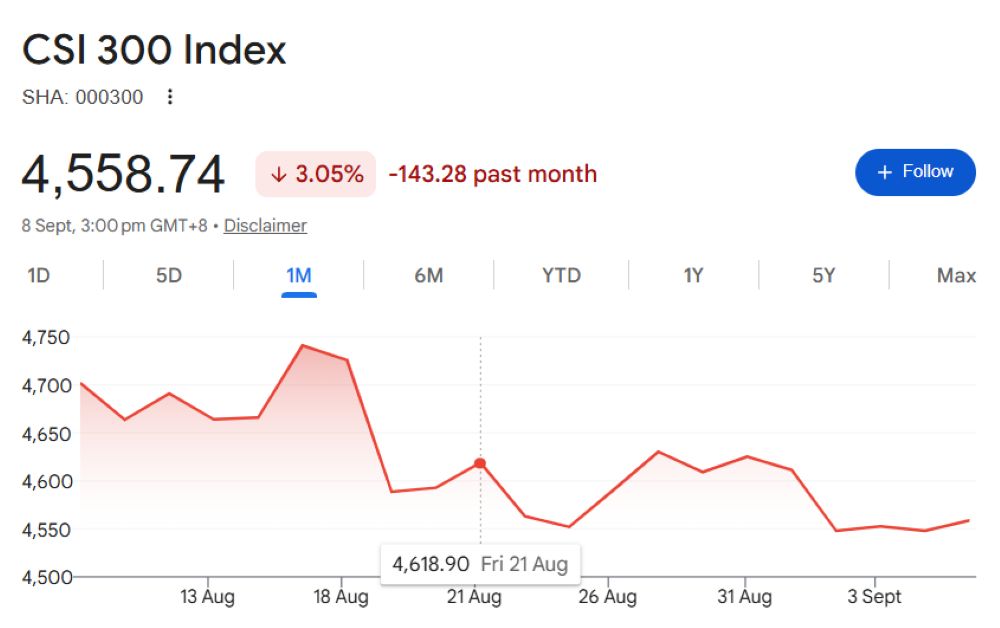
The CSI 300 index fell by around 9% during the quarter, while the technology-heavy STAR 50 index dropped 29%. This disconnect is partly a valuation problem. Technology shares had already surged: the STAR 50 rose 76% in the June quarter, while the CSI 300 gained 12%. Investors had priced in a large portion of the earnings improvement before the numbers arrived.
More importantly, the profit recovery is not broad-based. It is concentrated in sectors that benefit from the country’s technology push and the global buildout of artificial-intelligence infrastructure.
- Earnings grew 42% on the ChiNext board.
- Profits on the STAR board surged 370%.
- Broader main-board companies posted far weaker gains.
This is the K-shaped economy in action. A small group of technology firms, advanced manufacturers, and AI-linked companies are doing very well. Much of the rest of the economy is not. Resources, financial companies, and pharmaceutical firms have also benefited from commodity prices, trading gains, and demand for innovative medicines. Yet consumer-facing industries remain under pressure.
Agriculture, property, food and beverage, construction materials, and automotive companies have all been squeezed by weak domestic demand. A stronger yuan, tougher tax enforcement, and competition for capital from major new technology listings have added further pressure.
Even companies at the centre of the semiconductor push have struggled to convert improved earnings into lasting share-price gains. Investors are no longer satisfied with the phrase "AI". They want evidence that enormous spending on computing infrastructure will translate into durable returns.
That concern has intensified as Alibaba’s profits have fallen amid higher AI and computing costs, while Tencent has more than doubled its AI expenditure. China may be building a formidable AI ecosystem, but the same question hangs over Beijing, Silicon Valley, and every investor currently throwing money at data centres: where, exactly, are the sustained profits meant to come from?
Exports are booming because domestic demand is still too weak.
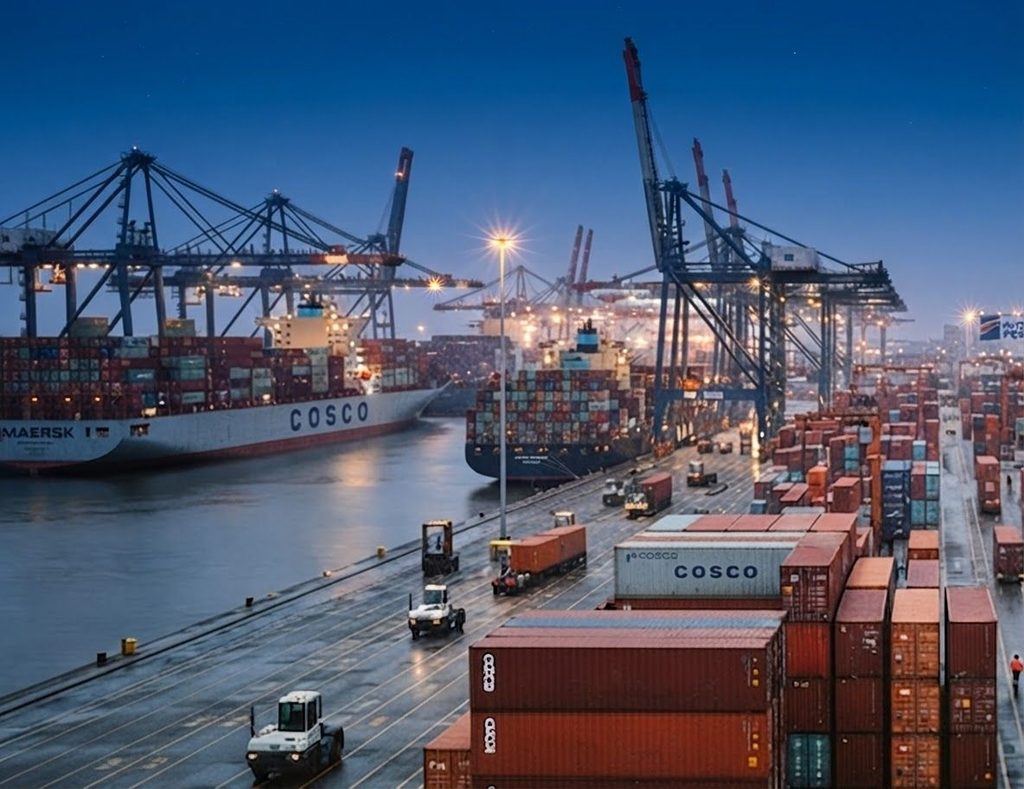
If China’s domestic economy is struggling to generate confidence, its export machine is doing its best to compensate.
Exports rose 25% year-on-year in August, after growth of almost 24% in July. Imports increased 28.2%, leaving a monthly trade surplus of $119.1 billion. China’s cumulative annual surplus was moving toward $806 billion, and the country was on course to approach the previous year’s record $1.2 trillion surplus.
Those are astonishing numbers, especially for an economy supposedly rebalancing toward household consumption. They also explain why the United States and Europe are becoming increasingly anxious about Chinese manufacturing capacity.
Global demand for AI infrastructure has helped support exports of semiconductors and electronics. Chip shortages have driven up prices in parts of the supply chain, creating another tailwind for Chinese exporters. Yet the deeper story is not simply that China is selling more technology products. It is that the economy remains dependent on selling more abroad because domestic consumption has failed to take up the slack left by property.
The bilateral imbalance with the United States widened sharply. China’s surplus with the US rose 44% year-on-year to more than $29 billion, its highest level since Donald Trump returned to the White House. Exports to the US rose 34.4%, while shipments to the European Union grew a more modest 6.7%.
This is unlikely to make the diplomatic atmosphere more relaxed. Washington is pressing Beijing to stimulate consumption and reduce its dependence on exports. European leaders are voicing similar concerns, warning that Chinese manufacturing dominance is placing pressure on domestic industries. Beijing, predictably, argues that such criticism is merely protectionism in a nicer suit.
There is truth in both positions. Protectionist politics is clearly growing in the West. But the concern about structural imbalances is not invented. When one major economy produces vastly more than it consumes, the rest of the world has to absorb the difference somehow. That creates commercial tensions even before tariffs, sanctions, and geopolitical distrust enter the room.
China’s export outlook is also becoming more exposed to energy and shipping disruption. As explored in this report on China’s slowing trade engine and geopolitical risks, higher input costs and unstable global shipping routes can quickly undermine an export model reliant on scale, speed, and thin margins.
Beijing is closing tax loopholes as fiscal pressure mounts.
The property slump is not merely changing housing policy. It is changing tax policy too.
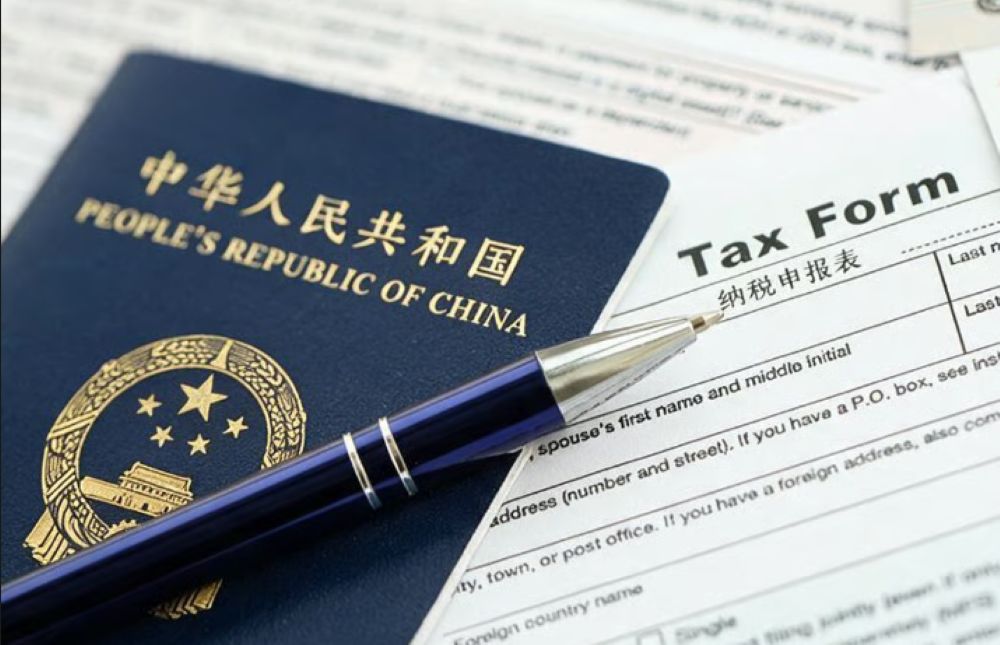
China has abolished a decades-old tax exemption for foreign individuals receiving dividends from foreign-invested enterprises. From September 1, dividend and bonus income paid to foreign individuals is subject to a 20% individual income tax. Foreign-invested enterprises must withhold the tax when dividends are distributed.
The old exemption dated back to 1994, when China was trying to attract overseas capital and had a very different set of economic priorities. Now the state’s concern is less about offering every possible incentive to foreign investors and more about preventing taxable income from slipping through cross-border cracks.
For many conventional foreign investors, the practical impact may be limited. Taxes paid in China can often be credited against liabilities in their country of residence. But the shift matters because Beijing will collect the revenue first, and because it brings foreign individuals closer to the tax treatment faced by Chinese citizens.
The reform is also aimed at structures used to minimise domestic tax exposure. Authorities have reportedly become increasingly concerned about Chinese nationals changing nationality or using offshore vehicles to avoid tax. Businesses registered abroad but operating primarily on the mainland, including firms using red-chip and variable-interest-entity structures, could face greater scrutiny.
This move follows tighter attention on offshore trusts and overseas investment profits. It is part of a broader effort to keep more domestically generated income inside China’s tax base. That does not mean the state has suddenly become ideologically opposed to foreign investment. It means fiscal necessity has a way of clarifying priorities.
For more on the wider push to strengthen revenue collection, including pressure on offshore assets and local tax enforcement, see this report on China’s tightening tax net and local-government fiscal strain.
Huawei is becoming the organiser of China’s semiconductor self-sufficiency drive.
The final piece of this increasingly complicated economic puzzle is technology. China knows that without domestic alternatives to foreign semiconductor tools, its ambitions in AI, advanced manufacturing, defence, and consumer electronics remain vulnerable to external pressure.

Huawei is now emerging as a central organising force in the attempt to remove foreign technology from China’s chip supply chain. Through its venture arm, Habor, and a Huawei-backed fund called Shenzhen Yuanzhi Xinghuo, the company has invested in domestic producers of optics, lithography components, and light sources.
One significant project involves Yuliangsheng, a Shanghai-based manufacturer that has co-developed an advanced domestic deep ultraviolet, or DUV, lithography machine. The company was spun out of SiCarrier, a startup reportedly linked to Huawei, although Huawei denies an affiliation.
Yuliangsheng’s equipment is reportedly being tested by Semiconductor Manufacturing International Corp., better known as SMIC, as well as on Huawei production lines. The machines are initially intended for less complex chips. The longer-term objective is much more ambitious: producing advanced AI chips through multi-patterning, a process that compensates for technological limitations by applying multiple lithography steps.
Lithography is one of the most difficult chokepoints in the semiconductor industry. The machines use highly precise optical systems to pattern circuits onto silicon wafers. China remains heavily reliant on foreign equipment, especially machines from Dutch manufacturer ASML, whose lithography tools dominate global semiconductor production.
China is particularly behind in projection lenses and high-powered light sources, two components where the physics is unforgiving and the engineering barriers are extraordinary. Yuliangsheng reportedly plans to manufacture 12 DUV machines this year, but its technology remains several years behind ASML in reliability and productivity.
That gap matters. It is not enough to create a machine that works occasionally in a laboratory or produces a small number of wafers. Commercial semiconductor production requires reliability, precision, throughput, maintenance, and an entire ecosystem of materials and expertise. This is why Chinese fabs, including CXMT and YMTC, continue to rely heavily on foreign equipment and have stockpiled ASML machines where possible.
Still, US restrictions may be producing the exact incentive Washington hoped to avoid. By cutting off access to advanced chips, design tools, and manufacturing equipment, the United States and its allies have made technological self-sufficiency a strategic necessity for Beijing. China is responding with subsidies, investment funds, industrial coordination, and a growing determination to link local equipment suppliers with major chip producers.
Huawei’s role is increasingly less about selling phones and more about coordinating a national industrial workaround. It connects experimental suppliers to commercial factories, helps fund component makers, and pushes domestic technology into real production environments.
China remains behind the global frontier in the most advanced lithography equipment. But it is also far more motivated than it was a few years ago. And motivation, money, state direction, and a vast domestic industrial base can become a very potent combination over time.
The uncomfortable reality: China is trying to replace three broken engines at once.
China is attempting to manage a historic property downturn, repair local-government finances, stimulate consumption, contain debt risks, maintain export growth, and achieve technological independence from the West. Each of these objectives is difficult on its own. Pursuing all of them simultaneously is a balancing act with very little margin for error.
The state can push banks to extend loans, ask developers to finish homes, encourage companies to invest in advanced technology, and direct capital toward strategic sectors. What it cannot easily command is household confidence. It cannot simply order people to spend more when property values are falling, wages are uncertain, and the old assumption that apartments always rise in value has disintegrated.
That is why the export sector and the semiconductor campaign matter so much. They are not merely sources of growth. They are the replacement engines Beijing hopes can carry an economy away from its dependence on real estate. Whether they can do so without triggering greater trade conflict abroad or leaving vast parts of the domestic economy behind is the much harder question.
Frequently Asked Questions
Why are falling land sales such a major issue for China’s local governments?
Local governments historically relied on selling land-use rights to developers for around one-third of their revenue. As developers retreat from the property market, municipalities have less money for infrastructure, public services, and debt repayments while still carrying large liabilities through local government financing vehicles.
Why are Chinese stocks falling despite strong profit growth?
Much of the earnings recovery had already been priced into technology shares after a major rally. Profit gains are also heavily concentrated in AI-linked and technology sectors, while large areas of the domestic economy, particularly consumer-facing industries, remain weak.
What is driving China’s unusually large trade surplus?
Strong exports of semiconductors, electronics, and other goods linked to global AI infrastructure demand have supported trade growth. At the same time, weak domestic consumption means China continues to depend heavily on selling manufactured goods overseas.
Why is Huawei investing in Chinese lithography technology?
US-led export controls have limited China’s access to advanced chips and foreign manufacturing equipment. Huawei is investing in domestic suppliers of lithography machines, optics, and light sources to reduce dependence on overseas technology and strengthen China’s semiconductor supply chain.