
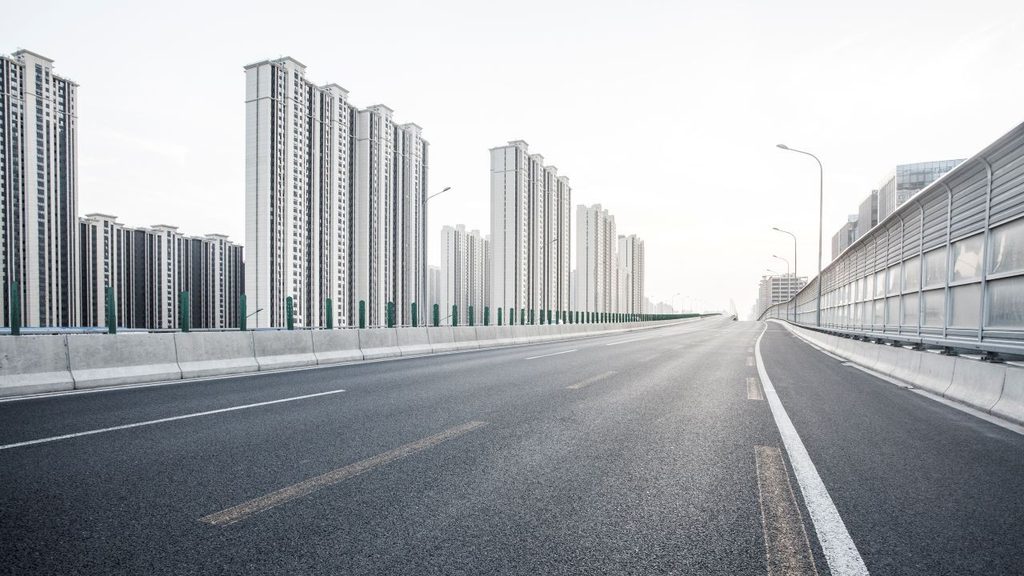
Photo by Nilanka Kariyawasam on Unsplash
Washington and Beijing have found something they can agree on: cheaper tariffs for a carefully chosen slice of trade. For businesses selling everything from American grain to Chinese toys, that is welcome news. It is also relatively modest news. The two countries still have major disputes to settle, and tariff relief alone cannot fix the weaknesses inside China’s economy.
One of those weaknesses is becoming harder to ignore. China has spent decades building roads, railways, airports and metro systems at a speed few countries could match. Much of that investment helped transform the country. But an expanding network is not automatically an expanding economy—particularly when demand is weak, populations are shifting and the bills keep arriving.
Three developments bring the distinction into focus: a limited US-China trade opening, an industrial profit recovery concentrated in a few sectors, and a warning from Chinese economist Li Xunlei that parts of the country have more transport capacity than they can use efficiently.
Key Takeaways
- Proposed US-China tariff cuts would cover about $60 billion in annual trade, but major disputes remain unresolved.
- China’s industrial profits are growing unevenly, with electronics responsible for nearly two-thirds of the first eight months’ overall profit growth.
- Road, rail, airport and urban-transit expansion increasingly outpaces usage in parts of China, adding pressure to debt-funded networks.
- Future infrastructure investment faces a harder test: whether its productivity gains justify the cost of building and maintaining it.
Table of Contents
- A Real, but Limited, US-China Tariff Break
- Industrial Profits Are Rising. The Recovery Is Not Broadening.
- China Has Built an Extraordinary Network. Is It Being Used?
- High-Speed Rail, Airports and Metros Face the Same Test
- The Investment Model Has Run Into a Demographic Wall
A Real, but Limited, US-China Tariff Break
Following a summit between US President Donald Trump and Chinese leader Xi Jinping, the two governments outlined reciprocal tariff cuts covering roughly $30 billion of imports in each direction. Together, the proposals would affect about $60 billion in annual bilateral trade. That is substantial for the companies involved but a relatively small portion of the roughly $415 billion in goods the two economies exchanged last year.
The lists show how deliberately narrow the opening is. The United States identified 77 categories of Chinese goods that could receive lower tariffs, including toys, fireworks, sporting equipment and household products. China’s list covers 1,619 categories of US goods, ranging from meat, seafood, dairy and grains to coal, timber and medical equipment.
These are proposals, not cuts already in force. China said the reductions would take effect simultaneously once both countries complete their domestic legal procedures. Around 90% of the covered products would move to most-favoured-nation tariff rates. US Trade Representative Jamieson Greer described the selected goods as non-sensitive, pointing to improved access for American farmers and medical-device makers and lower costs for Chinese consumer products. Shares of some Chinese appliance makers rose after the lists appeared.
Agriculture may provide an early measure of whether the agreement delivers. China’s proposed cuts include wheat, corn and sorghum, potentially helping Beijing meet its commitment to buy at least $17 billion in American agricultural goods annually through 2028. The two sides also plan to establish an agricultural working group before year-end. Coal is on the list, too: the White House previously said China had agreed to purchase at least 10 million metric tonnes of US coal in each of 2027 and 2028.
None of this makes the larger rivalry disappear. The countries have extended their trade truce until January while pursuing a broader agreement, but export controls and Taiwan remain unresolved. The tariff lists are best understood as a practical reduction in friction, not a reset. That distinction matters when wider geopolitical tensions and pressures on China’s trade engine remain in play, as explored in this analysis of China’s trade and external risks.
Industrial Profits Are Rising. The Recovery Is Not Broadening.

China’s industrial profit figures offer another case where the headline looks better than the underlying picture. Profits at major industrial firms rose 4.2% year on year in August, down sharply from 11.2% growth in July. Across the first eight months of the year, earnings increased 15.7%, according to the National Bureau of Statistics.
A higher comparison base a year earlier contributed to August’s slower growth, according to a bureau analyst. But the more revealing figure concerns where the gains came from: electronics accounted for nearly two-thirds of overall industrial profit growth in the first eight months. Profits in computer, communications and other electronic-equipment manufacturing more than doubled. Demand connected to artificial intelligence has helped that sector, while elevated commodity prices have supported earnings in parts of raw-materials production.
That leaves a rather awkward question: what is happening everywhere else? Profits fell in automobile manufacturing, electrical equipment and steelmaking over the same eight-month period. Consumption growth was subdued in August, and fixed-asset investment fell 7.2% across the first eight months. Manufacturers can produce more, but if customers are reluctant to spend and competitors are fighting over the same sales, higher output does not necessarily mean healthier margins.
Beijing has stepped up efforts to tackle excess capacity and aggressive price competition, including a three-year plan to phase out less efficient capacity in industries such as steel and concrete. Reducing supply-side pressure could help some producers. It cannot, by itself, create the stronger household and business demand needed for a durable, broad-based recovery. The same tension—promising pockets of growth alongside persistent cost and demand pressures—also runs through other recent industrial profit data.
This matters for the infrastructure debate. When private demand is sluggish, construction offers an appealing way to generate activity quickly. The trouble begins when the project being built has no convincing source of future users or revenue.
China Has Built an Extraordinary Network. Is It Being Used?

China’s transport system is one of the defining achievements of its economic rise. Economist Li Xunlei, chief economist at Zhongtai Financial International and a former official, is not disputing that history. His warning is about the present: structural overcapacity now stretches across motorways, railways, airports and urban public transport, especially in places with population decline and weaker growth.
Start with roads. By the end of 2025, China had 199,400 kilometres of motorways, compared with 106,000 kilometres in the United States. Yet China had 1,847 motor vehicles per kilometre of motorway, against 3,672 in the US, 2,662 in Japan and 5,333 in South Korea. Those comparisons do not tell us that every road is unnecessary. They do show that network size and usage are very different measures of success.
The regional figures sharpen the point. Between 2014 and 2024, Tibet, Yunnan, Guangxi, Qinghai and Guizhou—the five regions expanding motorways fastest—each recorded annual mileage growth of at least 8.48%. Their road freight turnover, however, grew by only 1.8% on average. Shanghai’s motorway network expanded just 0.7% annually, while its freight turnover increased 10.1%.
In other words, some of the fastest road-building took place where freight demand grew relatively slowly. Meanwhile, an area adding roads far more cautiously saw much stronger growth in their use. That is not a neat argument for building nothing outside Shanghai. It is a strong argument for asking what each new kilometre is supposed to accomplish.
Debt makes that question urgent. In 2021, China’s toll roads generated 663 billion yuan in revenue but recorded almost 1.3 trillion yuan in expenditure. Debt principal and interest payments alone exceeded a full year of toll revenue. A road can be useful and still present a serious financing problem; usefulness does not make repayments disappear.
High-Speed Rail, Airports and Metros Face the Same Test
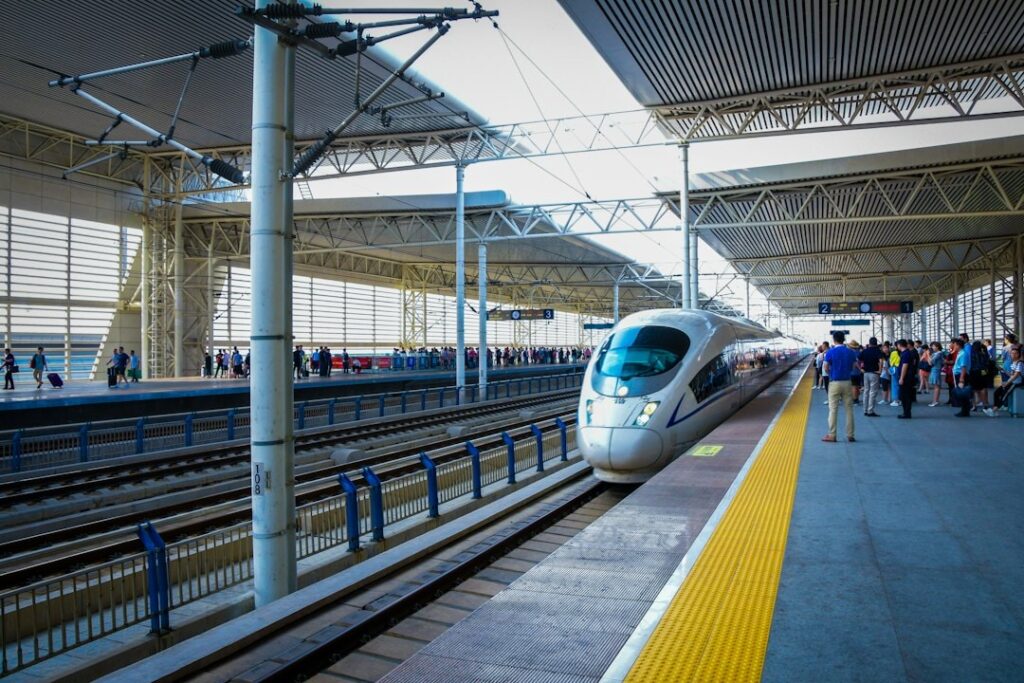
The rail network presents a similar mismatch between impressive expansion and weaker utilisation. China’s railways grew from 121,000 kilometres in 2015 to 165,000 kilometres in 2025. High-speed rail reached 50,400 kilometres—more than 70% of the world’s operating high-speed rail network.
Yet passenger volume per kilometre of high-speed rail peaked in 2018 and had not returned to that level by 2024, despite a 65% expansion of the network. At the end of 2025, China State Railway Group owed 6.17 trillion yuan, including 5.04 trillion yuan of interest-bearing debt. The network’s scale is remarkable. So is the financial obligation attached to it.
High-speed rail also competes with aviation, another transport system whose traffic is unevenly distributed. China had 270 certified transport airports in 2025. Just 41 handled more than 10 million passengers each and accounted for 83.7% of total traffic. At the other end of the scale, 191 airports each handled fewer than 2 million passengers and together accounted for only 5.9%.
Not every smaller airport should be judged solely by passenger totals; connections to less-populated regions can have value. But the figures do make it difficult to assume that adding capacity everywhere will bring comparable economic returns. If rail and air services compete for limited demand on a route, building more of both can deepen the problem.
Urban transport adds another layer. Annual passenger volume per bus has fallen to roughly a third of its 2010 level, while ridership per kilometre of bus routes has dropped to 16% of its former level. China operates about 45% of the world’s metro mileage despite having around 17.5% of its population. More than half of Chinese cities with metro systems are estimated to fall below the government’s passenger-intensity benchmark for new lines.
Keeping these networks running costs money even after construction ends. Beijing provided nearly 25 billion yuan in metro subsidies during 2024. For more indebted local governments, similar obligations are harder to absorb. The wider pressure on urban rail funding is already visible in forecasts for a sharp decline in urban rail investment.
The Investment Model Has Run Into a Demographic Wall
Why keep building when utilisation is falling? Because infrastructure has long served more than one purpose. It can support growth, generate construction employment and give local officials a visible sign of development. When an economy was younger, rapidly urbanising and moving people and goods at an extraordinary pace, expanding transport networks often met genuine new demand.
Li’s argument is that those conditions have changed. Total passenger traffic peaked as early as 2012. China’s population officially began declining in 2022, while people have increasingly concentrated in major centres such as Shanghai, Hangzhou, Shenzhen and Chengdu. Some regions continue adding infrastructure as they lose residents.
The result is a difficult policy choice. Li argues for continued investment in growing metropolitan areas and sharp restrictions on new projects where population decline is sustained. That would direct resources towards places more likely to use them. But stopping construction in weaker regions would also remove a familiar source of local activity, potentially intensifying economic and debt pressures there. Continuing to build may postpone that reckoning while making the eventual bill larger.
Peking University finance professor Michael Pettis puts the underlying economic mistake plainly: infrastructure should not be treated as a source of growth in its own right. It is a cost that makes an economy richer only when the productivity gains exceed the costs of construction and maintenance. If weak industries, population outflows or other constraints are holding an area back, another road or station may deliver less value—not more.
That helps explain why changing course is so difficult. Construction produces an immediate boost. The test of whether the project was worthwhile comes later, after the ribbon-cutting, when passengers, freight and revenues either appear or fail to. China’s infrastructure boom helped power an extraordinary transformation. Its next challenge is less photogenic, but arguably just as important: deciding where another project will genuinely pay its way—and where it is time to stop.
Frequently Asked Questions
Have the US-China tariff cuts taken effect?
No. The two governments have outlined reciprocal cuts, but China says they will take effect simultaneously after both countries complete their domestic legal procedures.
Why are China’s rising industrial profits a concern?
Growth is concentrated in a narrow set of industries. Electronics accounted for nearly two-thirds of overall profit growth in the first eight months, while profits fell in sectors including automobiles, electrical equipment and steelmaking.
Does transport overcapacity mean China should stop building infrastructure?
No. The argument is for more selective investment: continuing projects where growing demand supports them, while restricting new construction in areas facing sustained population decline and weak utilisation.