
China’s political economy has become extremely good at producing impressive numbers, colossal infrastructure projects and carefully choreographed displays of state capacity. It is rather less good at dealing with the unglamorous consequences of everything going wrong at once. A Himalayan flood destroys a strategic border crossing. American AI chips are technically allowed back in, yet Chinese firms are discouraged from buying them.
Tax revenue rises while public spending barely moves. Then, because apparently the country’s food-safety system needed another grim subplot, authorities launched a national crackdown after footage allegedly showed cabbages being treated with formaldehyde.
These stories may seem unrelated. They are not. Each exposes the same broader problem: China’s development model remains highly capable of mobilising resources after a crisis but much less reliable at preventing risks created by fragmented oversight, local financial pressure, infrastructure gaps and political incentives that reward appearance over resilience.
Key Takeaways
- Himalayan infrastructure faces growing danger from unstable terrain, glacier retreat and extreme rainfall.
- Chinese AI firms are using clusters and software optimisation to offset weaker domestic chips.
- Fiscal revenue is improving, but restrained spending limits support for China’s weakening domestic economy.
- The cabbage scandal exposes persistent gaps in cold-chain logistics, traceability and food-safety enforcement.
Table of Contents
- A Himalayan Disaster With Consequences Beyond the Border
- Nvidia’s China Problem Is Not Going Away
- China’s AI Firms Are Learning to Work Around Chip Constraints
- Rising Revenue, Weak Spending and a Fiscal System Stuck in Neutral
- Why the Formaldehyde Cabbage Scandal Matters
- The Same Governance Problem Wearing Different Costumes
A Himalayan Disaster With Consequences Beyond the Border
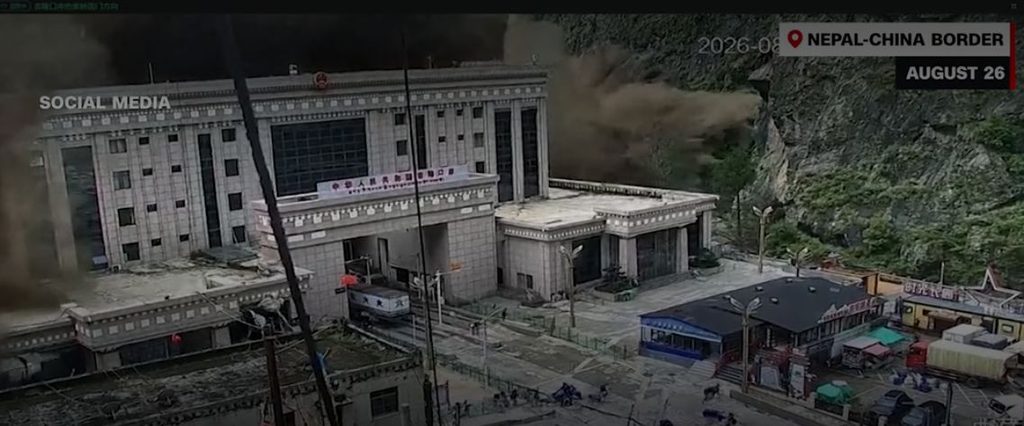
Flood Hits China/Nepal Crossing

3 Seconds Later

5 seconds later
A catastrophic flash flood struck Gyirong County in Tibet, near the China-Nepal border, killing more than 150 people and leaving hundreds missing. Torrential rain, mud and boulders tore through remote Himalayan settlements, damaging roads, bridges, buildings and the strategically important Gyirong border port before surging downstream into Nepal.
Xi Jinping ordered an all-out rescue operation, with authorities instructed to search for missing people, relocate those still in danger and prepare for worst-case scenarios. China’s Ministry of Natural Resources activated its level-two emergency response, while Beijing allocated 120 million yuan in disaster relief funding and a further 100 million yuan for recovery and reconstruction.
That is the familiar Chinese state response: centralise, mobilise, allocate funds, issue orders and project urgency. And, to be clear, rapid emergency mobilisation matters enormously when entire communities have just been wiped out. But it does not answer the more uncomfortable question: why are so many settlements, roads and strategic facilities exposed to precisely the sort of cascading geological disaster that scientists have warned is becoming more likely?
The immediate cause remains under investigation. Preliminary evidence suggests that a major landslide may have blocked the Altay River, allowing water to build up before bursting downstream. Researchers are also examining whether an ice-rock avalanche from a higher-altitude glacier triggered or intensified the event.
The Himalayan region is particularly vulnerable to this kind of disaster. Retreating glaciers, unstable terrain and increasingly severe rainfall can combine with frightening speed. A blocked river does not politely wait for a planning meeting. It becomes a temporary dam, accumulates enormous pressure and then turns into a cross-border wall of water.
China’s vast construction drive has also made the stakes higher. Roads, border facilities and settlements have been built across some of the most geologically volatile terrain on earth. That may serve economic and strategic goals, but where regulation, inspection and land-use planning are inadequate, it also creates more assets—and more people—directly in harm’s way.
This is not merely an environmental problem. It is an infrastructure-governance problem, a regional-security problem and a humanitarian problem stretching across national borders.
Nvidia’s China Problem Is Not Going Away
Meanwhile, the technological confrontation between Washington and Beijing has reached a rather absurd stage. Nvidia reportedly made a small number of H200 AI-chip sales in China during the quarter ending in July 2026—the company’s first reported AI processor sales in the country since early 2025. Yet those shipments amounted to less than 1% of Nvidia’s data-centre revenue.
The reason is not especially mysterious. The United States has permitted conditional H200 exports to approved Chinese buyers, subject to a 25% fee paid to the US government. Beijing, however, has continued steering domestic firms away from American technology as it tries to build a more self-sufficient semiconductor ecosystem.
Nvidia ended up recording a $400 million charge for excess H200 inventory over the previous six months. That is a fairly expensive reminder that a licence to sell is not the same thing as a functioning market.
Overall Chinese revenue still reached $7.88 billion, nearly double the previous year, but much of that came from gaming hardware and products outside the most severe export restrictions. The company continues to forecast no China revenue from its data centre and AI-chip operations. The reality is simple: Nvidia is still extraordinarily important to China’s AI ambitions, but relying on it has become strategically inconvenient, politically risky and increasingly difficult.
The H200 itself is two generations behind Nvidia’s latest Rubin processor, but it remains competitive with Chinese alternatives. That matters because US restrictions have not eliminated China’s AI industry; they have pushed it into a complicated and expensive race to compensate for weaker hardware with more software, more networking and more engineering.
This is the same pressure explored in China’s deepening AI chip constraints: export controls can slow China’s access to cutting-edge chips, but they also create powerful incentives to build domestic alternatives faster.
China’s AI Firms Are Learning to Work Around Chip Constraints
That workaround was on display in the launch of Z.ai’s GLM 5.3 Flash model, previously known online as the mysterious “Ox” model. Before formally revealing it, the company anonymously deployed the system through OpenCode and OpenRouter to gather unbiased feedback. It rapidly became one of the platforms’ most popular models.
The more significant claim was not merely that the model attracted attention. Z.ai said its entire test run operated on Chinese-made AI chips, connected through a high-bandwidth network and supported by a specialised inference engine built with the open-source SGLang framework.
Chinese processors remain constrained by memory capacity and bandwidth, particularly for models handling context windows of up to one million tokens. Instead of pretending this problem does not exist, Z.ai appears to have thrown engineering at it: using large clusters, redesigning inference workloads and accepting additional computing and communications demands in exchange for more efficient memory use.
There is a mildly dystopian wrinkle here. GLM 5.3 reportedly helped optimise the infrastructure on which it was running. An AI agent powered by the model was used to develop kernels, identify performance bottlenecks and improve the serving system. The machines are now being asked to tune the machinery needed to run more machines. Very normal. Nothing potentially transformative about that at all.
Still, it would be premature to declare that US controls have failed. Leading American chips remain crucial, and China’s domestic semiconductor industry continues to lag at the high end. But restrictions are clearly forcing Chinese firms to become more inventive. If a company can link enough less-powerful chips together efficiently, software optimisation can narrow some of the practical gap.
This is why the rivalry cannot be reduced to a simple question of who makes the best individual processor. The real competition is increasingly about clusters, networks, tooling, models, power supply, data centres and the ability to convert hardware limitations into an engineering problem rather than an existential one.
China’s broader AI sector is moving quickly. Manycore AI’s first-half revenue reportedly nearly quadrupled to $116.6 million, while DeepSeek’s revenue reportedly rose tenfold. Moonshot AI is also negotiating with Microsoft, Amazon and Google over international distribution of its K3 model. The sector may be restricted, but it is very far from stagnant.
Rising Revenue, Weak Spending and a Fiscal System Stuck in Neutral
China’s fiscal data presented another familiar contradiction. General public budget revenue rose 11.7% year-on-year in July, the strongest monthly growth since late 2024. Tax receipts increased 13.9%, supported by stronger income-tax collections and a surge in stock-market activity.
Stamp-duty revenue from securities trading jumped 108.6%. Corporate income-tax receipts rose 20.8%, while personal income-tax receipts increased 25.9%. For the first seven months of 2026, general public budget revenue reached 14.37 trillion yuan, up 5.8% year-on-year.
On paper, that looks encouraging. In practice, the improvement was deeply uneven. Central-government revenue rose 9.1%, while local-government revenue increased only 3.3%. Local authorities remain under extreme pressure from the prolonged property downturn and the collapse of land-sale income, which for years functioned as a vast off-budget lifeline for local finances.
More troubling still, spending barely rose. General public budget expenditure increased just 0.5% in July. Over the first seven months of the year, authorities had completed only 54.3% of planned annual spending—the second-lowest rate for the period in five years.
There is a limit to how much comfort can be extracted from healthier tax receipts when the government is not deploying funds quickly enough to support weak consumption, falling investment and an ongoing property crisis. Fiscal policy cannot stabilise demand if it remains trapped in spreadsheets, approval processes and bureaucratic caution.
Provincial audits found that some special-purpose bond funds had remained idle, been diverted to projects with lower-than-expected returns or been poorly documented. China authorised 4.4 trillion yuan in new special-purpose bonds in both 2025 and 2026. That is an extraordinary amount of financing to mishandle.
The core issue is not simply whether Beijing has money. It is whether the money reaches productive uses before the economy deteriorates further. China’s leadership is trying to manage growth, debt, local-government stress and financial risk simultaneously. Unfortunately, “do everything carefully” can become a recipe for doing too little when support is most needed.
For further context on the country’s debt and financing pressures, see this analysis of China’s leverage and fiscal strain.
Why the Formaldehyde Cabbage Scandal Matters
Finally, there is the story that should never be normal but somehow keeps returning: alleged formaldehyde-treated cabbages.

Authorities launched nationwide inspections after footage recorded by a citizen blogger in Kangbao County, Hebei, appeared to show freshly harvested cabbages being dipped in formaldehyde solution before being loaded onto unrefrigerated trucks. The chemical was allegedly being used as a cheap preservative to maintain the vegetables’ appearance and reduce losses during transport.
China’s Food Safety Office, Ministry of Agriculture and Rural Affairs, and State Administration for Market Regulation ordered investigations, tracing efforts, and measures to prevent affected produce from reaching markets. Officials have also announced special inspections of cabbages and other perishable vegetables. Several districts and counties in Jiangxi began seeking public tips about produce being soaked, sprayed or coated with prohibited chemicals, offering rewards of up to 3,000 yuan.
Formaldehyde is prohibited as a food additive and is classified by the International Agency for Research on Cancer as a Group 1 carcinogen. The public-health implications are therefore not remotely ambiguous. This was not a regulatory technicality. If the allegations are confirmed, it was an attempt to preserve food by treating it with a carcinogenic chemical.
The practice is also not new. A similar case emerged in Shandong in 2012, where reports suggested that a small, inexpensive quantity of formaldehyde solution could treat many tonnes of cabbage. The economics are grotesquely straightforward: refrigerated transport costs 30% to 50% more than ambient transportation, while transportation itself can account for 20% to 40% of a vegetable’s value.
When margins are thin, cold-chain coverage is limited and supply chains involve multiple layers of wholesalers, some operators will find illegal shortcuts. That does not excuse the conduct. It explains why periodic crackdowns are not enough.
The scandal has also spilt into South Korea, where cabbage imports matter enormously ahead of kimjang, the traditional kimchi-making season. China supplies nearly all of South Korea’s imported Napa cabbage and accounted for 99.9% of the country’s kimchi imports in the 12 months through July. South Korean authorities are now investigating whether any affected shipments entered the country.
That is the real cost of poor traceability. A local food-safety failure does not remain local when agricultural supply chains cross borders. Trust, once damaged, is much harder to refrigerate into freshness.
The Same Governance Problem Wearing Different Costumes
A deadly flood, an AI-chip blockade, underpowered fiscal stimulus and chemically treated vegetables are not the same crisis. But they are all symptoms of a system wrestling with the consequences of rapid growth and uneven oversight.
In the Himalayas, the challenge is ensuring that development does not outrun environmental risk management. In technology, it is adapting to an external blockade without becoming dependent on inefficient domestic substitutes. In public finance, it is converting revenue and borrowing capacity into useful support rather than allowing money to stagnate. In food safety, it is building enough cold-chain infrastructure and traceability to stop dangerous shortcuts before they reach a market.
China remains hugely capable. It can direct capital, mobilise agencies and build at a scale that few countries can match. But state capacity is not just about how quickly a government responds when disaster strikes. It is also about whether it can create institutions capable of preventing the disaster, detecting the fraud, spending the money and enforcing the rules before the consequences become impossible to ignore.
Frequently Asked Questions
What caused the flash flood near the China-Nepal border?
The precise cause remains under investigation, but preliminary evidence points to a landslide blocking the Altay River before water burst downstream. Scientists are also examining a possible ice-rock avalanche from a higher-altitude glacier.
Why are Nvidia’s H200 sales in China so limited?
US exports are conditional and limited to approved customers, while Chinese authorities are discouraging domestic firms from relying on American technology and promoting local semiconductor alternatives.
Why is formaldehyde in cabbage such a serious issue?
Formaldehyde is banned as a food additive and classified internationally as a Group 1 carcinogen. Alleged use on vegetables also reveals weaknesses in supply-chain traceability and refrigerated transport infrastructure.