Beijing is trying to pull off an increasingly difficult trick: keep an economy burdened by property collapse, exhausted local governments, weak household demand, and mounting trade tensions moving forward without unleashing the kind of enormous stimulus package that could make all those problems worse.
The answer, at least for now, is artificial intelligence.
AI infrastructure, semiconductor manufacturing, renewable-energy exports, satellite networks, and space technology are being treated as more than growth industries. They are becoming the scaffolding for a broader Chinese strategy: preserve economic momentum, reduce technological dependence on the West, strengthen military capacity, and make other countries more dependent on Chinese systems.
That is a formidable ambition. It is also riddled with risks.
China’s leadership has now signalled far more concern about the domestic economy than it did only a few months ago. At the same time, the country’s stock market has been rocked by an AI sell-off, a strategically important chipmaker has become a fresh target for Washington, Belt and Road spending is being redirected toward clean energy, and Beijing’s commercial space programme is growing into something that could eventually challenge SpaceX.
These are not separate stories. They are different fronts in the same campaign: China is trying to engineer a future in which it owns more of the physical and digital infrastructure that powers the global economy.
Table of Contents
- Beijing’s Economic Optimism Has Become Much Harder to Maintain
- The AI Stock Boom Has Turned Into an AI Reality Check
- Belt and Road Is Becoming Cleaner, More Commercial, and More Strategic
- China’s Commercial Space Industry Is Not Entirely Commercial
- The Bigger Picture: Growth, Security, and Influence Are Being Fused Together
- Frequently Asked Questions
Beijing’s Economic Optimism Has Become Much Harder to Maintain
The Chinese Communist Party’s Politburo has called for stronger counter-cyclical adjustment, faster public spending, and greater efforts to expand domestic demand. That sounds dry, bureaucratic, and suitably vague. But the shift in language matters.
Earlier in the year, officials were still celebrating an economy that had supposedly started strongly and exceeded expectations. The latest message was noticeably more anxious, stressing the need to take the “difficulties and challenges” in economic performance seriously.
This is hardly surprising. Annual growth slowed unexpectedly to 4.3% in the second quarter, slipping below the government’s 4.5% to 5% target range. The headline number itself is problematic for Beijing. The underlying picture is worse.
Chinese households remain reluctant to spend. The property crisis, now dragging on for more than half a decade, has wiped away confidence and eroded household wealth. Local governments are struggling under substantial debt burdens. And the old formula of building more infrastructure, selling more apartments, and exporting more manufactured goods is increasingly running into both financial and geopolitical limits.
Markets were not impressed by the Politburo’s response. The CSI 300 extended its losses after the announcement, while China’s 10-year government bond yield fell towards 1.7%. Longer-term bond futures rallied as investors positioned for prolonged weakness.
In plain English: investors heard the warning but did not see a convincing rescue plan.
Beijing’s immediate priority appears to be spending money that has already been authorised, rather than unveiling a major new fiscal bazooka. Policymakers pledged to accelerate the use of government bond proceeds after a prolonged slump in public spending contributed to the downturn.
There is still some room to move. Macquarie estimates that unused government bond quotas in the second half of the year sit around 1.3 trillion yuan above the equivalent period last year. Another 800 billion yuan in policy-financing tools has yet to be deployed.
But fiscal room is not the same thing as fiscal confidence. China has huge debt levels, particularly at the local-government level. More borrowing can relieve pressure in the short term while quietly accumulating new risks beneath the surface.
The Party has also called for the construction of the so-called “six networks", a major infrastructure push intended to support AI ambitions and improve resilience against geopolitical, economic, and natural-disaster shocks. This is where the economic agenda begins to merge with the national-security agenda.
AI infrastructure has helped keep Chinese factories busy, supporting double-digit export growth in related equipment and components. But there is a catch: AI-related industries reportedly accounted for more than half of China’s quarter-on-quarter expansion between April and June.
That may sound like success. It may also mean one narrow, heavily subsidised sector is concealing a much broader economic malaise.
China’s leadership is trying to stabilise property, resolve local-government debt, and restore confidence in capital markets. It is also calling for “balanced trade development", an apparent acknowledgement that export-led growth is creating serious friction abroad. Beijing can sell ever more batteries, solar panels, electric vehicles, servers, and industrial equipment to the world—but other governments are increasingly unwilling to accept the domestic consequences.
For more on the wider structural problem, including Beijing’s own recognition that export-led growth cannot continue indefinitely, see this analysis of China’s increasingly unsustainable export model.
The AI Stock Price Boom Has Turned Into an AI Reality Check
China’s markets have spent years behaving as though every technology company with an AI strategy, a semiconductor division, or a vague connection to data centres deserves a heroic valuation. This is, as usual, how bubbles work: everyone is a visionary until the bill arrives.
Chinese technology shares tumbled as the global AI sell-off spread to mainland suppliers of the chips, servers, and equipment needed to build data centres. The CSI 300 fell 1.1%, extending its July decline to 8.6%—its steepest monthly fall since January 2016. The more technology-focused CSI-AI index plunged 5.8%.
The trigger came from the United States, where disappointing earnings and spending forecasts from major technology firms rattled confidence in the assumption that extraordinary AI investment will automatically produce extraordinary profits.
It turns out that spending hundreds of billions of dollars on computing infrastructure is not, by itself, a business model. A shocking revelation, one imagines, to everyone who has stapled “AI” to a pitch deck.
The weakness was felt across Asia. South Korea’s Kospi had already fallen sharply from its mid-June peak after an extraordinary run in semiconductor and AI-linked shares. But China’s reversal was particularly brutal because its market had become tightly tied to national hopes of achieving semiconductor self-sufficiency.
That was made painfully clear by the dramatic listing of memory-chip producer CXMT. The company’s shares surged 466% on their market debut, briefly giving it a valuation of roughly 3.3 trillion yuan, or just under US$500 billion. It subsequently fell almost 14% from that peak.
CXMT raised approximately US$8.6 billion to expand production of DRAM chips used in smartphones, electric vehicles, data centres, and military equipment. The company is central to Beijing’s push to develop a domestic semiconductor industry that can survive increasingly restrictive US export controls.
But strategic importance and commercial valuation are not the same thing. China can direct huge pools of capital toward a company it considers nationally vital. It cannot guarantee that investors will continue paying any price for it.
State-backed funds, commonly described as the National Team, bought shares ahead of the listing, helping support the broader market while other Asian indices weakened. That support carries its own grim little message: if state funds are absorbing risk, private money may see an opportunity to exit.
CXMT’s high-profile debut also makes it a more visible target for Washington. A bipartisan group of US lawmakers is reportedly preparing to demand an investigation into the company and Beijing’s support for it. The Pentagon added CXMT to its list of Chinese military companies in June, though comprehensive sanctions have not yet followed.
Further restrictions could damage the company’s reported efforts to supply Apple. So CXMT now embodies the contradiction at the centre of China’s technology strategy: every success in building a national champion may attract greater foreign scrutiny, more controls, and more pressure to decouple.
The wider contest is not merely about commercial chips. It is about whether China can build an independent technological base robust enough to withstand a long-term confrontation with the United States. The advanced-chip bottleneck remains one of the clearest constraints on that ambition, as explored in this report on China’s fragile recovery and AI chip constraints.
The Belt and Road Is Becoming Cleaner, More Commercial, and More Strategic
While domestic growth is faltering, Beijing is continuing to project industrial power abroad through the Belt and Road Initiative.
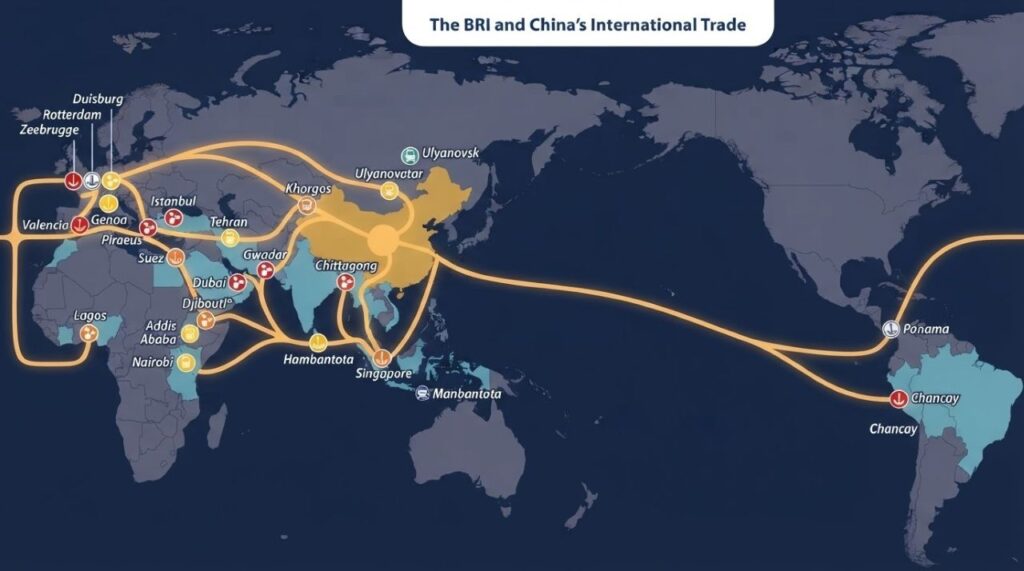
Chinese Belt and Road engagement reached a record US$126.3 billion in the first half of 2026.
As it's edging above the US$123.3 billion recorded during the same period a year earlier. Construction contracts accounted for US$76.5 billion, while investments totalled US$49.8 billion.
The most important change is the concentration of money in green energy. China committed a record US$20.1 billion to overseas green-energy projects during the first six months of the year, more than the total recorded across all of 2025.
This includes US$11.8 billion in construction contracts and US$8.3 billion in direct investment. Manufacturing, technology, metals, and mining have also attracted growing funding.
The geopolitical context is not subtle. The war in Iran and the resulting pressure on oil and natural-gas prices have sharpened the appeal of cheaper and more reliable electricity. Governments want to reduce exposure to volatile fossil-fuel markets while increasing power supplies for AI data centres.
China is exceptionally well positioned for this. It has a vast clean-technology manufacturing base, and exports of solar panels, batteries, and other green technologies have risen strongly. Where Western countries frequently see Chinese overcapacity, many developing countries see affordable infrastructure that can actually be delivered.
There has also been a major shift in how these projects are financed. Private companies represented 48% of Chinese Belt and Road engagement in the first half of 2026, compared with just 13% in 2022.
That suggests this is no longer simply a state-directed geopolitical exercise. Chinese clean-energy companies are increasingly expanding because they have commercially competitive products and need overseas markets.
Of course, the Belt and Road Initiative’s old problems have not disappeared. It remains dogged by criticism over opaque lending, debt burdens, and limited access to Chinese markets. Africa received nearly US$33.5 billion in Chinese investment, almost triple the level a year earlier, but the question for recipient countries remains the same: does this infrastructure generate durable local prosperity, or does it deepen dependency on Beijing?
China’s answer is increasingly clear. It wants to combine renewable power, digital systems, AI infrastructure, manufacturing, and financing into a package that makes it indispensable across the developing world.
Notably, no new Belt and Road projects were announced in Pakistan or Russia. Engagement with Russia has remained weak since the invasion of Ukraine. Pakistan, meanwhile, appears to be improving ties with Washington as tensions between China and India ease, although allegations of Pakistani territory being used as a transit point for Chinese weapons bound for Iran complicate any simple reading of the relationship.
China’s Commercial Space Industry Is Not Entirely Commercial
Perhaps the most consequential development is taking place above the atmosphere.
China is rapidly building a commercial space sector that could challenge SpaceX, enhance military capabilities, and extend Beijing’s technological influence into countries that may one day depend on Chinese launch systems, satellite connectivity, and remote-sensing services.
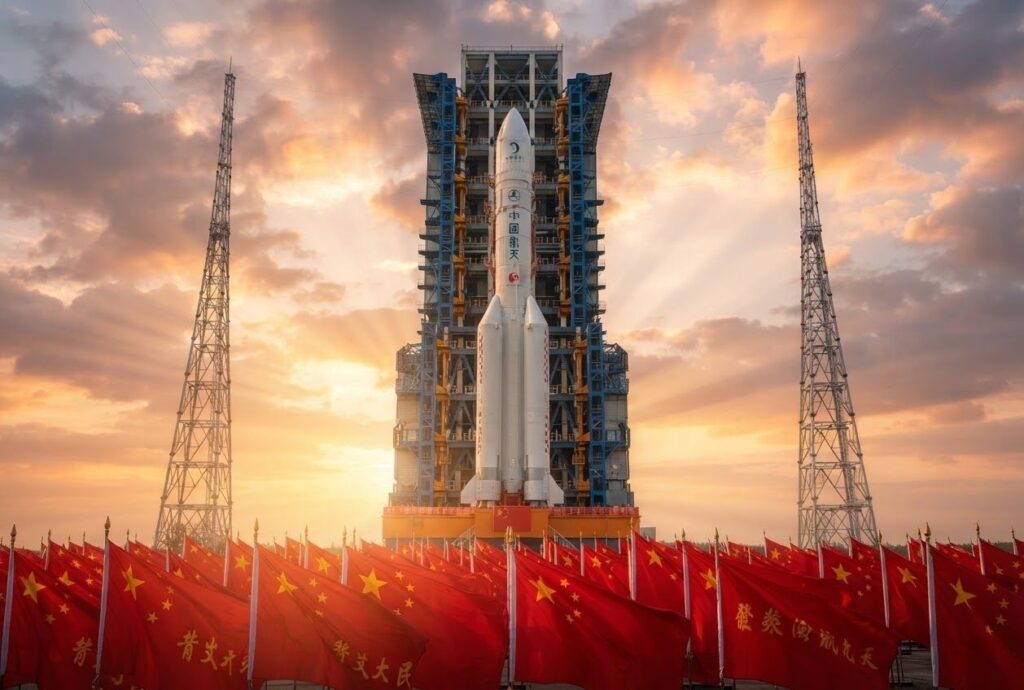
A new CSIS report on China’s commercial space expansion describes an industrial ecosystem of launch startups, satellite internet operators, remote-sensing firms, reusable-rocket developers, and satellite manufacturers growing at remarkable speed.
International attention has traditionally focused on China’s military satellites, lunar ambitions, and human spaceflight programme. But the commercial sector may be more important precisely because it blurs the line between civilian and military activity.
Chinese companies can be nominally private or commercial while receiving government financing, infrastructure, technology, or guaranteed contracts. Their satellites and launch vehicles can serve civilian customers while supporting military communications, surveillance, targeting, and battlefield connectivity.
This is the meaning of “blurred orbits".
China’s Guowang and Thousand Sails networks each plan to deploy more than 10,000 satellites. These low-Earth-orbit constellations could compete directly with Starlink by providing broadband services across large areas. They could also offer secure military communications and surveillance capacity.
China is also building automated satellite "gigafactories". Estimated annual production capacity has risen from roughly 500 satellites three years ago to between 4,100 and 5,000 today. If Beijing can pair that manufacturing capacity with genuinely reliable reusable rockets, the cost of deploying huge constellations could fall sharply.
SpaceX still leads the world in reusable launch technology and satellite broadband. But China has scale, state support, vast manufacturing capacity, and a political system that can direct resources toward strategically important industries with a speed Western governments often struggle to match.
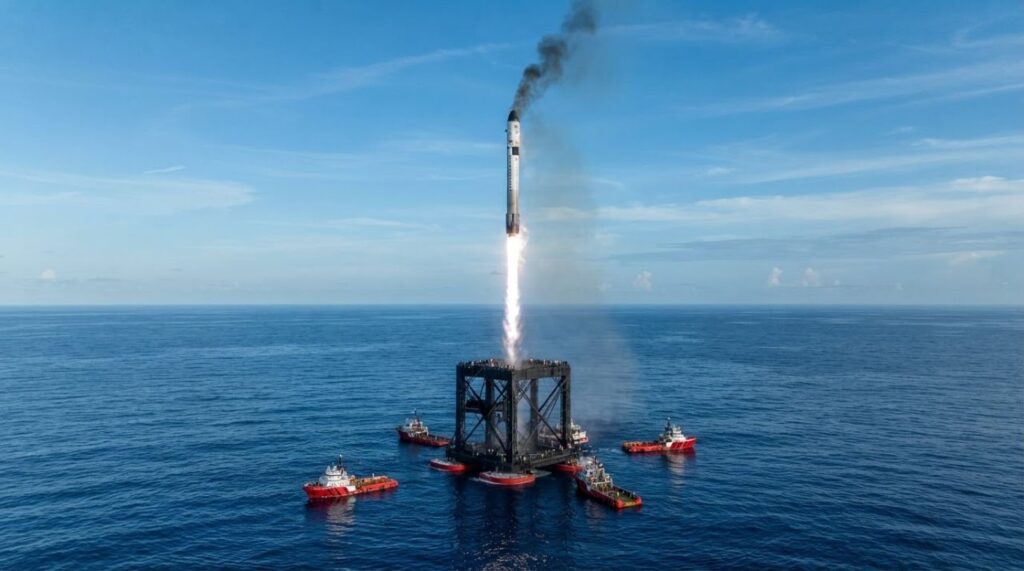
The plans extend beyond communications. Chengdu is emerging as a centre for space-based computing, with China seeking to place AI processing infrastructure in orbit. The idea is to analyse information gathered by satellites before it is sent back to Earth, reducing delays and dependence on ground networks.
China is simultaneously upgrading state-run space infrastructure. A Long March 7A rocket recently launched the Tianlian 301 communications and data-relay satellite, the first of a third generation of such systems, intended to improve communications between the Tiangong space station and ground facilities.
The strategic lesson from Ukraine has been impossible to miss. Starlink demonstrated that commercial satellite networks can become critically important in wartime. Beijing is working to build a comparable ecosystem where commercial innovation, industrial policy, military requirements, and global diplomatic outreach all reinforce one another.
For developing countries, Chinese satellite internet, remote sensing, and launch services may be cheap, accessible, and attractive. They may also bring dependence on Chinese infrastructure standards, Chinese-managed data flows, and a Chinese political system that has made technological sovereignty one of its central national objectives.
The Bigger Picture: Growth, Security, and Influence Are Being Fused Together
The clearest thread running through all these developments is that Beijing no longer treats economics, technology, military power, and foreign policy as separate categories.
AI data centres support growth but also strengthen computing capacity. Semiconductor self-sufficiency reduces vulnerability to US controls but also expands military-industrial capability. Green-energy exports create commercial opportunities but also give China influence over future electricity systems. Satellite constellations can provide broadband to civilians and connectivity to armed forces.
This is the strategic model China is building: an economy that is more technologically self-reliant, more capable of surviving external pressure, and more embedded in the infrastructure of other countries.
It is an ambitious model. Yet its domestic foundation looks increasingly unstable. Consumer confidence remains weak. The property crisis remains unresolved. Local debt remains dangerous. The stock market’s AI mania has shown signs of cracking. And the more China leans on exports and strategic technology, the more it risks provoking the protectionism and restrictions it is trying to escape.
Beijing’s economic challenge is therefore not just how to spend more money. It is how to prevent a narrow cluster of state-backed strategic industries from becoming the only thing holding up a much weaker economy.
That is a very expensive gamble. And it is one China is now making on land, at sea, in data centres, and increasingly, in orbit.
Frequently Asked Questions
Why is China placing so much emphasis on AI infrastructure?
AI infrastructure is helping support factory activity, exports, semiconductor investment, and data-centre construction at a time when household spending and property investment remain weak. Beijing also sees AI as strategically important for technological self-sufficiency, military capability, and competition with the United States.
What caused China’s technology shares to fall?
The sell-off followed disappointing results and spending forecasts from major US technology firms, which raised doubts about whether enormous global investment in AI infrastructure will generate sufficient returns. Chinese suppliers of data-centre and AI equipment were hit particularly hard.
Why is CXMT important to Beijing?
CXMT is a major Chinese producer of DRAM memory chips used in consumer electronics, electric vehicles, data centres, and military equipment. It is central to China’s attempt to develop a more self-sufficient semiconductor supply chain amid tightening US technology restrictions.
How is the Belt and Road Initiative changing?
The initiative is increasingly concentrated in green energy, manufacturing, technology, metals, and mining. Private Chinese firms now account for a far larger share of engagement than they did several years ago, suggesting a stronger commercial incentive alongside Beijing’s traditional geopolitical goals.
Can China’s commercial space sector compete with SpaceX?
SpaceX remains ahead in reusable launch and satellite broadband. However, China’s rapidly expanding satellite manufacturing capacity, state support, planned low-Earth-orbit constellations, and growing launch industry could make it SpaceX’s most formidable long-term competitor.