
China’s economy is increasingly splitting into two very different countries. One is a fast-growing, technologically advanced export machine, concentrated in coastal provinces with major technology firms, advanced manufacturing clusters and access to global markets. The other is a slower, more indebted and property-dependent economy, where local governments are short of money, land sales have collapsed and the old growth model is quietly running out of road.
This is China’s K-shaped economy: some regions are going up, others are heading in the opposite direction. And Beijing’s response is revealing. Rather than simply redistributing wealth or stimulating domestic demand on a vast scale, the government is leaning harder into technology, export competitiveness, financial control and tax enforcement.
At the same time, Washington is trying to constrain China’s influence abroad through infrastructure funding, tariffs, supply-chain restrictions and technology controls. Yet the United States is discovering a familiar problem: separating from China is very easy to announce and extraordinarily difficult to execute.
Table of Contents
- China’s regional economy is splitting in two
- Local governments are losing the land-sale money that kept the system running
- The offshore-trust crackdown is about revenue—but also control
- Fang Xinghai’s investigation sends a message to China’s financial establishment
- Washington is building a counter-China infrastructure strategy
- Tariffs, metals and AI reveal the limits of economic separation
- The bigger picture: control is becoming China’s default answer
- Frequently Asked Questions
China’s regional economy is splitting in two
Provincial data for the first half of 2026 offers a fairly blunt picture of the divide. Zhejiang, the eastern province that is home to Alibaba and technology firms including DeepSeek and Unitree, grew by 5.7% year on year. Its economic output reached nearly 4.8 trillion yuan, comfortably ahead of national first-half growth of 4.7%.

It was not an isolated performance. Anhui, Shandong and Shanghai each expanded by 5.6%, supported by high-tech manufacturing and overseas demand. Jiangsu, a major centre for electronics, biopharmaceuticals and strategic industries, grew by 5.2%.
Even Guangdong, still China’s largest provincial economy, managed growth of 4.5%. That is relatively modest compared with Zhejiang or Shanghai, but it remains meaningful given the scale of Guangdong’s economy and its importance to Chinese exports, electronics and manufacturing supply chains.
The winning regions have several things in common:
- They have deep links to global trade and foreign demand.
- They host major technology, electronics and advanced-manufacturing clusters.
- They are better positioned to benefit from Beijing’s industrial-policy priorities.
- They have more capacity to attract capital, skilled workers and private-sector investment.
The laggards tell a different story. Hainan grew by just 2%, despite the fanfare surrounding its designation as a free-trade port. Its economy remains heavily exposed to tourism, agriculture and a weak property market. Yunnan expanded by 2.5%, reflecting its dependence on tobacco, mining and tourism. Liaoning, part of China’s old northeastern industrial heartland, recorded the same rate.
These regions are tied to the sectors Beijing is trying to move beyond: property, resource extraction, coal, steel, traditional manufacturing and consumption models that are struggling to regain momentum. The central government wants advanced technology, green industries and industrial self-sufficiency. Unfortunately for the slower provinces, not everyone gets to become a semiconductor hub.
That does not mean the divergence is permanent. A major deterioration in global investment in artificial intelligence, or a large-scale national push to stimulate domestic consumption, could narrow the gap. But both scenarios have costs. Technology investment can cool rapidly when returns disappoint, while a serious consumption-led recovery would likely require Beijing to undertake the politically uncomfortable task of transferring more resources to households and poorer regions.
For now, the K-shaped economy is likely to become more pronounced. And that is a fiscal problem as much as an economic one.
Local governments are losing the land-sale money that kept the system running
For years, local governments were able to finance infrastructure, public services and development projects through land sales. It was a deeply flawed model, but it worked while property prices rose and developers kept buying land.

That model is now badly damaged. The property downturn has reduced land-sale revenues precisely when slower-growing provinces need more money to support employment, welfare spending and local infrastructure.
This creates a rather ugly feedback loop. Weak regions have fewer high-growth industries, weaker consumption, less property activity and less fiscal revenue. They then have less capacity to invest in the infrastructure and incentives needed to attract new industries. The rich provinces race ahead, while the poorer ones become increasingly dependent on central support or local fiscal improvisation.
That helps explain why Beijing is looking harder at tax enforcement. As explored in this analysis of China’s tightening local tax net, fiscal stress is not simply a bookkeeping issue. It is increasingly shaping the state’s relationship with private capital, offshore wealth and businesses operating across borders.
The offshore-trust crackdown is about revenue, but also control
China has introduced detailed new guidance allowing authorities to tax assets and income held through foreign trusts as though they remained under the direct ownership of Chinese residents. It is a major escalation in Beijing’s effort to bring offshore wealth back within its regulatory and fiscal reach.
Under the framework, Chinese tax residents who place assets into offshore trusts must report and pay individual income tax on gains generated by those structures. Crucially, tax may apply even if the income stays inside the trust and is not distributed to beneficiaries.
The rules take a broad “look-through” approach. In plain English, putting assets into a foreign trust does not necessarily make them disappear from the perspective of Chinese tax authorities. Transferring property into the trust may itself create a taxable gain. Income generated later—potentially including profits from offshore companies controlled by the trust—can generally be taxed annually.
A 20% personal income tax may apply at the establishment, operation and liquidation stages, depending on the transaction and income involved.
The reach of the new guidance is particularly significant for people who have acquired foreign residency or citizenship. Leaving China does not automatically remove an individual from its tax system if authorities conclude that their principal economic interests remain in China.
There is, however, a limited compliance window. Individuals who transferred assets into offshore trusts between 2023 and 2025 have 90 days to declare them and settle outstanding taxes without late-payment surcharges. Income earned before 2026 may be reported under a simplified framework covering interest, dividends or bonus income.
Formally, this is not a new tax. Beijing presents it as clarification and enforcement of existing worldwide income rules. Functionally, though, it marks the beginning of the end for a system in which wealthy entrepreneurs, investors and middle-class households could use offshore trusts and shell companies to hold assets at a comfortable distance from mainland scrutiny.
For decades, these structures were often established in low-tax jurisdictions with limited transparency. They allowed families to manage overseas shares, business holdings and wealth beyond the immediate reach of mainland authorities. Beijing now appears determined to make that arrangement much less viable.
The state’s case is straightforward enough: close loopholes, improve fairness and ensure that tax residents pay what they owe. But the timing matters. China’s government needs revenue, local finances are under strain and confidence among wealthy households is already fragile. A serious push for back taxes and more intrusive scrutiny may raise money, but it could also encourage precisely the sort of capital flight and risk aversion Beijing wants to prevent.
Fang Xinghai’s investigation sends a message to China’s financial establishment
Fang Xinghai’s investigation sends a message to China’s financial establishment
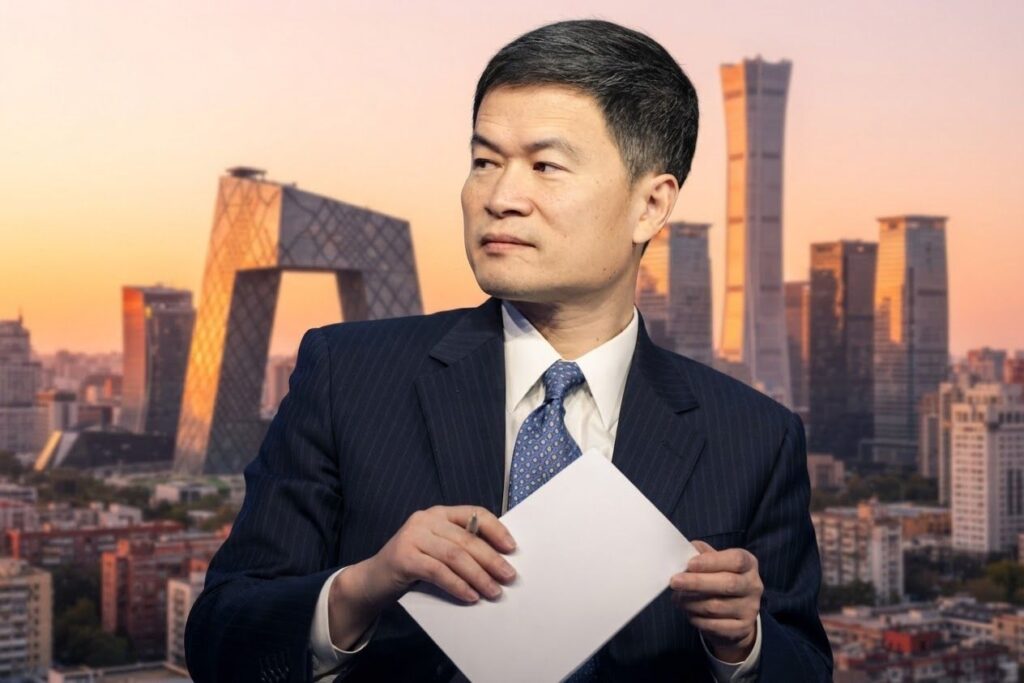
The investigation of Fang Xinghai, the former vice chairman of the China Securities Regulatory Commission, adds another layer to the story. Fang, who retired from the regulator in 2024, was one of the country’s most internationally recognisable financial officials: a Stanford-trained economist, fluent English speaker and important intermediary between Beijing and Wall Street.
He helped open Chinese markets to foreign institutions and played a role in the 2022 agreement allowing American regulators to inspect audits of Chinese companies listed in the United States. He was also associated with market-orientated reform at a time when China was still trying to reassure global investors that its financial opening would continue.
Now, China’s corruption watchdog says he is suspected of “serious violations of discipline and law”—language that usually signals severe political and potentially criminal consequences.
Investigators may examine Fang’s entire two-decade regulatory career. One likely focus is Ant Group’s aborted initial public offering. The planned listing had been expected to raise roughly $30 billion at an estimated valuation of $200 billion before authorities abruptly suspended it in 2020. Fang had been involved in the relevant issuance department and was reportedly focused on producing the world’s largest IPO.
His support for quantitative trading may also attract attention. Critics have argued that foreign high-frequency traders had advantages over China’s retail investors and contributed to volatility in commodity markets. The investigation arrives amid reports that Beijing is considering tighter controls on quantitative funds and broader scrutiny of the financial sector.
The immediate issue is not whether Fang is guilty of any wrongdoing; that is for the investigation to determine. The larger issue is what his downfall signals. Fang was seen as one of a shrinking group of Chinese technocrats who understood global financial markets and could credibly communicate Beijing’s policies to foreign institutions.
His removal reinforces the impression that political loyalty, discipline and centralised control are taking priority over the market-orientated instincts associated with an earlier era of reform. For foreign investors, this is not exactly reassuring. A system that sidelines its most internationally literate financial officials may find it harder to convince global capital that rules will remain predictable.
Washington is building a counter-China infrastructure strategy
While China tightens control at home, the Trump administration is preparing a significant effort to push back against Chinese influence abroad. The State Department has notified Congress of plans to allocate $175.8 million to replace ageing undersea telecommunications cables across Central America and the Caribbean.

The aim is to offer governments secure US and allied alternatives before strategically important digital infrastructure is controlled by Chinese companies. El Salvador, Guatemala, Honduras, Nicaragua and Haiti could benefit, although Washington is not expected to work directly with Nicaragua’s government.
This is part of the broader CABLE initiative, which stretches across the Western Hemisphere, Africa and Asia. More than $340 million is under consideration for over 50 projects designed to reduce China’s economic, technological and diplomatic leverage.
Potential measures include security operations centres in Argentina and Belize to monitor cyber threats and critical infrastructure. Other projects would help governments protect ports, offshore fisheries and critical-mineral resources from alleged Chinese exploitation or infiltration.
The basic argument from Washington is that Chinese-backed projects can look cheap at the beginning but may carry hidden maintenance costs, performance problems and political strings. That is the American pitch, anyway: not merely “don’t use Chinese infrastructure" but “here is a supposedly more secure alternative.”
It is a much more practical strategy than simply complaining about the Belt and Road Initiative. China built influence in many regions by financing physical infrastructure when Western governments were not offering much of an alternative. If Washington wants to compete, it needs to fund cables, ports, cyber defences and supply chains—not just issue speeches about strategic competition.
The interesting wrinkle is that this tougher approach is taking place alongside an apparent diplomatic thaw. Donald Trump is expected to meet Xi Jinping around the United Nations General Assembly in September. The United States is therefore pursuing a familiar dual-track policy: maintain a workable relationship at the top while escalating long-term competition everywhere else.
Tariffs, metals and AI reveal the limits of economic separation
The same contradiction is visible in the tariff dispute. China has criticised Washington’s latest Section 301 tariffs while stating that the United States had previously promised to cap replacement duties on Chinese goods at 20%.
The immediate dispute concerns efforts to replace tariffs imposed under the International Emergency Economic Powers Act after those measures were ruled invalid, alongside a separate Section 122 import surcharge. China’s Commerce Ministry said the current replacement tariff rate stands at 12.5%, implying that Washington could add another 7.5 percentage points without breaking its reported commitment.
But that does not mean Chinese imports face a universal 20% ceiling. The reported limit applies to a specific category of replacement tariffs discussed in bilateral negotiations. Many goods are still subject to earlier Section 301 tariffs and sector-specific levies, leaving total effective tariffs considerably higher in some cases.
Beijing has kept retaliatory measures in place against US fentanyl-related and reciprocal tariffs, while reserving the right to respond to future American moves. Meanwhile, Washington is pressing Mexico to impose Section 232-style duties on steel and aluminium from outside North America, partly to prevent Chinese goods from entering American supply chains through third countries.
Yet supply-chain decoupling runs into the same irritating obstacle every time: China still produces things the United States needs.
US defence contractors and manufacturers face a January 2027 deadline to stop buying certain rare earths, magnets and critical minerals from China, Russia, Iran and North Korea. Industry representatives warn that domestic suppliers are nowhere near ready to meet demand, meaning Washington may need to issue exemptions for Chinese materials.
Technology policy is similarly messy. China has criticised potential US sanctions tied to allegations that Chinese AI developers used model distillation to extract capabilities from leading American systems. But major Silicon Valley firms—including Nvidia, Microsoft, Meta, IBM, Hugging Face and nearly 200 startups—have defended open-weight AI models. Their concern is that sweeping restrictions could hurt innovation while strengthening already dominant closed-model companies.
In other words, Washington wants to limit China’s technological rise, but American companies still rely on Chinese materials, global supply chains and, in some cases, an open AI ecosystem that cannot be cleanly divided by nationality. The strategic ambition is clear. The industrial reality is rather less cooperative.
As China’s trade engine loses momentum amid broader geopolitical pressure, the tensions outlined in this assessment of China’s slowing trade growth and global disorder are likely to become even more difficult to manage.
The bigger picture: control is becoming China’s default answer
These developments may look separate—a provincial growth gap, offshore trusts, a financial regulator under investigation, American cable projects, tariffs and rare-earth restrictions—but they are connected by a broader shift.
China is trying to preserve growth by concentrating resources in strategic sectors while tightening control over capital, financial markets and politically sensitive institutions. The United States is trying to reduce China’s global leverage while discovering just how embedded Chinese industry remains in modern supply chains.
Neither side is heading toward simple decoupling. Instead, the world is getting a more fragmented version of globalisation: more tariffs, more industrial policy, more strategic infrastructure funding, more export controls and more political scrutiny of capital.
For China, the immediate challenge is internal. Advanced provinces may continue to grow, but the widening gap with slower regions will place more pressure on local finances and social stability. For Beijing, control may feel like the safest answer. The question is whether more control can generate the confidence, consumption and innovation needed to sustain growth over the long term.
Frequently Asked Questions
What is China’s K-shaped economy?
A K-shaped economy describes a divergence in which some sectors, households or regions recover and expand while others stagnate or decline. In China, technology and export-orientated provinces such as Zhejiang, Anhui, Shandong and Shanghai are outperforming regions more reliant on property, tourism, mining and traditional industries.
Why is China targeting offshore trusts?
China’s new guidance clarifies how tax authorities will apply existing worldwide-income rules to assets and income held through foreign trusts. The approach allows authorities to treat offshore trust assets as remaining under the control of Chinese tax residents in many circumstances, increasing both tax collection and state oversight of offshore capital.
Does foreign residency remove someone from China’s tax system?
Not necessarily. The new framework indicates that Chinese authorities may still treat someone as within the tax system if their principal economic interests remain in China, even if they have obtained foreign residency or citizenship.
Why is Fang Xinghai’s investigation important?
Fang was a prominent financial technocrat associated with market opening and engagement with foreign investors. His investigation may further unsettle international investors and reinforce concerns that politically reliable, centrally controlled governance is displacing more market-orientated approaches in China’s financial system.
Can the United States realistically reduce its dependence on China?
Washington can reduce exposure in selected sectors through tariffs, alternative infrastructure projects and domestic investment. However, rare earths, magnets, critical minerals, manufacturing inputs and global technology ecosystems demonstrate that rapid separation remains difficult. The United States may still require exemptions and transitional arrangements where domestic supply cannot meet demand.