A trillion-dollar trade surplus. A rapidly expanding nuclear arsenal. A strategic partnership with Russia that supposedly offers an alternative to American dominance. On paper, China looks increasingly difficult to contain.
But look a little closer, and the picture becomes considerably less comfortable for Beijing.
A proposed meeting between Donald Trump, Xi Jinping and Vladimir Putin is struggling over something as basic as how the conversation should work. China’s enormous export machine is becoming increasingly dependent on an overseas technology boom. And Russian businesses are discovering that paying in yuan does not magically make American financial sanctions disappear.
These are not separate problems. They reveal the same underlying tension: China has accumulated enormous economic and geopolitical power, but turning that power into independence is proving much harder than accumulating it.
Key Takeaways
- A proposed Trump–Xi–Putin meeting faces disagreements over its format, nuclear talks and competing priorities.
- China’s trade surplus exceeded $1 trillion in ten months, despite faster import growth.
- AI-related exports support growth but increase exposure to overseas investment cycles and trade barriers.
- Russia’s declining use of yuan export payments shows that alternative currencies do not automatically neutralise US sanctions.
Table of Contents
- First, they have to agree on how to talk
- The Nuclear Disagreement Is Much Bigger Than the Meeting
- The Trade Truce Is Buying Time, Not Solving the Dispute
- A Record Surplus, With an Awkward Catch
- The AI Boom Is Doing Some Very Heavy Lifting
- Russia’s Yuan Experiment Hits the Dollar System
- Alternative Payments Are Not Necessarily Cheap Payments
- Power Is Not the Same as Independence
First, they have to agree on how to talk.
The proposed Trump–Xi–Putin meeting on the sidelines of the November 18–19 Asia-Pacific Economic Cooperation gathering in Shenzhen sounds consequential. Three nuclear powers, one room, plenty to discuss.
Except they cannot agree on what kind of meeting they are having.
According to reporting by the Wall Street Journal’s Lingling Wei, Beijing wants prepared statements, an agreed agenda and a predetermined outcome. Washington wants a more open exchange, allowing the leaders to tackle contentious subjects directly.
That might sound like diplomatic housekeeping. It is not. Whoever controls the format also helps control the risks.
For Xi, a carefully negotiated meeting limits the possibility of an awkward public disagreement or an unexpected demand. For Trump, an open-ended encounter creates room for direct bargaining. These approaches are not especially compatible when the subjects include nuclear weapons and the war in Ukraine.
The timing adds another complication. Xi is preparing for the Communist Party’s 2027 leadership congress while managing purges and senior personnel decisions. An unpredictable encounter with Trump and Putin introduces uncertainty into a political environment where choreography matters enormously.
Beijing is reportedly willing to discuss Ukraine and other major issues if the substance is negotiated beforehand. Otherwise, it would prefer a separate bilateral meeting. In other words, China is interested in the diplomacy. It is rather less interested in improvising it.
The Nuclear Disagreement Is Much Bigger Than the Meeting
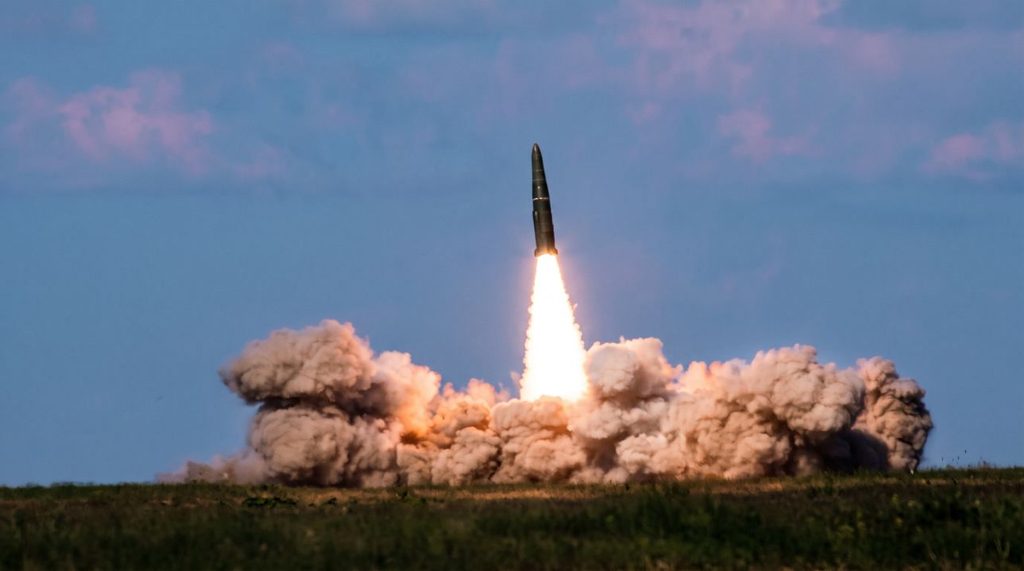
Trump has said he wants to discuss denuclearisation. Secretary of State Marco Rubio has framed the proposed gathering as an opportunity for talks among the three nuclear powers.
China, however, has consistently resisted trilateral nuclear negotiations.
The reason is straightforward. Although Beijing’s arsenal is expanding rapidly, it remains substantially smaller than those of the United States and Russia. Joining a three-way negotiating process could, from China’s perspective, institutionalise that imbalance rather than resolve it.
A Chinese official told the Wall Street Journal that Beijing would not agree to participate in such talks. That leaves Washington proposing a discussion that China does not want, at a meeting whose rules remain unsettled.
The stakes have risen since New START, the last major US–Russia nuclear arms treaty, expired in February without a replacement. The Trump administration argues that a successor agreement must include China. Beijing’s resistance therefore creates a fundamental obstacle, not merely a scheduling problem.
Putin, meanwhile, has another priority: advancing a settlement of the Ukraine war favourable to Russia, potentially with Chinese support and without Ukrainian President Volodymyr Zelensky participating.
So the three leaders would arrive with markedly different objectives. Washington wants to discuss nuclear constraints. Moscow sees an opportunity over Ukraine. Beijing wants control over the process before committing to either.
A photograph would be easy enough to understand. A shared negotiating agenda is another matter entirely.
The Trade Truce Is Buying Time, Not Solving the Dispute
Running underneath this diplomatic uncertainty is a fragile US–China trade truce. Both sides are keeping it alive. Both also accuse the other of undermining it.
Following a November 6 call with Vice Premier He Lifeng, US Treasury Secretary Scott Bessent and Trade Representative Jamieson Greer demanded concrete Chinese action on agricultural purchases, rare earths and other critical minerals. Bessent urged Beijing to implement its Busan commitments immediately.
China’s account emphasised concerns about recent American trade restrictions, while describing the discussions as constructive. That is a familiar diplomatic arrangement: everyone agrees the conversation was useful, while disagreeing about what the other side needs to do.
Nevertheless, both governments extended suspensions of several restrictions for another two months:
- China prolonged pauses covering additional tariffs, port fees and measures against American companies.
- Washington extended selected tariff exclusions and suspended restrictions involving Chinese maritime industries and affiliates of blacklisted entities into January 2027.
These extensions matter. They prevent an immediate escalation and preserve negotiating space. But they are not evidence that the underlying arguments have disappeared.
US officials previously told the Financial Times that China was fulfilling only around two-thirds of its rare-earth commitments. Trade is expected to receive fuller attention when Trump and Xi meet at the G20 in Miami in December, potentially after preparatory talks between economic officials.
For now, the truce is functioning more like a rolling postponement than a durable settlement. As earlier analysis of summit diplomacy and China’s nuclear posture illustrates, economic bargaining and security concerns are increasingly difficult to separate.
A Record Surplus, With an Awkward Catch
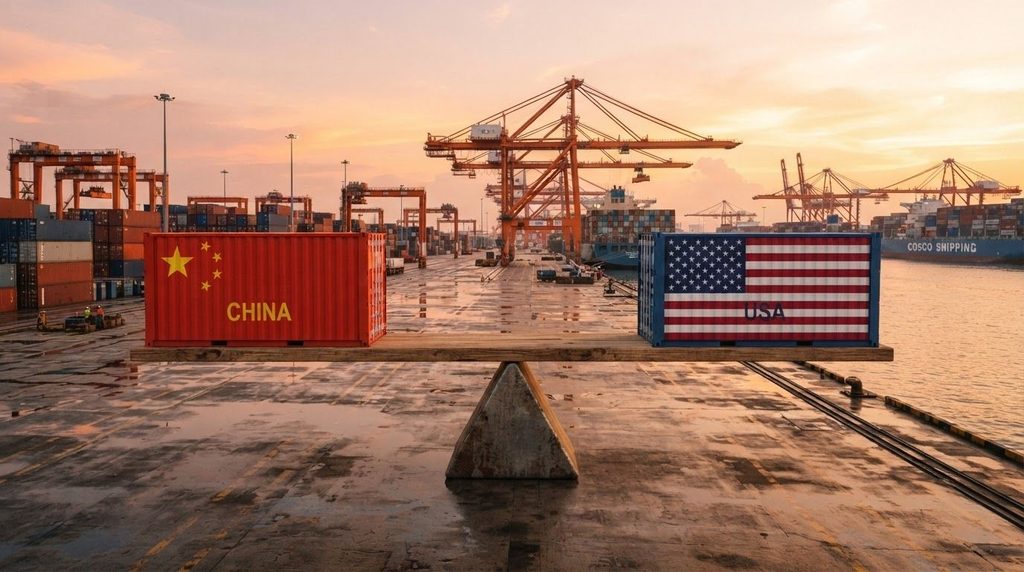
China’s export numbers make the trade dispute harder to contain. Its goods trade surplus reached $1.04 trillion in the first ten months of 2026, nearly 9% above the $964.8 billion recorded a year earlier. That puts China on course to exceed the previous year’s record annual surplus of $1.2 trillion.
For Beijing, this demonstrates formidable manufacturing strength. For trading partners struggling to protect their own industries, it looks rather different.
The geographical breakdown explains why:
- European Union: China’s surplus reached $310 billion, already exceeding the $292 billion recorded throughout the previous year.
- Southeast Asia: The surplus reached $293 billion, up approximately 34%.
- United States: The surplus reached $266 billion, up approximately 14%.
October exports rose 35.2% year on year, slightly below September’s 36.3% expansion and economists’ forecasts. Imports grew even faster, jumping 41.6% in their strongest increase since 2021.
At first glance, that import surge looks like encouraging evidence of Chinese demand returning. Unfortunately, the composition matters.
Growth was concentrated in higher-priced energy and technology components. That offers limited evidence of a broad recovery in domestic spending. Factories buying inputs and consumers feeling confident are not the same thing.
October’s surplus consequently narrowed to $105.3 billion, down from $133 billion in September and its smallest level since May. But a smaller monthly imbalance does not erase the record accumulated across the year.
This is the structural problem explored in the debate over whether China’s export-led growth model is sustainable. Strong overseas sales can support production without fixing weak demand at home. They can also provoke the very trade restrictions that make overseas growth harder to sustain.
The AI Boom Is Doing Some Very Heavy Lifting

One of the most striking features of China’s export performance is how much of it is tied to technology investment. According to ING chief China economist Lynn Song, high-tech exports rose 66.6% in October, while semiconductor exports increased 137%. Across the first ten months, integrated-circuit exports increased 111% by value.
Impressive? Certainly. But here comes the important qualification: their export volume rose only 3.2%.
The value of those shipments more than doubled without anything approaching a doubling in the number shipped. Rising prices therefore played a major role. That distinction matters because an export boom driven heavily by prices has a different foundation from one driven by a comparable expansion in physical demand.
Chips and computer parts accounted for approximately 40% of the increase in total export value. AI-related products represented 28% of Chinese exports during the first three quarters.
That is substantial exposure to a particular investment cycle.
The manufacturing momentum is broader than AI hardware alone. Vehicle shipments rose 50% by volume to 9.74 million units, while solar panels, batteries and industrial robots also contributed. China plainly has multiple sources of export strength.
Nevertheless, the AI connection introduces a vulnerability. Citi economists warned that a slowdown in American AI investment following the Democrats’ midterm election victory could weaken Chinese exports. That is a risk assessment, not a certainty. The underlying dependence, however, is clear: spending decisions abroad are supporting an increasingly important part of China’s growth.
Meanwhile, Europe has imposed tariffs on Chinese electric vehicles and a quota on hybrid imports. Emerging economies are also deploying more trade-defence measures against inexpensive Chinese products.
Beijing argues that foreign restrictions on advanced technology constrain its ability to import more. But that does not remove the exposure. If overseas demand cools while trade barriers rise, China’s factories face pressure from both directions—and weak domestic demand offers limited relief.
Russia’s Yuan Experiment Hits the Dollar System
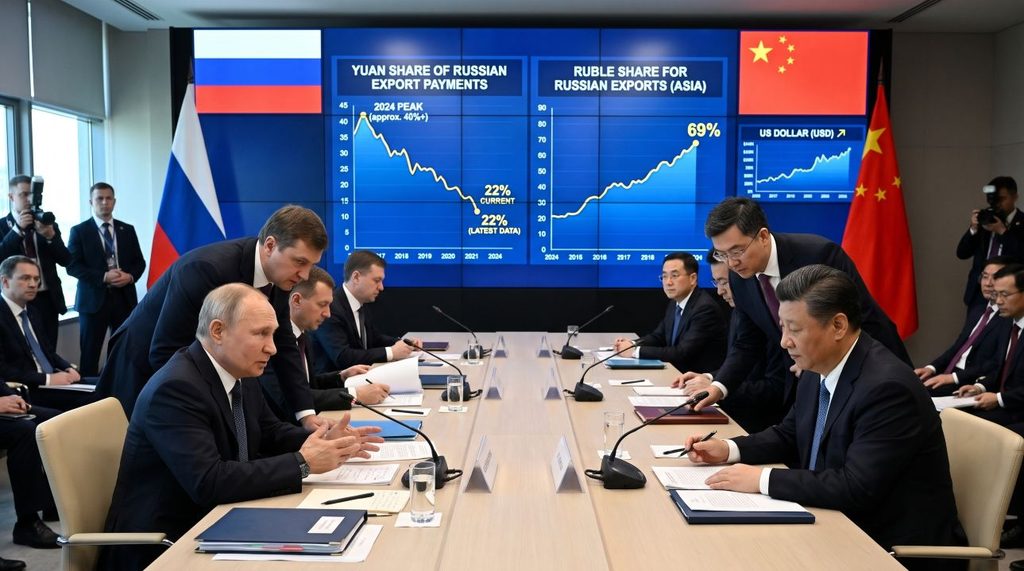
Then there is the financial relationship with Russia, where the gap between strategic ambition and practical independence becomes particularly visible.
After Russia’s full-scale invasion of Ukraine in 2022 triggered sweeping Western sanctions, Russian businesses embraced the yuan. It became central to trade, lending, deposits and foreign-exchange transactions.
China’s emergence as Russia’s largest trading partner reinforced that shift. Russia also received yuan from buyers outside China, extending the currency’s use beyond transactions directly involving Beijing.
For advocates of moving away from the dollar, this looked promising.
But Russian central bank data cited by Bloomberg show that the yuan’s share of payments for Russian exports has fallen to 22%, roughly half its mid-2024 peak. The rouble now accounts for 69% of payments for Russian exports to Asia.
The turning point was Washington’s expansion of secondary sanctions in June 2024. Major Chinese lenders, facing the risk of American penalties, curtailed dealings with Russian businesses. Payments were frozen, delayed or returned.
This exposes an easily missed distinction: the currency used for a transaction and the financial exposure of the bank processing it are different things.
A payment denominated in yuan does not automatically protect a Chinese bank from American pressure. Those institutions still have powerful incentives to preserve access to international dollar-based finance. The reach of US sanctions targeting Russian activities therefore extends beyond transactions conducted in dollars.
Political friendship does not make that commercial calculation disappear.
Alternative Payments Are Not Necessarily Cheap Payments
Russian businesses have increasingly turned to middlemen, payment agents and third countries. Those routes can keep transactions moving, but they introduce costs, delays and uncertainty—even when contracts and counterparties have been checked.
Logistics provider STT Logistics estimates that cross-border payment costs with China, including intermediary commissions and fees, now average 15–20% of transaction values.
That is hardly a frictionless alternative financial system. It is an expensive workaround.
The difficulties also complicate Beijing’s ambitions for the yuan. Its share of SWIFT payments has slipped behind the Japanese yen, although Chinese officials argue that those figures exclude substantial activity through China’s CIPS network and internal banking channels.
That qualification matters. SWIFT figures alone do not capture every international use of the yuan. Equally, activity outside SWIFT does not prove that participating banks are insulated from sanctions.
China also maintains tight capital controls and says it does not seek to replace the dollar outright. The immediate issue is therefore not whether the yuan can suddenly take over global finance. It is whether using it provides the protection that some Russian businesses expected.
The evidence suggests that protection has clear limits.
Power Is Not the Same as Independence
Put these developments together and a less comfortable picture emerges than the headline trade surplus suggests.
China can manufacture at extraordinary scale, but still depends heavily on foreign customers. It can build a closer strategic relationship with Russia, but its banks remain sensitive to American sanctions. It can help convene consequential diplomacy, but cannot easily reconcile the participants’ competing objectives.
None of that means China is weak. It means its strength comes with dependencies that political messaging cannot simply wish away.
The real test is not whether Trump, Xi and Putin can arrange a meeting, or whether China can post another enormous surplus. It is whether Beijing can turn industrial success and diplomatic influence into a more resilient position.
For now, the factory output is real. So are the constraints.
Q: Why is the proposed Trump–Xi–Putin meeting struggling to get off the ground?
A: The three leaders cannot agree on the format or agenda: Xi wants a tightly scripted event with predetermined outcomes, while Trump wants an open-ended discussion on denuclearisation and Putin wants a favourable settlement on Ukraine. Because China's nuclear arsenal is smaller than the US and Russian stockpiles, Beijing also refuses to join three-way nuclear arms talks.
Q: What is the hidden vulnerability behind China’s record $1.04 trillion trade surplus?
A: While China's exports are booming, growth is heavily propped up by rising prices on AI-related hardware and chips rather than surging physical demand or domestic consumption. This leaves China's economy exposed to foreign tech investment cycles and escalating global tariffs while domestic spending remains weak.
Q: Why hasn't paying in Chinese yuan protected Russian businesses from Western sanctions?
A: Following expanded US secondary sanctions, major Chinese banks curtailed Russian transactions to protect their own access to the global dollar system, causing the yuan's share of Russian export payments to drop by half. Russian firms now rely on costly middlemen and payment agents, adding 15–20% in transaction fees.
Q: What is the central takeaway about China’s global position from these developments?
A: Accumulating massive economic and geopolitical power is not the same as achieving strategic independence. Despite its manufacturing scale and diplomatic clout, Beijing remains deeply constrained by its reliance on foreign buyers and the global dollar-based financial system.