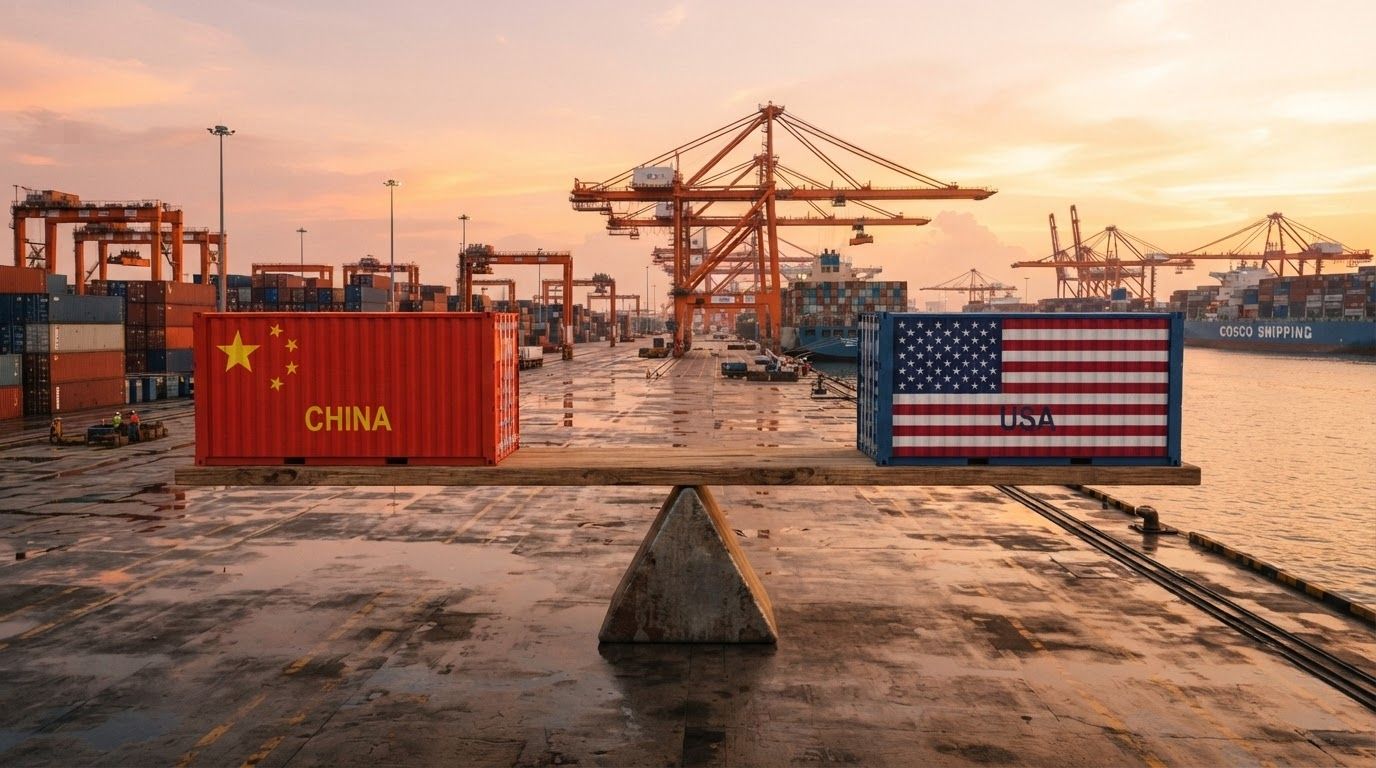
China is approaching a milestone that ought to be cause for celebration. The country that launched its economic reforms in 1978 is nearing the World Bank’s high-income threshold. Its economy has grown from roughly $1.3 trillion when it joined the World Trade Organization in 2001 to nearly $20 trillion. Exports have expanded around thirteenfold.
That is an extraordinary transformation. But an impressive national balance sheet is not the same thing as a financially secure population.
For millions of Chinese families, falling property values, inadequate pensions and uncertain employment matter rather more than an international classification. Meanwhile, Beijing continues to prioritise industrial power, political control and technological competition.
Three developments expose the tension: China’s struggle to turn national wealth into household security, another lengthy prison sentence for Hong Kong activist Joshua Wong, and allegations surrounding Nvidia’s dealings with a company suspected of diverting advanced chips to China.
These are different stories. But each raises a question about accountability: who benefits from the system, who bears its risks, and what happens when official ambitions collide with inconvenient realities?
Key Takeaways
- China is nearing high-income status, but weak pensions, housing losses and job uncertainty continue to restrain household spending.
- Manufacturing strength cannot eliminate the risks of weak domestic demand and rising foreign trade barriers.
- Joshua Wong’s further prison sentence has intensified criticism of Hong Kong’s national security law.
- Reported Nvidia investigations raise unresolved questions about chip diversion, corporate influence and export-control enforcement.
Table of Contents
- A Rich-Country Label Will Not Pay the Bills
- The Housing Engine Has Become a Household Burden
- Beijing Wants Consumers to Spend. Its Safety Net Tells Them to Save.
- The Industrial Success Story Has a Demand Problem
- Joshua Wong’s Sentence Shows the Other Side of Beijing’s Priorities
- Nvidia’s China Controversy Goes Beyond a Corporate Scandal
- The Missing-Chip Question Is Bigger Than the Headlines
- Export Controls Are Only as Strong as Their Enforcement
- The Bottom Line: National Power Is Not Household Prosperity
A Rich-Country Label Will Not Pay the Bills
First, some perspective. China’s reduction in extreme poverty has been enormous. The World Bank estimates that close to 800 million people escaped extreme poverty after economic reforms began, accounting for roughly three-quarters of the global reduction over that period.
That achievement deserves recognition. It also needs to be understood properly.
When Xi Jinping declared victory over absolute poverty in 2021, Beijing’s benchmark was equivalent to approximately $2.30 a day. At the World Bank’s $8.30 benchmark for upper-middle-income economies, more than one-fifth of China’s population remained below the poverty line in 2022.
Different thresholds answer different questions. Escaping extreme deprivation does not necessarily mean having enough income to absorb a medical bill, support an elderly parent or survive unemployment.
Likewise, crossing a high-income threshold changes a country’s classification. It does not automatically change how its income is distributed. Hundreds of millions of people can remain financially vulnerable inside an economy that looks increasingly prosperous from a distance.
The Housing Engine Has Become a Household Burden

For years, property helped bridge that gap. A home was not merely somewhere to live. It was a store of wealth, a retirement plan and, for some families, their principal financial cushion. Now that cushion is shrinking.
Housing prices have fallen roughly a fifth from their 2021 peak. Real estate still represents around 47% of household assets, although that is down from earlier estimates approaching 70–80%. Families remain heavily exposed to an asset that no longer offers the reassurance it once did.
The response is hardly mysterious. When your largest investment loses value and your future income looks uncertain, spending freely is not the obvious next move.
Household bank deposits have roughly doubled since 2019 to around 165 trillion yuan. Beijing keeps encouraging consumption. Households keep building financial defences.
This is the central problem with treating weak consumption as a confidence issue that can be solved through encouragement. Confidence needs something to stand on. A deteriorating retirement cushion and an unreliable income do not provide much support.
As explored in this analysis of China’s deepening property losses, even slower price declines would not reverse the wealth damage already sustained.
Beijing Wants Consumers to Spend. Its Safety Net Tells Them to Save.
The public safety net makes caution more understandable.
Unemployment insurance reaches only about a third of the workforce. The minimum monthly rural pension increased by just 20 yuan in the increase described here, bringing it to 163 yuan. That is an extraordinarily thin foundation for financial security.
Younger workers face their own uncertainty. Unemployment among 16- to 24-year-olds outside education stands at around 18%.
Put those pressures together, and the consumption figures become less puzzling. Household consumption accounts for approximately 40% of Chinese GDP, compared with roughly 55–70% across high-income economies.
The issue is not simply whether people have money in bank accounts. It is whether they can afford to stop treating that money as insurance against everything else.
Income distribution makes the problem harder. In 1978, the top 10% of earners and the bottom half each received about a quarter of national income. The top tenth now receives more than 40%, while the bottom half receives less than 14%.
That is an awkward backdrop for “common prosperity”. The slogan promises broadly shared gains. The economic strategy still directs substantial resources towards advanced manufacturing and technology.
The Industrial Success Story Has a Demand Problem
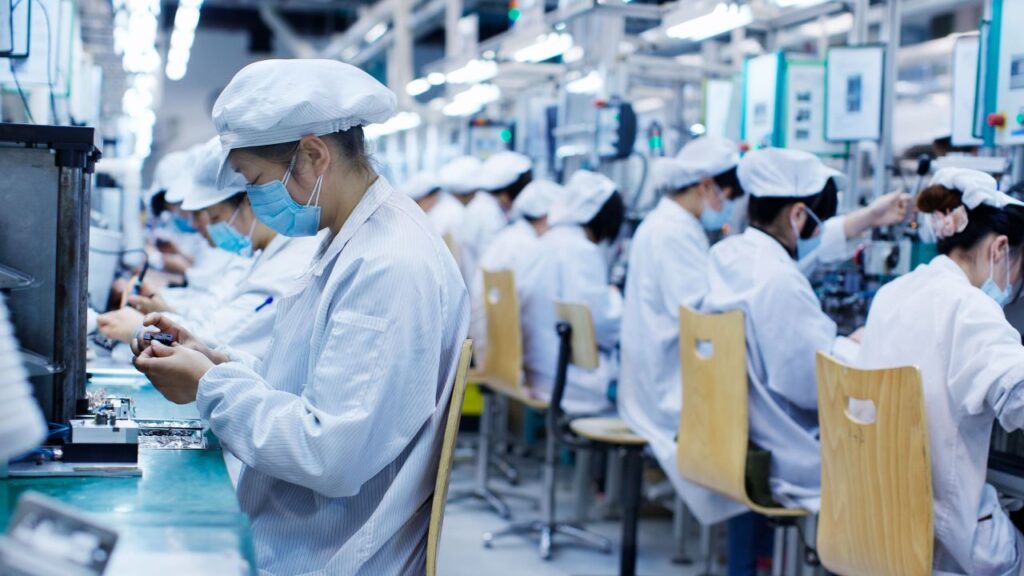
There is no denying the manufacturing achievements. China produces more than 70% of the world’s electric vehicles and roughly 80% of its batteries and solar panels.
But factories need customers. When domestic demand is weak, selling abroad becomes more important. And that is where China’s industrial success starts running into other countries’ political priorities.
After WTO accession, Chinese exports were closely associated with products such as toys and textiles. Today, Chinese manufacturers compete in industries that advanced economies regard as central to their future growth and employment.
The result is rising tariffs and trade barriers. Beijing can build enormous production capacity, but it cannot force foreign governments to welcome the resulting imports.
This is why the debate over the limits of export-led growth matters. A stronger domestic consumer sector would not merely improve living standards. It could reduce dependence on markets that are becoming increasingly resistant.
Demographics make delaying that adjustment more costly. China is expected to have around 400 million retirees by 2035.
Economist David Daokui Li estimates that providing a liveable pension to roughly 130 million rural elderly people would cost 1.25 trillion yuan annually, or about 4% of government spending. That would support some of China’s poorest households while potentially reducing the amount their working-age relatives need to save for parental care.
The trade-off is real. With government debt already historically high, redirecting spending towards households would constrain other priorities. Beijing cannot indefinitely promise stronger consumption while protecting every investment commitment and global ambition from the bill.
Joshua Wong’s Sentence Shows the Other Side of Beijing’s Priorities
Economic insecurity is not the only pressure confronting people under Chinese sovereignty. In Hong Kong, the boundaries of permissible political activity have narrowed dramatically.
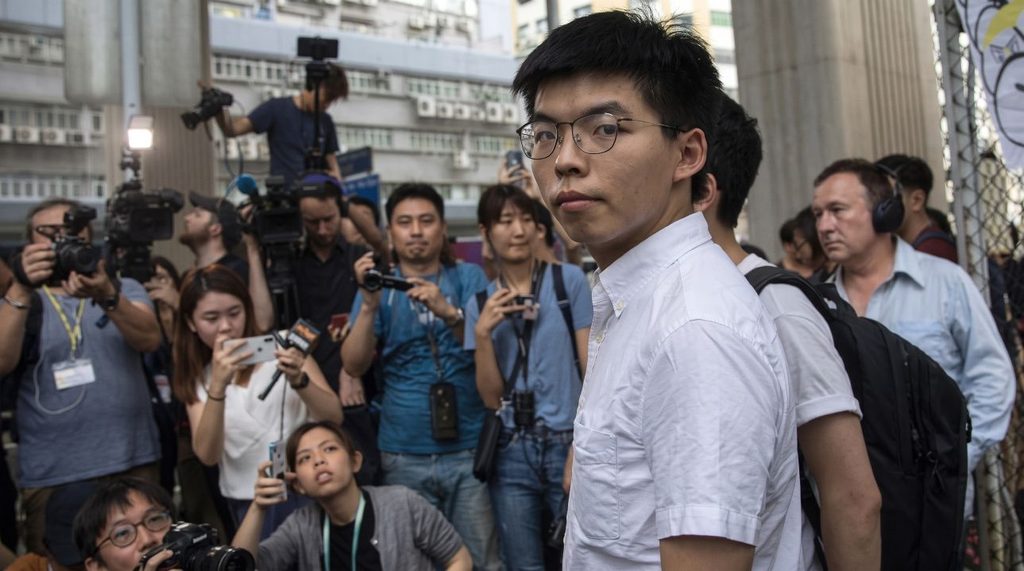
A Hong Kong court sentenced pro-democracy activist Joshua Wong to a further ten years in prison after he pleaded guilty to conspiring to collude with foreign forces. Wong has been behind bars since 2020 and is the only Hong Kong activist to have been prosecuted twice under the city’s national security law.
Prosecutors accused him of working with exiled activist Nathan Law to encourage foreign governments to impose sanctions, blockades or other measures against China.
The court described the offence as grave. Its reasoning referred both to Wong’s efforts to seek US intervention before the law took effect in 2020 and to his subsequent sharing of Law’s social media posts calling for sanctions.
That distinction matters. The inclusion of pre-enactment activity raises concerns about retrospective punishment, while the court also identified conduct after enactment.
Wong first became internationally prominent as a teenage leader of the 2014 Umbrella Movement, which demanded genuinely competitive elections. His earlier national security conviction concerned an unofficial opposition primary held in 2020.
Hong Kong police welcomed the latest ruling. Britain and the United States condemned it. Britain’s Foreign Office said the law was being used to punish political expression and urged Beijing and Hong Kong authorities to uphold the freedoms guaranteed under the 1984 Sino-British Joint Declaration.
The disagreement is fundamental: authorities present the prosecution as protecting national security; critics see political expression being treated as a security threat.
Nvidia’s China Controversy Goes Beyond a Corporate Scandal

Huang allegedly had an affair for the head of Nvidia
Then there is Nvidia, where reported questions about chip exports, corporate influence and a senior executive’s personal relationship have converged. These allegations require care. Suspected chip diversion is not proven diversion. An intelligence allegation is not a public judicial finding. Questions about access to sensitive information are not evidence that information was actually obtained.
Even with those qualifications, the reported sequence deserves scrutiny.
The New York Times reported that the US Commerce Department paused work on a suspected chip-smuggling investigation after Nvidia’s chief lawyer contacted officials about the case. The inquiry concerned whether Singapore-based MegaSpeed International had diverted advanced Nvidia chips to China.
Bloomberg separately reported that Nvidia general counsel Tim Teter contacted Jeffrey Kessler, the Commerce official overseeing export controls, to ask whether his bureau had been involved in Singapore’s detention of a MegaSpeed executive. Sources cited by Bloomberg said the bureau had not been involved.
According to the Times, Teter subsequently emailed investigators saying Kessler had authorised Nvidia to contact them. Officials questioned the communication because Nvidia remained a potential subject of the inquiry.
Commerce alerted partner law-enforcement agencies. The Justice Department then asked Commerce to pause its work, and the department complied.
That does not establish that Nvidia improperly secured the pause. It does raise an obvious accountability question: how should investigators handle contact from a powerful company that may itself fall within their investigation?
The Missing-Chip Question Is Bigger Than the Headlines

The hardware accounting is particularly important. US officials had asked Nvidia to audit MegaSpeed. Nvidia initially said it had accounted for the hardware, but Bloomberg reported that MegaSpeed had imported approximately 50,000 more chips than Nvidia located at its data centres.
The reporting did not establish where those chips went. That limitation is crucial. A discrepancy warrants investigation; it does not, by itself, prove a destination.
According to the Wall Street Journal, MegaSpeed operated as an intermediary between chip suppliers and customers seeking computing capacity, with Alibaba among its major clients. Bloomberg reported that Teter later told a White House official Nvidia had stopped doing business with MegaSpeed.
Separately, reports described an internal Nvidia investigation following Jensen Huang’s disclosure of an affair. The Times reported that US officials believed the woman involved had been recruited by China’s Ministry of State Security. China’s Foreign Ministry rejected the allegations as groundless, and the underlying intelligence has not been made public.
Analyst Bill Bishop argued that potential exposure could extend beyond chip allocations to private communications, policy discussions or device access. Those are risk scenarios, not established breaches. But they explain why the matter cannot sensibly be reduced to celebrity gossip.
Export Controls Are Only as Strong as Their Enforcement
Scrutiny also extends to transactions Washington explicitly approved.
The Times reported finding little evidence of an operating presence in China for New Matrix, a company cleared through a Commerce national security review to assemble Nvidia H200 chips into AI systems. That approval followed President Donald Trump’s decision to permit H200 sales to China subject to government review.
The question is therefore broader than whether somebody evaded the rules. It is whether the approval process adequately establishes who the customers are and where the hardware ultimately goes.
The US Bureau of Industry and Security oversees export controls, but congressional pressure could change the boundaries of executive discretion. Lawmakers from both parties were already seeking tighter restrictions through the annual defence bill, with further efforts reported for a lame-duck session.
Stronger controls could further constrain China’s access to advanced computing and unsettle an already fragile US–China relationship. Leaving credible enforcement questions unanswered carries risks of its own.
The Bottom Line: National Power Is Not Household Prosperity
China’s economic achievements are substantial. So are the gaps those achievements have not closed.
A high-income classification cannot substitute for a pension. Manufacturing dominance cannot guarantee willing overseas customers. National security legislation does not settle arguments about political freedom. And chip-export approvals mean little if authorities cannot reliably establish the final recipient.
The central challenge is not whether China can accumulate more national power. It plainly can. The harder question is how that power is exercised—and whether ordinary households receive enough security to share meaningfully in the prosperity it produces.
Frequently Asked Questions
Why is China’s household consumption relatively low?
Housing losses, limited social protection, employment uncertainty and unequal income distribution encourage households to save. Consumption remains around 40% of GDP.
What would stronger rural pensions change?
They could increase elderly households’ income and reduce the need for working-age relatives to save for their parents’ care.
Has the reported Nvidia chip diversion been proven?
No conclusion establishing the chips’ destination was presented in the reporting described here. The reported discrepancy and related allegations remain matters requiring investigation.