China opened the week with a cluster of developments that, taken together, say a great deal about where the country stands right now. A small plane crash into Beijing's tallest tower has triggered a sudden clampdown on private aviation. Chinese equities have fallen sharply after last year's AI enthusiasm faded. Brussels and Beijing are trying to stabilise trade relations even as Europe prepares for a tougher stance. And fresh manufacturing data once again shows the same imbalance at the heart of the economy: exports remain strong while domestic demand stays weak.
Each story matters on its own. Together, they point to a broader pattern of tightening control, economic strain, and growing external resistance to China's current growth model.
Table of Contents
- Beijing tightens control after aircraft hits CITIC Tower
- Chinese stocks lose momentum as AI optimism fades
- EU and China launch a new trade consultation channel
- European automakers cut costs as Chinese competition grows
- Manufacturing grows again, but the imbalance is getting harder to ignore
- The common thread across these stories
- FAQ
Beijing tightens control after aircraft hits CITIC Tower
Chinese authorities have moved quickly after a light aircraft struck the 528-metre CITIC Tower in Beijing, killing the pilot and injuring 13 people on the ground. The crash happened late Friday afternoon and immediately raised difficult questions about how a small private aircraft was able to approach one of the most sensitive airspaces in the country.

Officials have released only limited information. The cause of the incident remains under investigation, and public details about the pilot have been sparse. At the same time, online discussion and footage related to the crash have been rapidly scrubbed, which has only intensified attention on the security implications.
Even without a major public policy announcement from Beijing, operators across the country say the response has already arrived. Flight schools, glider clubs, and skydiving businesses in several regions reported receiving notices that private fixed-wing aircraft and glider activity must stop until further notice. Flight data also showed recreational activity dropping sharply, especially in northern China where operations appeared to halt almost immediately.
Some drone training programmes in Beijing have also paused outdoor sessions, though reports from southern cities suggest the restrictions are not being applied equally nationwide.
Why this crash is drawing such an intense response
This was not just another aviation accident. The aircraft reportedly took off from a flying school about 50 kilometres east of central Beijing and headed toward the city. Its transponder signal disappeared shortly before it entered one of the capital's tightly controlled no-fly zones.
That detail is crucial. Airspace around Beijing is heavily restricted, especially near government compounds and critical infrastructure. For a small aircraft to get this close to the political centre of the country is the kind of failure that is likely to unsettle senior leadership.
The incident also threatens to complicate one of Beijing's favoured emerging sectors: the so-called low-altitude economy. This category includes drones, recreational aviation, flying taxis, and other short-range aerospace activities. Chinese policymakers have been promoting the sector as a future growth engine, but this crash exposed a basic problem. Expansion is much harder when regulators cannot guarantee control.
A key question now is whether authorities will force private aircraft and future low-altitude vehicles to use hard geofencing technology that blocks entry into restricted areas. That system already exists in many drone platforms. If regulators decide that small manned aircraft cannot be reliably retrofitted with similar safeguards, then that part of the market could face severe long-term limitations.
The likely outcome is not the end of the low-altitude economy but a regulatory overhaul. In fact, Beijing may use this incident to tighten standards and reduce political risk before allowing the sector to expand further.
Chinese stocks lose momentum as AI optimism fades
China's equity market has had a rough year, especially compared with the optimism that carried into 2026 after a strong 2025. What many expected to be a continuation of an AI-driven rebound has instead turned into one of the weakest performances among major global markets.

The MSCI China Index is down 15 per cent this year, ranking near the bottom globally. Two of the country's biggest technology names, Tencent and Alibaba, have each fallen more than 29 per cent, erasing a combined market value of roughly US$337 billion.
The scale of the decline matters because expectations coming into the year were much higher. Investors had hoped that China's advances in artificial intelligence, especially after the rise of DeepSeek, would support a broader rerating of Chinese assets. There was also confidence that Beijing would do more to steady growth and improve earnings.
That confidence has not held.
What is driving the sell-off?
The biggest drag is still the domestic economy. Consumer spending remains weak, and that has hurt profits across internet platforms, retailers, and carmakers. The property downturn continues to weigh on household confidence, which in turn holds back consumption.
There is also a market rotation underway. Global investors have shown a clear preference for AI hardware over software and platform companies. That has benefited markets such as Taiwan and South Korea, where chipmakers dominate the index composition. Chinese internet firms have not captured the same enthusiasm.
On top of that, geopolitics has returned as a major concern. Renewed scrutiny from the United States toward Chinese technology companies has revived fears around sanctions, restrictions, and broader regulatory risk. Beijing's tighter monitoring of cross-border capital flows has added another layer of unease, particularly for Hong Kong-listed Chinese firms that rely on foreign investor confidence.
Not every part of the market is falling
There is an important distinction inside China's markets. While offshore and internationally tracked Chinese equities have struggled, the mainland CSI 300 index has risen about 6 per cent this year.
That strength has come largely from domestic technology hardware manufacturers and industrial companies. In other words, the parts of the economy tied more closely to production and state-backed industrial capacity are doing relatively better than consumer-facing sectors.
This split reinforces a central reality of the current Chinese economy. Industrial output, especially in strategic sectors, remains supported. Household demand does not.
Unless Beijing rolls out far stronger stimulus aimed directly at consumers, earnings pressure in large parts of the economy is likely to continue. For global investors, the excitement around Chinese AI progress has not disappeared entirely, but it has been overtaken by concerns about growth quality, policy risk, and the fading appeal of the broader market.
EU and China launch a new trade consultation channel
Brussels and Beijing have agreed to create a new high-level consultation mechanism designed to ease trade tensions and address the widening imbalance between European imports from China and European exports to China.
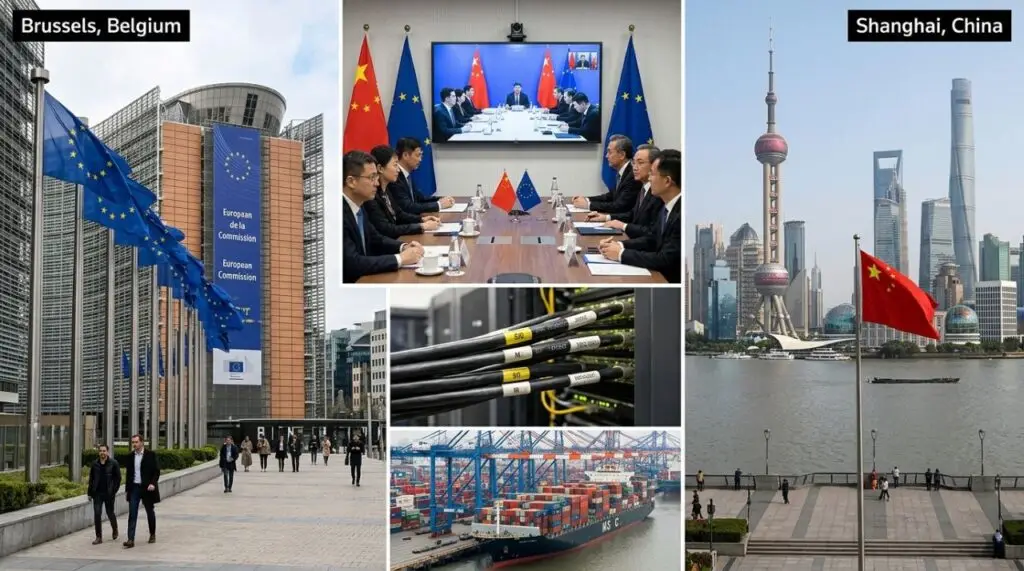
The new framework emerged from talks in Brussels with China's commerce minister and the EU trade commissioner. It is intended to provide a structured platform for dealing with the disputes that have piled up as Chinese exports continue to flood into European markets.
The mechanism will focus on four areas:
- Trade and investment
- Export controls
- Intellectual property rights
- World Trade Organization reform
A working group on trade flows is due to begin immediately. Both sides have agreed to share data and track import trends together. If major imbalances appear, discussions can be escalated to the political level.
An initial roadmap with concrete goals is expected soon, and the first review of progress is scheduled for September. A further round of engagement is expected in China in October, where European officials hope to show at least one practical result from the new dialogue.
Rare earths remain a major pressure point
One issue getting special attention is rare earths and permanent magnets. European officials say they received assurances from Beijing that Chinese export controls in this area will not disrupt European supply chains.
That matters because China remains dominant in the global rare earth market, and any interruption would have immediate consequences for manufacturing across Europe, especially in automotive and industrial supply chains.
Still, reassurance is not the same as resolution. European policymakers are increasingly aware that dependence on Chinese-controlled inputs leaves industries vulnerable, and that concern is becoming part of a broader strategic rethink.
European automakers cut costs as Chinese competition grows
The timing of the EU-China trade talks is not accidental. Europe's manufacturing base, particularly its automotive sector, is under mounting pressure from Chinese producers.

Germany's car industry is now entering a major cost-cutting phase. Reports indicate Volkswagen is preparing to eliminate up to 100,000 jobs over the coming years while closing four factories in Germany. BMW has warned of restructuring costs that could reach €1 billion, with analysts expecting substantial job cuts and lower European output. Mercedes-Benz has also intensified cost reductions, including suspending summer bonuses and overseeing thousands of voluntary departures.
These are not isolated company adjustments. They reflect a deeper competitiveness problem. Chinese manufacturers have been gaining market share with the support of scale, state backing, and aggressive export pricing. European officials increasingly accept that China's industrial model is not likely to change on its own.
That is why Brussels is considering stronger defensive tools. New investigations into Chinese imports could begin before August, opening the door to emergency tariffs or quotas in sectors such as chemicals and machinery.
The message coming out of Europe is becoming clearer: dialogue will continue, but patience is wearing thin.
Manufacturing grows again, but the imbalance is getting harder to ignore
Fresh official data for June showed China's manufacturing sector expanding slightly more than expected. The official manufacturing PMI rose to 50.3 from 50 in May, just above the threshold that signals expansion and above market expectations of 50. 1. The non-manufacturing PMI, covering services and construction, also edged higher to 50. 2.
On paper, that suggests modest stabilisation. In practice, it tells a more familiar story.
The factory side of the economy is holding up because exports are still doing the heavy lifting. Global demand for AI-related infrastructure has supported outbound shipments of chips, computers, and other technology goods. Industrial production remains resilient in part because export-orientated manufacturing continues to receive significant state support.
Export prices have also risen at their fastest pace in more than three years, reinforcing the idea that external demand is still sustaining the industrial sector.
Domestic demand remains the weak link
The problem is that stronger manufacturing data is masking weakness elsewhere. Retail sales have softened. Property prices remain under pressure. Fixed asset investment has also weakened. These are all signs that internal demand is still too fragile to provide balanced growth.
That leaves Beijing in a difficult position. The economy is still moving, but it is moving on a narrow base. Instead of broad domestic recovery, growth is being carried by exports and industrial output.
And that model is running into resistance abroad. Europe is considering more action against rising Chinese imports. The United States remains deeply sceptical of China's trade practices. The more China relies on subsidised exports to maintain momentum, the more it risks provoking barriers in the very markets it depends on.
Will Beijing offer more support?
Investors are looking for additional policy easing. China's central bank recently lowered the rate on a new liquidity facility, a move some economists see as effectively a limited interest rate cut. The goal is straightforward: reduce borrowing costs and provide support to economic activity.
But the deeper issue is not just liquidity. It is the structure of demand. If households remain cautious and the property slump continues to suppress confidence, easier money alone may not be enough to change the picture.
That is why the latest data, while better than expected, does not really resolve anything. It confirms resilience in manufacturing, but it also confirms how dependent the economy has become on an export-led model that is facing both fiscal strain at home and political pushback abroad.
The common thread across these stories
The aviation crackdown, the market selloff, the EU trade talks, and the manufacturing data may seem unrelated at first glance. They are not.
All four developments point to a system under pressure to preserve control while buying time.
- In aviation, authorities are likely to tighten regulation after a security breach near the political centre.
- In markets, investors are pulling back as growth doubts overwhelm earlier AI enthusiasm.
- In trade, Europe is trying to manage imbalances while preparing defences against Chinese overcapacity.
- In the economy, exports are keeping activity afloat, but domestic weakness remains unresolved.
That does not mean collapse is imminent. It does mean the current model is becoming harder to sustain without either major internal reform or deeper friction with external partners.
For now, the data still shows industrial resilience. The politics, however, are becoming less forgiving both inside China and overseas.
FAQ
Why did China suspend private recreational flights after the Beijing crash?
Authorities appear to be responding to serious security concerns after a light aircraft struck the CITIC Tower in Beijing. Operators across the country reported receiving orders to halt fixed-wing recreational flights and glider activity, suggesting a broad precautionary crackdown while the investigation continues.
What is the low-altitude economy in China?
The term refers to emerging industries operating in lower airspace, including drones, recreational aviation, flying taxis, and related aerospace services. Beijing has been promoting it as a future growth sector, but the recent crash may lead to tighter safety and geofencing requirements.
Why are Chinese stocks performing so poorly this year?
Several factors are weighing on equities: weak consumer demand, the continuing property downturn, investor preference for semiconductor heavy markets like Taiwan and South Korea, and renewed geopolitical risks surrounding Chinese technology firms and capital controls.
What is the new EU-China trade mechanism supposed to do?
It is a high-level consultation channel focused on trade and investment, export controls, intellectual property, and WTO reform. It is meant to help both sides monitor trade flows, address imbalances, and reduce the risk of escalation as tensions over Chinese imports continue to grow.
Is China's economy still growing because of exports?
Recent PMI data suggests that manufacturing is still expanding largely because exports remain strong, especially in technology-related goods. The concern is that domestic demand is much weaker, with softer retail sales, property prices, and investment making growth increasingly dependent on external markets.
Could Europe impose more tariffs on Chinese goods?
Yes. European officials are considering new investigations into Chinese imports, and those could lead to emergency tariffs or quotas in sectors such as chemicals and machinery if trade imbalances continue to worsen.
For now, this China news update is less about one headline than about the pattern connecting them. The centre is tightening, the economy remains lopsided, and key trade partners are becoming more defensive. That combination is likely to define the months ahead.