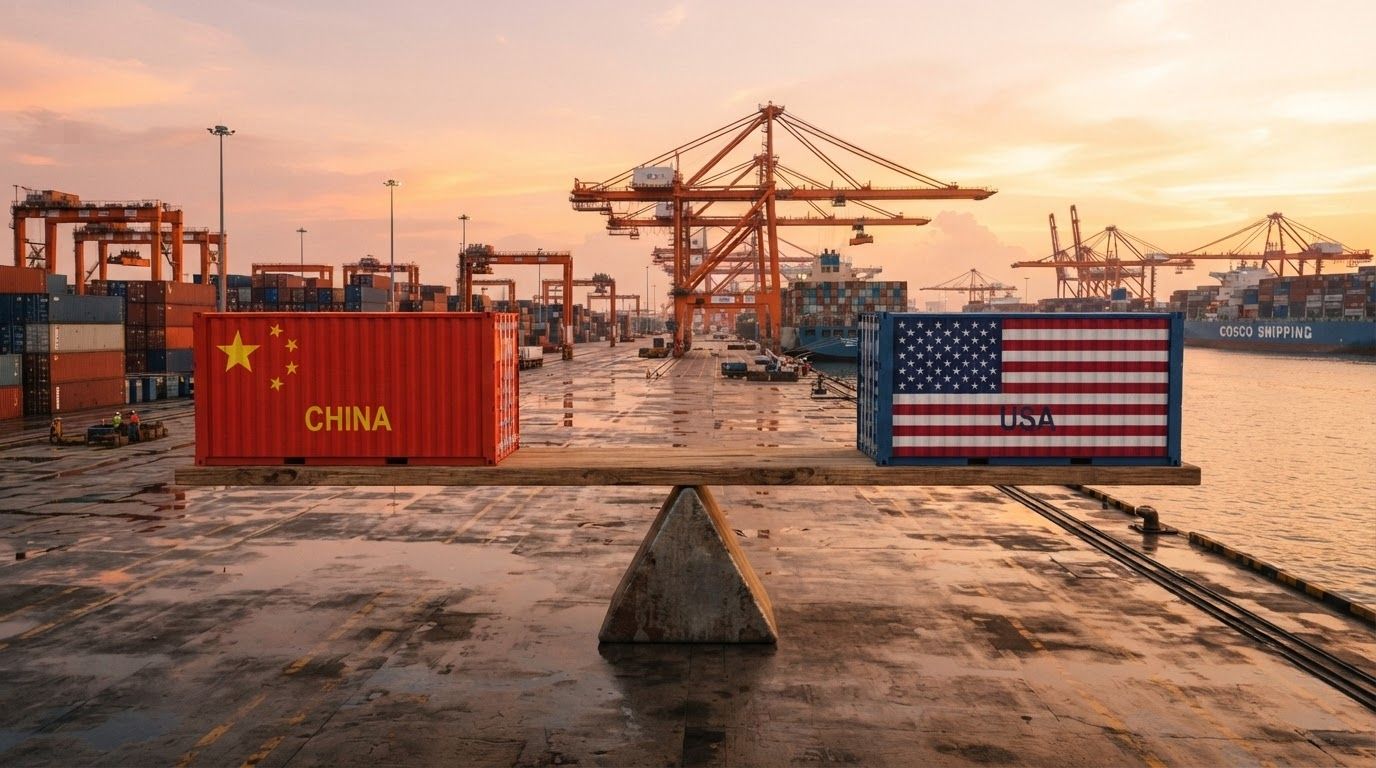
A trade agreement is only useful if the materials actually arrive. A marriage incentive only works if people want to marry. And a semiconductor restriction has an obvious weakness if the computing power it targets can still be rented somewhere else.
That is the awkward reality running through three major pressure points facing China: an increasingly strained trade ceasefire with Washington, another slump in marriage registrations, and a widening struggle over access to Nvidia’s technology.
These are different problems. But they share an uncomfortable feature. Governments can announce agreements, subsidies and restrictions relatively quickly. Getting businesses, households and supply chains to behave as intended is considerably harder.
For Beijing, the result is pressure from several directions at once. For Washington, it is another reminder that economic leverage does not automatically translate into control. And for Nvidia, being indispensable is starting to look like a political liability.
Key Takeaways
- Washington says China is falling short on rare-earth and some agricultural commitments; Beijing rejects allegations of non-compliance.
- China recorded 4.65 million marriages in the first nine months of 2026, the lowest comparable total in 18 years.
- Overseas cloud computing complicates restrictions intended to limit Chinese access to advanced American chips.
- Nvidia faces simultaneous pressure from US political scrutiny and China’s drive for technological independence.
Table of Contents
- The US-China Trade Truce Has a Delivery Problem
- China’s Marriage Incentives Are Running Into a Much Bigger Problem
- Nvidia’s Political Access Is Becoming Less Reliable Protection
- The Cloud Complicates America’s Chip Controls
- Beijing Wants Independence. Chinese Businesses Still Want Nvidia.
- Announcements Are the Easy Part
The US-China Trade Truce Has a Delivery Problem

Washington’s latest message to Beijing is blunt: deliver what you promised. During a Friday call with Chinese Vice Premier He Lifeng, US Treasury Secretary Scott Bessent and Trade Representative Jamieson Greer pressed China to implement the agreement Donald Trump and Xi Jinping reached in Busan in October 2025.
Bessent demanded that China “fully and immediately implement its commitments”. Greer highlighted agricultural purchases, rare earths and other critical minerals.
The distinction matters. This is not simply another disagreement about what a future deal should contain. Washington says commitments already made are not producing sufficient results.
The Busan agreement helped contain a confrontation that disrupted corporate supply chains and rattled financial markets. During Xi’s subsequent September visit to Washington, the leaders extended the truce until 10 January 2027. That bought time. It did not remove the underlying disputes.
In September, US officials told the Financial Times that China was fulfilling only about two-thirds of its rare-earth commitment. One person familiar with the situation said supplies had not increased since Bessent raised the issue with Xi that month. Beijing rejects allegations that it is failing to honour the agreement.
There is a similar split in agriculture. Washington considers China compliant on soybean purchases but says commitments covering other agricultural products remain unfulfilled.
So the agreement is not simply working or failing. Some obligations appear to be progressing; others remain contested. That is precisely the sort of uncertainty businesses struggle to plan around.
Why Japan’s shortages matter to American manufacturers

The problem also extends beyond direct US-China trade. Washington is concerned about Chinese restrictions on yttrium exports to Japan. The mineral is used in products ranging from jet engines to missiles, and Japanese manufacturers supply components that ultimately go into American goods. Local companies have warned Tokyo that stockpiles are running dangerously low.
In other words, a restriction does not need to target an American factory directly to create an American supply-chain problem.
Greer previously acknowledged that rare-earth shipments were arriving, but below the agreed volume and pace. He described parts of China’s implementation process as bureaucratic. Whether the obstacle is administrative friction or a deeper political disagreement, manufacturers still need the material.
For background on the minerals involved, the US Geological Survey’s rare-earth resources provide useful technical context.
Tariffs add another deadline. Exclusions covering certain Chinese products are due to expire on 10 November, and industry groups want them extended because of their importance to supply chains.
The expected Trump-Xi meeting at the Asia-Pacific Economic Cooperation summit in Shenzhen offers an opportunity to address these problems. More detailed discussions are anticipated at December’s G20 summit in Miami.
But another meeting is not the same thing as another shipment. The practical test is whether companies receive reliable supplies under predictable tariff rules before the January deadline, bringing the whole arrangement back into question.
China’s Marriage Incentives Are Running Into a Much Bigger Problem

Meanwhile, China’s demographic figures offer little comfort. According to Ministry of Civil Affairs figures, 4.65 million couples registered marriages during the first nine months of 2026. That was the lowest January-to-September total in 18 years. Another 2.08 million couples registered divorces.
More concerning than the headline number is the direction of travel. Marriage registrations fell year on year by:
- 6% in the first quarter.
- 9% in the second quarter.
- 15% in the third quarter.
Third-quarter registrations totalled 1.37 million, only slightly above the corresponding period’s record low of 1.32 million in 2024.
This is not what a turnaround looks like.
Authorities have introduced housing assistance, cash payments and wedding vouchers. This year’s government work report pledged stronger housing support for families with children, alongside efforts to promote positive attitudes towards marriage and childbirth.
In one Dongguan village, newlyweds received marriage subsidies. Additional incentives included travel funds for couples who met through a local matchmaking festival.
Those measures may help individual couples. But the national figures suggest modest financial incentives are struggling to change family-formation decisions on the scale Beijing needs.
That distinction is important. The numbers do not prove every subsidy is useless. They show that, collectively, the measures have not yet reversed the decline.
The consequences reach far beyond weddings.
China’s population officially fell by 3.39 million in 2025. The number of people aged 60 and above reached 323.38 million, representing 23% of the population—nearly one in four.
A shrinking workforce and an expanding elderly population put pressure on growth, pensions, healthcare and care provision. Fewer marriages also risk further weakening births, reinforcing the demographic decline.
This is why marriage registrations are more than a social statistic. They are another signal of the economic pressures taking shape over the coming decades.
Our coverage of China’s demographic decline and wider external pressures explores that broader combination of domestic and international challenges.
The central difficulty is brutally simple: a government can offer a wedding voucher. It cannot make that voucher sufficient to change someone’s decision about marriage and children.
Nvidia’s Political Access Is Becoming Less Reliable Protection

Then there is Nvidia, which faces a rather different version of the same problem: political intentions colliding with commercial realities. Jensen Huang’s access to President Trump has helped the company argue for looser semiconductor export restrictions. But the Democratic takeover of both chambers of Congress creates new opportunities for hearings and investigations into its China business, and political relationships.
The pressure may be bipartisan. Republicans who favour tougher controls could also become more willing to challenge a weakening president.
That does not mean Congress will immediately impose new restrictions. Trump retains substantial executive authority. It does mean that access to the president is a less dependable shield when scrutiny is coming from several directions.
Republican committee chairmen Brian Mast, John Moolenaar and Rick Crawford have already requested a joint closed-door briefing about Huang’s interactions with Megaspeed executive Alex Huang, who is not related to him, and Nvidia’s safeguards against foreign espionage.
The lawmakers described Alex Huang as a publicly reported Chinese intelligence asset. That remains an allegation, not an established finding. Their request does not establish wrongdoing by Jensen Huang.
They proposed a briefing on 18 November and requested confirmation, or an alternative date, by 11 November.
The distinction between scrutiny and proof is essential here. Congressional attention can create substantial pressure without demonstrating that the conduct being investigated was improper.
The Cloud Complicates America’s Chip Controls

The more fundamental issue is not who met whom. It is where the computing happens. Restrictions can prevent particular Nvidia processors from being shipped directly to China. But Chinese developers can often legally rent access to advanced processors operating in overseas data centres.
The hardware stays abroad. The computing service crosses the commercial boundary instead.
That is an awkward problem for a policy built around controlling physical exports. The US Bureau of Industry and Security provides official information on American export controls, but the commercial arrangements surrounding remote computing make their strategic effects harder to assess than a shipment destination alone would suggest.
Reuters reported that Nvidia has instructed cloud customers to sell at least 51% of their services to non-Chinese companies. The instructions reportedly apply globally to future contracts, leave existing agreements unaffected and have been communicated verbally.
That raises two immediate questions: how does Nvidia define a Chinese customer, and how does it monitor compliance?
A percentage requirement is straightforward to announce. Applying it consistently across international computing businesses is another matter.
CNBC reported that Moonshot AI explored leasing capacity at European facilities hosting Nvidia’s Blackwell systems. The White House previously accused the developer of accessing Blackwell processors through Thailand.
Those examples illustrate the policy challenge. They do not mean every overseas computing arrangement is unlawful.
The potential scale is substantial
The New York Times described a report circulated within US government agencies identifying direct or indirect Chinese ownership in 38 of 128 Southeast Asian data-centre projects.
It estimated that computing capacity accessible to Chinese companies across five regional countries approached the amount available throughout mainland China.
That is an estimate, not a precise inventory of unrestricted access. Even so, it helps explain why overseas computing arrangements are attracting attention in Washington.
Commercial deals are already feeling the pressure. The Financial Times reported that Oracle cancelled an estimated US$7 billion agreement that would have offered Tencent access to as many as 100,000 advanced AI chips in Southeast Asia.
American officials reportedly raised concerns, while Chinese officials encouraged Tencent to support domestic processors.
The result is a transaction squeezed from both sides: Washington concerned about access to American technology, and Beijing pushing demand towards Chinese alternatives.
Beijing Wants Independence. Chinese Businesses Still Want Nvidia.

Nvidia is also facing obstacles inside China. Reuters reported that approximately 600,000 H200 chips were stored in Hong Kong awaiting mainland shipments, while Chinese authorities withheld large-scale import approval.
Bloomberg separately reported that Chinese companies ordered around six million Nvidia RTX Pro chips, but expected to receive only approximately 1% within four months because of production constraints and regulatory barriers.
That exposes a central tension in China’s technology strategy. Authorities want less dependence on American computing hardware. Businesses continue seeking substantial quantities of it.
It would be tempting to treat those shortages as proof that Beijing has misunderstood the capabilities of domestic suppliers. The available information does not establish that. Policymakers may knowingly accept near-term disruption to strengthen local alternatives.
Still, demand for Nvidia hardware suggests those alternatives do not meet every commercial requirement. As our analysis of China’s advanced-chip bottleneck explains, access to computing remains an important constraint on AI expansion.
Nvidia’s influence in Washington is attracting scrutiny, too. The Information reported that OpenAI leaders avoided publicly taking a position on China chip controls partly because they feared alienating Huang. It also described allegations that Nvidia used institutional relationships and funding to challenge research supporting tighter restrictions.
Those reports could supply material for congressional inquiries. They should not be confused with findings of misconduct.
Announcements Are the Easy Part
The connecting thread is not that every policy is failing. It is that implementation is exposing the limits of political control.
The trade truce depends on actual deliveries and workable tariff arrangements. Demographic policy depends on millions of private decisions that modest incentives have not reversed. Semiconductor restrictions depend on controlling access to a service that can be delivered from another country.
Nvidia sits directly in the middle of that last struggle. Washington wants stronger barriers against Chinese access. Beijing wants less dependence on American technology. Chinese businesses still want computing power, and Nvidia still wants customers.
Its dominance remains an enormous commercial advantage. It also makes the company an unavoidable political target.
For China, the immediate questions are therefore practical rather than rhetorical: will critical minerals arrive, will family-formation trends stabilise, and will businesses obtain the computing capacity they need?
The answers will matter considerably more than the next reassuring announcement.
Frequently Asked Questions
When does the US-China trade truce expire?
The extension described here runs until 10 January 2027. Disputes remain over rare-earth deliveries and some agricultural purchases.
Why does China’s marriage decline matter economically?
Fewer marriages risk further weakening births, adding to population decline and ageing-related pressures on the workforce, pensions, healthcare and care services.
Can Chinese companies access Nvidia chips overseas?
Chinese developers can often legally rent computing capacity in overseas data centres, even when restrictions prevent particular processors from being shipped directly to China. Such arrangements are attracting increasing scrutiny.