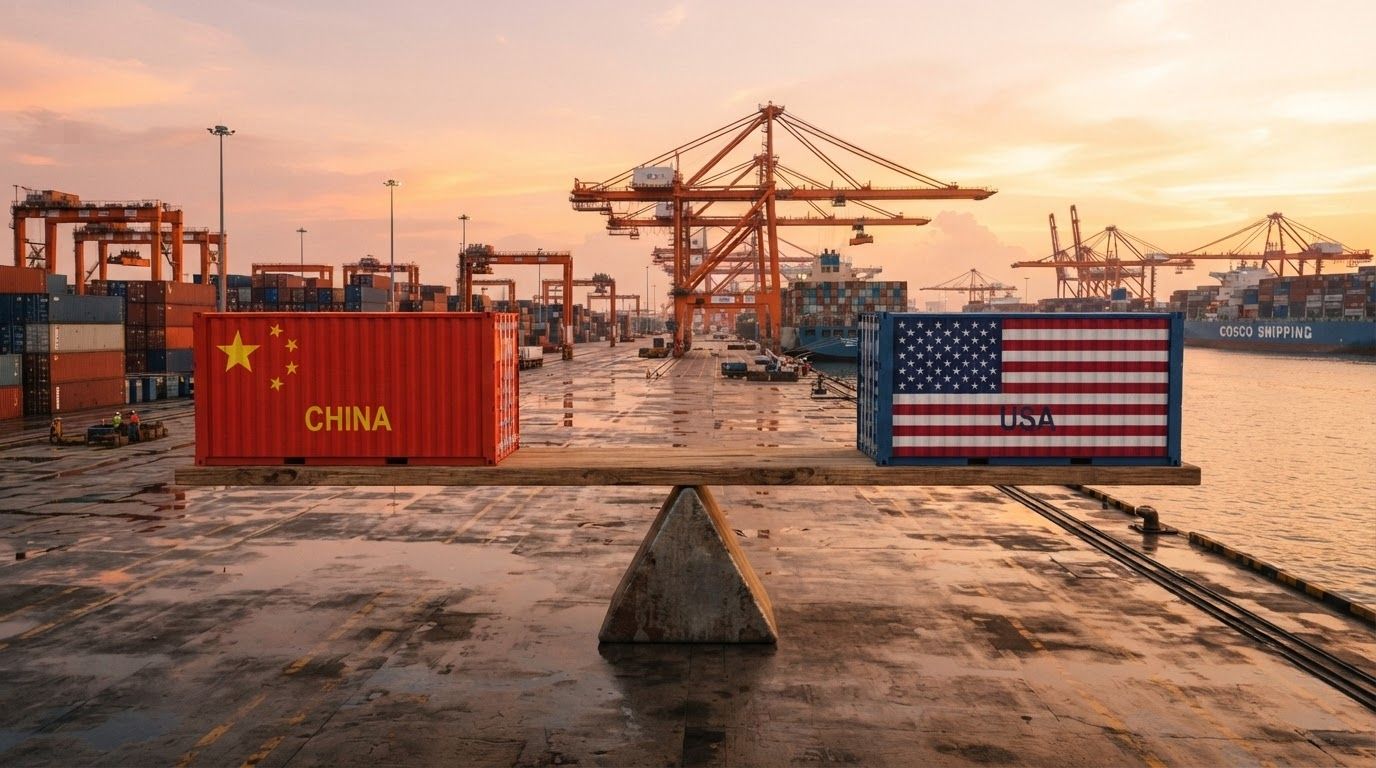
Beijing can mobilise state investors, push billions into stock funds, and make it cheaper for companies to buy their own shares. It can even put new listings on hold so fewer businesses compete for investors’ money. What it cannot do quite so easily is make people believe again.
That is the problem connecting three apparently separate developments: Donald Trump’s midterm defeat, China’s spectacular stock market rebound, and another tense exchange between Beijing and Manila. In each case, Chinese policymakers have tools to influence events. But influence is not control, and a temporary improvement is not necessarily a durable solution.
A weaker American president might be easier to negotiate with. Or he might become less predictable. A state-backed rally might stop a financial panic. Or it might leave the underlying reasons for selling untouched. Diplomatic dialogue might prevent a maritime confrontation from escalating. But only if the behaviour producing those confrontations changes.
For Beijing, the uncomfortable question is whether its interventions are rebuilding stability—or simply buying another few weeks of it.
Key Takeaways
- Trump’s midterm defeat complicates US-China relations without guaranteeing either accommodation or confrontation.
- Large-scale state buying lifted Chinese stocks, but weakening profits remain a major obstacle to recovery.
- China’s industrial achievements have not consistently translated into strong shareholder returns.
- China-Philippines dialogue remains open, while maritime disputes and infrastructure concerns sustain distrust.
Table of Contents
- Trump’s Defeat Is Not Automatically Beijing’s Victory
- Beijing’s Stock Market Rescue Arrives With a Very Large Bill
- China’s Industrial Success Has Not Guaranteed Investor Success
- In the Philippines, Dialogue Is Running Behind Distrust
- The Missing Ingredient Is Durable Confidence
Trump’s Defeat Is Not Automatically Beijing’s Victory
On Chinese social media, the reaction to the Republican midterm losses was hardly restrained. A Weibo hashtag describing Trump’s “total defeat” attracted more than 70 million views by Wednesday evening.
Official Beijing was considerably more careful. Foreign ministry spokesperson Mao Ning described the elections as an American domestic matter and emphasised implementing the understandings reached between Trump and Xi Jinping.
That caution makes sense. A president weakened at home does not necessarily become weaker in the areas that matter most to China.
Trump retains considerable discretion over trade and foreign policy. The Democrats’ congressional victory complicates his political life, but it does not remove his ability to impose pressure, negotiate concessions, or change direction.
Nor does it guarantee that the recent accommodation with Beijing will survive.
The September Trump-Xi summit extended a trade truce after the tariff confrontation that pushed duties into triple digits in 2025. Washington has also shown restraint over semiconductor restrictions and support for Taiwan. With another leaders’ meeting expected in roughly two weeks, both sides have reasons to preserve that relative calm.
But one reason for American restraint has just weakened.
Before the election, a fresh confrontation risked provoking Chinese retaliation and damaging the American economy at a politically disastrous moment. Now that the votes have been cast, that immediate electoral constraint matters less.
The question is whether Trump remains equally concerned about the economic consequences.
Congress Could Make Accommodation Harder
There is another complication. Republicans unhappy with Trump’s China policy may now feel freer to challenge him, potentially finding common ground with Democrats who also favour tougher restrictions.
Advanced semiconductors and Taiwan are obvious pressure points.
The proposed MATCH Act illustrates the direction of travel. It would push the administration to identify additional semiconductor equipment and Chinese manufacturing facilities for restrictions, while pressing allies to adopt comparable controls.
A Democratic Congress could also scrutinise tariff exemptions, export-control enforcement, and semiconductor agreements more aggressively. Trump would still have room to negotiate, but promises requiring congressional support would become harder to deliver.
The delayed $14 billion Taiwan arms package is particularly sensitive. Lawmakers already worried that Trump might bargain away support for Taipei now have another decision to challenge.
Some Chinese analysts nevertheless expect stability to continue. Da Wei of Tsinghua University anticipates relative bilateral calm alongside greater congressional pressure. There is a straightforward economic argument for restraint, too: both countries can inflict substantial damage on the other.
But mutual vulnerability is an incentive, not an insurance policy. As the broader debate over China’s trade exposure and geopolitical instability demonstrates, commercial dependence does not make political confrontation disappear.
Beijing also says it is communicating with Washington and Moscow about a possible Xi-Trump-Putin meeting at the upcoming APEC summit. Such a gathering would give Xi a diplomatic platform and Putin an opportunity to ease his international isolation while bringing Ukraine and wider security questions into the discussion.
A weakened Trump might want a diplomatic achievement. He might face emboldened congressional hawks. He might decide that confrontation now carries fewer electoral costs.
All three possibilities are plausible. That is precisely why celebrating his defeat as an uncomplicated Chinese victory misses the point.
Beijing’s Stock Market Rescue Arrives With a Very Large Bill
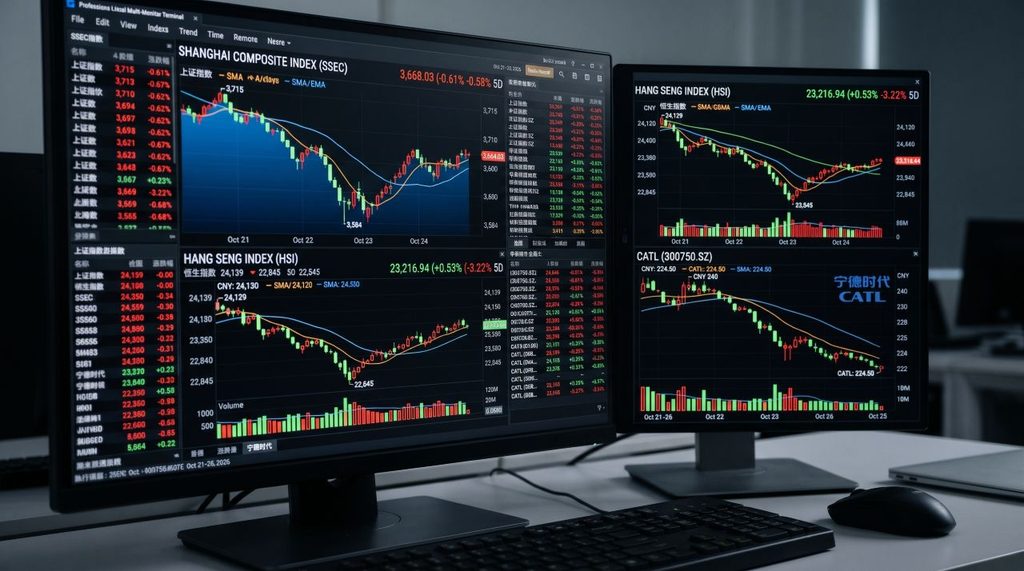
Meanwhile, China’s stock market delivered the sort of rebound that looks reassuring in a headline. On Wednesday, ChiNext surged 6.4%, the Shanghai Composite gained 2.16% in its strongest rebound in seven months, and the CSI 300 advanced approximately 2.3%. A STAR-market technology index jumped 9.92%.
After a sell-off that erased more than $3 trillion in market value, that was meaningful relief.
It was also heavily supported.
State investors—the so-called “national team”—stepped in aggressively. Broad-market exchange-traded funds attracted an estimated 85.9 billion yuan in net inflows on November 3.
Separately, Bloomberg-compiled figures cited by the Financial Times showed $11.5 billion entering nine ETFs commonly associated with government support. That was their second-largest daily inflow on record. These are separate measures of the intervention, not figures that should simply be added together.
The technology focus was unmistakable. ChinaAMC’s STAR 50 ETF received $1.7 billion, while E Fund’s ChiNext ETF attracted $1.4 billion.
Exchange-traded funds provide a way to buy exposure to a basket of securities. In this case, the buying pattern suggested support for sectors central to Beijing’s ambitions in artificial intelligence and semiconductor self-sufficiency.
The rescue did not stop there.
- Banks requested more than 200 billion yuan in additional lending quotas to finance corporate buybacks and purchases by major shareholders.
- The central bank made 100 billion yuan of liquidity capacity available through its securities-sector swap facility at a fee of just 10 basis points.
- Companies moved to expand share repurchases, including a proposal for a buyback programme worth between 2.5 billion and 5 billion yuan.
This is not a government politely expressing confidence. It is a government deploying financial machinery to support prices.
Even then, the response was not immediate. Tuesday’s liquidity support failed to prevent another sharp decline, including a 2.37% drop in ChiNext. Wednesday’s reversal therefore shows that intervention was gaining traction—not that a durable market bottom had been established.
Stopping Share Sales Does Not Fix Corporate Profits

Authorities have also been restricting the supply of shares competing for investors’ money. According to the Financial Times, regulators informally instructed investment banks to pause initial public offerings, while large sales by existing shareholders were temporarily suspended. Even strategically important chipmaker YMTC reportedly put its listing on hold.
The immediate logic is understandable: if money is scarce, stop creating additional demands on it.
But this exposes an awkward contradiction. Beijing wants capital markets to finance industrial development. It also wants those markets to protect existing investors from further losses. When confidence collapses, those goals can pull in opposite directions.
More importantly, none of these measures makes a struggling company more profitable.
Tencent’s financial reporting put combined third-quarter profits at mainland-listed companies down approximately 13% year-on-year. That reversed growth of roughly 25% in the previous quarter. Nine-month profit growth slowed to around 8%, compared with 19% in the first half.
Cheap financing can support share purchases. It cannot, by itself, reverse that earnings deterioration.
China’s Industrial Success Has Not Guaranteed Investor Success
This is where the problem becomes bigger than one market route.
According to Bloomberg, the CSI 300 delivered average annual returns of 4.2% over the past decade. The S&P 500 returned 15.6%.
That gap captures an uncomfortable distinction: building impressive industries and delivering impressive shareholder returns are not the same achievement.
Policy-backed investment can help create globally competitive businesses. It can also encourage excessive capacity, intense competition, and shrinking margins. Investors can correctly identify a national priority and still lose money backing it.
“China will build more of this” is not the same investment proposition as “the companies building it will earn attractive profits.”
For households, this matters enormously. The property downturn has already damaged a major route to wealth accumulation. Another stock market collapse further narrows the opportunities people believe are available to them.
Participation is showing signs of fatigue. New Shanghai A-share accounts totaled approximately 1.5 million in October, down 21.5% from September and 35.04% from a year earlier. Account openings remained higher across the first ten months overall, but the recent cooling is difficult to ignore.
Credit-market stress adds another layer. Problems involving trust-product payments and loan-extension requests at locally state-owned Zhuhai Huafa have challenged the assumption that government connections automatically provide financial protection.
The wider debate over China’s financing pressures and debt strain makes that distinction especially important. Access to support and a guarantee against losses are not interchangeable.
State purchases can interrupt forced selling and buy policymakers time. But restoring confidence requires a convincing answer to a much harder question: why should private investors expect better outcomes this time?
Unlike the 2024 rescue, the latest intervention has not been accompanied by an equally clear leadership signal of a broader economic policy shift.
Beijing has demonstrated its willingness to defend prices. Whether private capital follows remains the real test.
In the Philippines, Dialogue Is Running Behind Distrust

The same distinction between intervention and resolution appears in China’s relationship with the Philippines.During a Tuesday telephone call with Philippine Foreign Minister Teresa Lazaro, Chinese Foreign Minister Wang Yi accused Philippine politicians of provocation, crossing Beijing’s red lines, and politicizing economic and people-to-people exchanges.
He also alleged infringements on the legitimate rights of Chinese citizens and institutions in the Philippines.
Those are Beijing’s accusations, not an agreed description of events.
Wang urged restraint and caution on maritime issues, while emphasizing China’s determination to defend its sovereignty and pursue what Beijing calls national reunification. That brought Taiwan into a bilateral relationship already strained by maritime confrontations.
Manila’s security concerns have not emerged in a vacuum. Philippine authorities reported injuries during Chinese efforts to obstruct resupply missions to Second Thomas Shoal, including a June 2024 confrontation that wounded a Filipino sailor.
In 2023, the Philippines also expanded American military access by adding four locations under the Enhanced Defense Cooperation Agreement.
The resulting cycle is dangerous: Chinese pressure strengthens Manila’s demand for external security support, while closer US-Philippine cooperation deepens Beijing’s strategic mistrust.
According to the Chinese account of the call, Lazaro emphasized predictable relations, reaffirmed the Philippines’ one-China policy, and expressed willingness to address maritime disputes through consultation. She also highlighted economic and energy concerns and opportunities for cooperation during the Philippines’ ASEAN chairmanship.
Keeping that conversation open matters. But an open telephone line is not evidence that the underlying conflict is easing.
Suspicious Activity Is Not Proof of Cable Sabotage

Undersea communications infrastructure is adding another sensitive issue. Nikkei Asia reported that the Philippine Coast Guard detected a Chinese research vessel near submarine cable routes northwest of Itbayat in Batanes province.
During September, the vessel allegedly ignored radio calls, transmitted a false identification-system position, and maneuvered to evade enforcement. On October 1, the coast guard deployed its largest vessel to challenge it.
Those allegations warrant investigation. They do not establish that a cable was deliberately cut.
No confirmed case has established that China deliberately severed a Philippine submarine cable. Maintaining that distinction is essential, particularly when an already tense relationship makes the most alarming interpretation tempting.
The Missing Ingredient Is Durable Confidence
Across these developments, Beijing faces problems that power alone cannot neatly solve.
Trump’s defeat creates opportunities, but not predictability. State buying can generate a spectacular rally, but not stronger corporate earnings. Diplomatic engagement can preserve communication, but not automatically unwind years of maritime distrust.
None of those tools is useless. The danger is mistaking their immediate effects for lasting progress.
The meaningful tests come afterward: whether Washington sustains its restraint, whether private investors return without being propped up, and whether China and the Philippines can reduce confrontations rather than merely discuss them.
Beijing can buy time. What matters now is what it does with it.
Frequently Asked Questions
Why did China’s stock market rebound?
Aggressive purchases by state investors, substantial ETF inflows, and expanded financing support for corporate buybacks helped drive the rebound. Restrictions on new listings and large shareholder sales also sought to preserve market liquidity.
Does Trump’s midterm defeat benefit China?
Not necessarily. It could encourage Trump to seek diplomatic achievements, but it could also strengthen congressional pressure on China policy and reduce his immediate electoral incentive to avoid economic confrontation.
Why might investors remain cautious after the rally?
Corporate profits have weakened, long-term returns have disappointed, and household confidence has suffered from property and stock market losses. Intervention can support prices without resolving those concerns.
Has Chinese sabotage of Philippine submarine cables been proven?
No confirmed case has established that China deliberately severed a Philippine submarine cable. Reported suspicious vessel activity warrants investigation but does not itself prove sabotage.