There is a tendency in international politics to treat each fresh flashpoint as its own neatly contained crisis: Iran is a Middle Eastern problem, Chinese exports are an economics problem, humanoid robots are a Silicon Valley problem, and chip controls are a trade-policy problem. This is comforting. It is also increasingly detached from reality.
China’s reported preparation to supply Iran with hundreds of portable air-defence missiles, the renewed argument over its trade surplus, fresh US restrictions on Chinese robotics, and the apparent persistence of advanced-chip access all point in the same direction. Economic power, industrial policy, military logistics and technological competition are now bleeding into one another. The boundaries have not merely become blurry; they are being deliberately dismantled.
Beijing’s core challenge is to preserve strategic room to manoeuvre while insulating itself from external pressure. Washington’s is to constrain China’s technological and geopolitical reach without forcing the very escalation it claims to fear. Neither side appears especially close to solving that contradiction.
Table of Contents
- Reporting missiles for Iran would mark a much riskier step
- The renminbi argument is really an argument about power
- Tangshan’s anniversary and the politics of resilience
- Slovakia is useful to Beijing because Europe is divided
- The technology war has moved from chips to robots
- Advanced chips are still reaching Chinese AI companies
- What to watch next
- Frequently Asked Questions
Reported missiles for Iran would mark a much riskier step.
Reuters has reported that Iran could receive between 300 and 400 Chinese-made man-portable air-defence systems under a contract reportedly valued at $60 million to $70 million. The weapons named in the reporting, QW-12 and FN-16 systems, are designed to target low-flying aircraft, helicopters and drones.
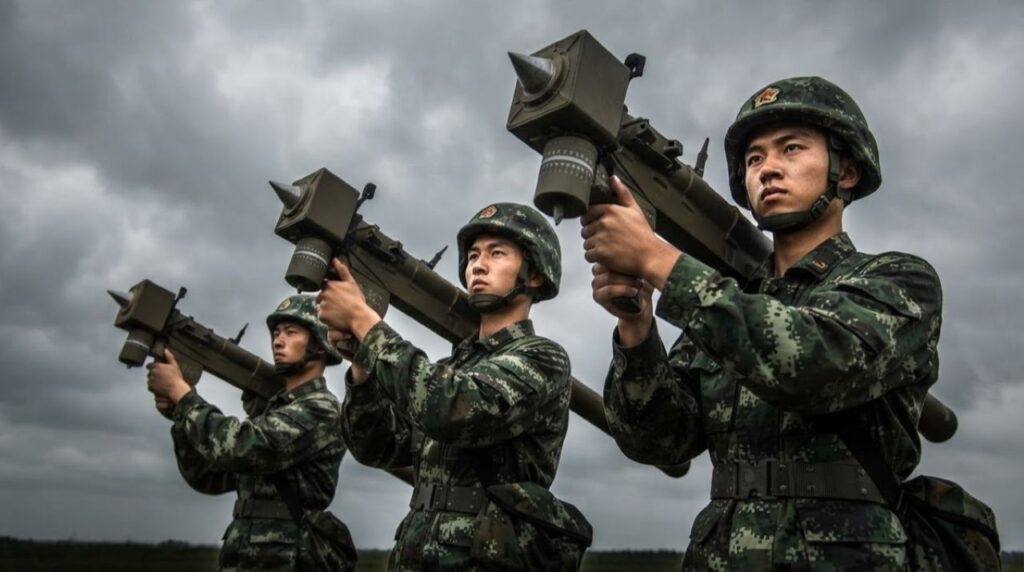
On paper, this is not the sort of arsenal that suddenly neutralises American long-range strike capacity. Shoulder-fired systems do not change the balance against high-altitude bombers, cruise missiles or major naval assets. But that does not make them strategically trivial. They can make low-altitude operations more dangerous, complicate drone deployments, force changes to helicopter missions and help restore layers of Iranian air defence damaged during conflict.
That is precisely why the reported deal matters. Beijing has long been Tehran’s most important economic partner and oil customer. It has also supplied dual-use goods that can serve civilian and military purposes. Directly transferring air-defence weapons during an active confrontation with the United States, however, would push the relationship into considerably more combustible territory.
The reported route is almost as sensitive as the weapons themselves: air shipment from Urumqi in western China, through Pakistan, and into Iran. Pakistan has tried to maintain relations with China, Iran, Saudi Arabia and the United States while also presenting itself as a mediator. If its territory is used for the transfer, Islamabad faces uncomfortable questions. Did authorities approve it? Did they look the other way? Or were they simply unable to stop it?
The unusually granular reporting on the alleged route may itself be a message. Western officials may be signalling that they are already monitoring the supply chain. In this kind of confrontation, publicity is not merely journalism; it can be deterrence by disclosure.
Donald Trump reportedly described the allegation as "surprising", particularly in light of assurances he says he received from Xi Jinping. That response illustrates the political problem rather neatly. Washington may want stable lines of communication with Beijing and a less volatile bilateral relationship. Yet if Chinese weapons are delivered to Iran and subsequently threaten or kill US personnel, the language of “constructive strategic stability” is likely to collapse under the weight of reality.
There is a wider military calculation too. The United States has reportedly used significant quantities of missile interceptors in the Middle East, raising concerns about strained inventories. Any perception that American munitions are being depleted could affect calculations far beyond Iran: in Moscow, in Beijing and, naturally, around Taiwan.
China has considerable insulation from one major consequence of a prolonged Middle East conflict: energy disruption. Its large crude stockpiles, reportedly around 1.1 billion barrels, could allow Beijing to reduce imports for months. That does not make an energy shock painless, but it gives China more resilience than many import-dependent economies. It also gives Beijing more freedom to tolerate instability that would be economically ruinous elsewhere.
For a broader look at how conflict around the Gulf can spill into Chinese inflation, industrial supply chains and strategic planning, see this analysis of Hormuz turmoil, debt strain and Taiwan blockade planning.
The renminbi argument is really an argument about power.
The debate over China’s currency has returned with all the familiar ingredients: a huge trade surplus, calls for an appreciating renminbi, accusations of unfairness and a polite technocratic insistence that the problem is terribly complicated. It is complicated. But it is not mysterious.
Former IMF chief economists and Hélène Rey, the incoming chief economic adviser at the Bank for International Settlements, argued in The Economist that the yuan is undervalued but that exchange rates are more a symptom than a root cause. In their telling, China’s surplus is driven by domestic policies that suppress consumption and encourage saving and industrial production, while the US deficit reflects large fiscal shortfalls and excessive demand.
Their preferred remedy is coordinated adjustment: China should move toward household consumption and services-led growth, while the United States should bring down its fiscal deficit. A grand currency bargain, they argue, is not enough.
There is a lot in this diagnosis that is plainly sensible. China does have a consumption problem. Its economic system has repeatedly directed capital toward investment, infrastructure, industrial upgrading and export capacity. Meanwhile, America’s fiscal position is hardly the picture of ascetic discipline.
But Peking University finance professor Michael Pettis disputes the assumed direction of causality. His argument is that surplus countries generate excess savings because household consumption is constrained relative to production. Those savings do not simply sit patiently at home. They are exported, and the United States absorbs them because its financial system is deep, open and capable of taking enormous capital inflows.
Under that framework, the influx of foreign capital helps strengthen the dollar, weakens US manufacturing competitiveness and encourages more debt accumulation. If Washington reduced its fiscal deficit without tackling the underlying capital inflows, the adjustment could arrive through slower growth, lower investment or higher unemployment instead. In other words, it is not enough to tell the US to behave better while pretending global imbalances simply fell from the sky.
A stronger renminbi would matter because it redistributes income. It would improve Chinese households’ purchasing power relative to exporters and producers, making consumption easier and the existing model slightly less lopsided. It would not, by itself, transform the economy. But it would be part of a serious rebalancing.
The deeper obstacle is political. Research by MIT professor Yasheng Huang, based on textual analysis of annual National Development and Reform Commission economic plans, found an increasingly pronounced supply-side bias. In 2014, the study’s supply-side and demand-side scores were broadly similar, at 7.8 and 7.5. By 2024, they had separated sharply: 9.5 for supply-side priorities and 6.3 for demand-side ones.
Technology, infrastructure and industrial upgrading have gained prominence. Employment, household income, social security and hukou reform have received comparatively less attention, even as youth unemployment became a major concern. This is not because Chinese policymakers have failed to notice that households need more spending power. It is because shifting income toward households also shifts economic influence away from the state-led industrial system.
A genuine demand-side pivot would require more than better slogans about consumption. It would mean redistributing wealth, security and bargaining power. That is why the currency dispute is ultimately political economy, not merely exchange-rate arithmetic.
Tangshan’s anniversary and the politics of resilience

Premier Li Qiang’s visit to Tangshan, marking 50 years since the 1976 earthquake, was a reminder of both the scale of the disaster and the importance Beijing places on the language of national resilience. The magnitude 7.8 earthquake levelled much of the northern industrial city, destroyed roughly 97% of its buildings and killed at least 242,000 people, according to official figures. Some estimates are higher.
The catastrophe struck in the final months of the Cultural Revolution, when China declined offers of foreign assistance and emergency capacity was severely constrained. Tangshan was subsequently rebuilt with redesigned infrastructure and stronger construction standards, eventually recovering and expanding its industrial base.
Li’s message focused on placing lives first, using “bottom-line thinking", improving early-warning systems, strengthening rescue capacity and preparing for worst-case scenarios. This is standard official language, of course. But it also reflects a governing mindset that now reaches well beyond natural disasters: anticipate disruption, build redundancy, maintain control, and ensure that the state can function under stress.
Slovakia is useful to Beijing because Europe is divided
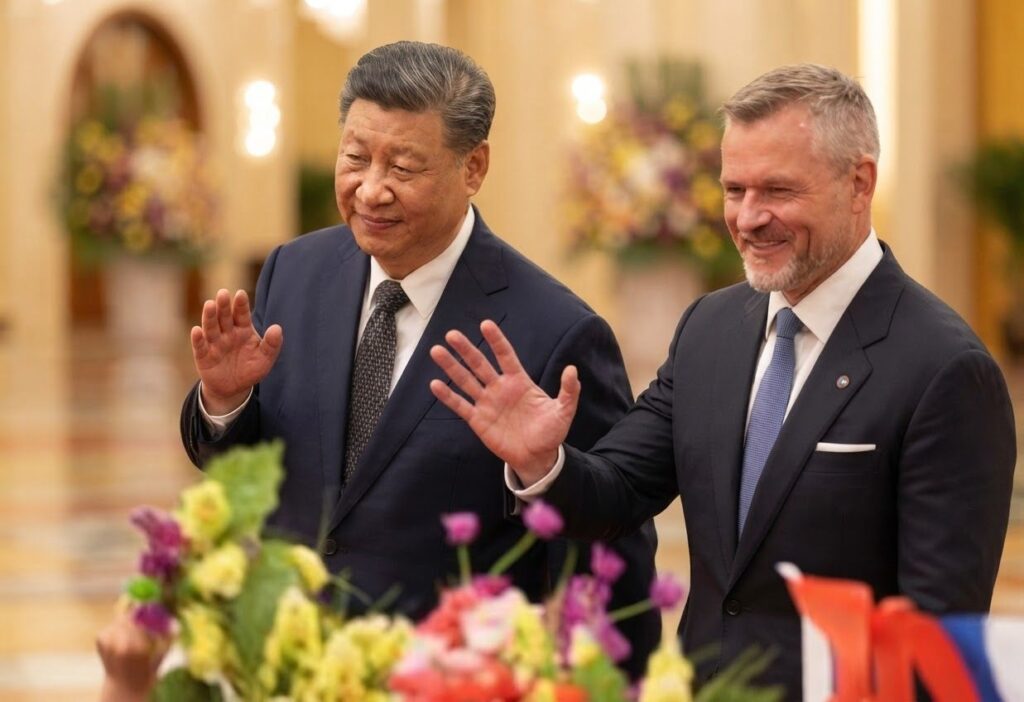
Xi Jinping’s meeting with Slovak President Peter Pellegrini in Beijing showed how China is trying to manage a more sceptical European Union without treating Europe as a single political bloc. Xi urged Slovakia to encourage Brussels to focus on agreement, manage disputes and avoid the escalation of economic tensions.
Slovakia is a particularly convenient partner for this strategy. It was among the minority of EU states opposed to tariffs on Chinese electric vehicles, has developed a strategic partnership with Beijing, and wants investment as it protects a major domestic automotive sector. Chinese battery maker Gotion High-tech and Slovak company InoBat are investing €1.2 billion in an EV battery plant expected to begin full-scale production in 2027.
For Beijing, friendly governments in Central Europe can act as buffers against tougher EU policy on trade, investment, technology and security. For Slovakia, Chinese capital and market access are attractive, particularly as the country navigates competition among Beijing, Brussels and Washington.
But this should not be mistaken for a clean geopolitical alignment. Europe’s concerns about China have not vanished, particularly around trade imbalances, industrial subsidies and Beijing’s relationship with Russia. Rather, China is exploiting the obvious fact that the EU’s members do not all have the same exposure, priorities or appetite for confrontation.
The technology war has moved from chips to robots.
The Trump administration is reportedly preparing to block imports of new Chinese humanoid and quadruped robot models, alongside restrictions on connected power inverters and certain data-centre equipment. Existing Chinese robot models already available in the US are expected to remain unaffected; the proposed controls focus on future releases.

The logic is straightforward enough. Connected machines operating in data centres, power infrastructure, factories and other sensitive facilities create security concerns that go beyond ordinary consumer imports. A humanoid robot is not just a flashy gadget when it can move through workplaces, collect data and plug into industrial systems. A power inverter is not merely a box when it helps connect renewable generation and batteries to the grid.
Still, this is a major expansion of the conflict. The US-China technology struggle began most visibly with advanced semiconductors, telecoms equipment and AI computing. It is now moving into the physical machinery through which AI may eventually operate in factories, warehouses, businesses and homes.
China’s embodied-AI sector is attracting huge investment. At least five companies reportedly have valuations above 20 billion yuan, while six more exceed 10 billion yuan. Unitree Robotics is preparing for a Shanghai listing at a possible valuation of roughly 40 billion yuan. BYD, meanwhile, says it will unveil its first humanoid robot in August.
The restrictions may offer some protection to emerging US manufacturers. They may also further split what should be a global commercial market into rival technology ecosystems. That is becoming the default pattern: not open competition, but competition conducted inside geopolitical walls.
China’s hardware constraints remain central to this process. The deepening AI chip squeeze is not only an economic issue; it is becoming a question of how quickly China can develop alternatives to a US-led technology stack.
Advanced chips are still reaching Chinese AI companies.
The apparent training of Moonshot AI’s Kimi K3 model using Nvidia processors, including advanced Blackwell chips subject to US export restrictions, is likely to intensify scrutiny in Washington. Kimi K3 is reported to be an open-weights model with 2.8 trillion parameters that approaches the performance of systems built by leading US labs despite Moonshot’s much smaller budget.
Where the training took place is crucial. One account suggested use of a data centre in Thailand, where Chinese access to Nvidia processors might be permissible under some conditions. Reporting also indicated that at least part of the work occurred in China. Moving giant pre-training datasets abroad is difficult because of Chinese controls on cross-border data transfers, making the offshore explanation less tidy than it first appears.
Alibaba has also reportedly used Nvidia processors, including Blackwell chips, to train its Qwen 3.8 Max model, which contains 2.4 trillion parameters. Whether these reports ultimately establish sanctions evasion, weak enforcement, legal loopholes or some mixture of all three, they expose an awkward reality: export controls only work to the extent that hardware, expertise, financing and supply chains can be policed across borders.
Taiwanese authorities are responding with a more aggressive crackdown on alleged chip smuggling. Recent investigations and a rare joint Coast Guard operation with the United States indicate that enforcement is moving beyond licensing paperwork into criminal probes and maritime interdiction. Nvidia has said smuggling is a “non-starter” and that its partners are responsible for compliance with export controls.
Then there is the issue of open-weight models. Chinese firms can distribute systems that developers around the world download, modify and deploy. That provides an inexpensive route to international AI influence, especially in developing countries where American frontier labs have less commercial or diplomatic reach.
Anthropic chief executive Dario Amodei has argued for tougher restrictions on China’s access to advanced chips and manufacturing equipment, as well as tighter action against smuggling and industrial-scale model distillation. Distillation allows a smaller model to reproduce some capabilities of a much larger one at a fraction of the computing cost. It is, in essence, another way to make hardware restrictions less decisive.
Yet Amodei has rejected a blanket ban on open-weight AI. His alternative is more coherent: systems sufficiently capable to create cyber, biological or alignment risks should face mandatory testing, whether they are open or closed. That is a more serious approach than pretending the label attached to a model is the principal safety issue.
Beijing is, meanwhile, investing in domestic alternatives. Shanghai Aishangna Electronic Technology Group has reportedly begun producing locally developed immersion deep-ultraviolet lithography machines, with around five systems expected this year and roughly 20 in 2027. They remain behind the most advanced Western equipment. But advanced technology denial does not freeze a rival in place forever; it creates powerful incentives to substitute, innovate and eventually build around the restriction.
What to watch next
- Whether the reported Chinese MANPAD shipment to Iran actually materialises, and whether Pakistan is publicly implicated in its transit.
- Whether Washington treats suspected advanced-chip access as an enforcement failure requiring tighter policing, rather than simply another reason to announce broader controls.
- Whether the US robotics restrictions become a narrow security measure or a template for blocking Chinese-connected technology across whole industrial sectors.
- Whether Beijing shows any real willingness to shift income toward households, rather than continuing to rely on investment, exports and strategic manufacturing.
- Whether EU divisions allow China to dilute tougher Brussels policy through bilateral investment and political outreach.
Frequently Asked Questions
Why would Chinese portable air-defence missiles matter in Iran?
They would not eliminate US long-range strike capabilities, but they could threaten drones, helicopters and low-flying aircraft. That would make some operations riskier and could help Iran rebuild air-defence capacity damaged during conflict.
Would a stronger renminbi solve China’s trade imbalance?
No. A stronger currency could increase household purchasing power and reduce the relative advantage of exporters, but China’s imbalance is also tied to weak consumption, high savings, industrial policy and the distribution of income between households and producers.
Why is the United States targeting Chinese robots?
US officials are increasingly concerned that connected Chinese technology could operate inside sensitive facilities, including data centres and electricity infrastructure. The proposed restrictions also reflect concern about Chinese competition in a fast-growing embodied-AI industry.
Do US chip restrictions still constrain Chinese AI development?
They impose real costs and limit direct access to the most advanced computing hardware. However, reports of Chinese firms using restricted chips, alongside smuggling concerns, offshore data-centre arrangements, model efficiency improvements and domestic semiconductor investment, show that the controls are difficult to enforce completely.
Why is Slovakia important in China’s relationship with Europe?
Slovakia has opposed some tougher EU measures against Chinese electric vehicles and is seeking Chinese investment in its automotive supply chain. Beijing sees such partners as useful voices inside a divided European Union, particularly when broader EU-China trade relations are deteriorating.