
The Rot Inside the Dragon: Why China’s Youth Unemployment Crisis Is a Global Ticking Time Bomb
By Tony Fiddis: China Analyst
For the last three decades, the global economic narrative has relied on a single, unchallenged assumption: China’s economic engine is unstoppable.
We’ve been told that Beijing’s unique brand of state capitalism can build hyper-efficient infrastructure, dominate critical supply chains, and lift hundreds of millions into the middle class without breaking a sweat.

But beneath the gleaming skyscrapers of Shenzhen and the massive automated ports of Shanghai, a systemic rot is setting in. And it centres on the very people who were supposed to inherit the Chinese century: the youth.
China is currently facing a catastrophic youth unemployment crisis. While Beijing has spent the last two years tweaking its data metrics, suspending publication of embarrassing figures, and engineering "revised" statistical methodologies, the ground reality remains grim. Millions of highly educated, ambitious young graduates are entering a labour market that simply has no place for them.
This isn't just a temporary post-pandemic hiccup. It is a structural failure of epic proportions—one that threatens domestic stability, compromises global supply chains, and risks derailing the world economy.
The Illusion of the "Revised" Statistics
To understand the scale of the problem, you have to look past the official curtain. When China’s youth unemployment rate for those aged 16 to 24 hit a record-breaking 21.3% in mid-2023, the National Bureau of Statistics (NBS) did what any embarrassed authoritarian regime does: they stopped publishing the data entirely.
When the numbers finally returned under a new "optimised" methodology, which conveniently excluded full-time students looking for part-time work, the headline figure magically dropped. Yet, even with these heavily massaged metrics, the youth unemployment rate has routinely spiked back into dangerous territory, stubbornly hovering at levels that would signal a severe recession in any Western economy.
Independent analysts tracking real-world proxies—such as platform gig-worker saturation, graduate underemployment, and the explosion of the "kongyiji" phenomenon (a viral cultural meme comparing over-educated graduates to a destitute, fictional Qing Dynasty scholar)—paint a far darker picture. Some independent academic estimates suggest that the true number of young people disconnected from meaningful work could be closer to one-in-three.
The Ultimate Structural Mismatch
How did the world’s manufacturing superpower end up here? It is the result of a profound structural mismatch between Beijing’s economic steering and the aspirations of its populace.
For twenty years, the Chinese government urged families to invest everything into higher education. Parents spent life savings on after-school tutoring and Gaokao university entrance exam prep. The strategy worked too well. China now produces over 11 million university graduates every single year.
The problem? China’s economy hasn't evolved fast enough to absorb them.
[The Educational Mismatch Trap]
High-Tech / White-Collar Desires ──> (11M+ Graduates / Year)
                                          │
                                          ▼  [THE GAP]
                                          ▲
Factory Floor / Blue-Collar Reality  ──> (State-Driven Industrial Focus)
Beijing's state-directed economic blueprint remains heavily hyper-focused on old-school fixed-asset investments: heavy industry, advanced manufacturing, EV batteries, and infrastructure. These industries require specialised engineers or blue-collar factory workers. They do not require millions of history, marketing, law, or traditional software degrees.
Compounding this were Beijing’s brutal regulatory crackdowns on the exact sectors that used to employ young white-collar workers: consumer tech giants (Alibaba and Tencent), the private tutoring sector, and the highly leveraged real estate industry. By crushing these fields in the name of "common prosperity", the state inadvertently incinerated millions of entry-level corporate jobs.
"Let Them Eat Bitter": The Party’s Response
The social contract in China has long been simple: give up your political freedoms in exchange for economic upward mobility. With that contract fracturing, the Chinese Communist Party (CCP) is getting nervous.
So far, the official policy response has amounted to gaslighting on a national scale. Xi Jinping has publicly urged the youth to learn to "eat bitter" (chi ku)—a cultural idiom meaning to endure hardships without complaint—and suggested that unemployed graduates move back to rural villages to revitalise the countryside through manual labour.
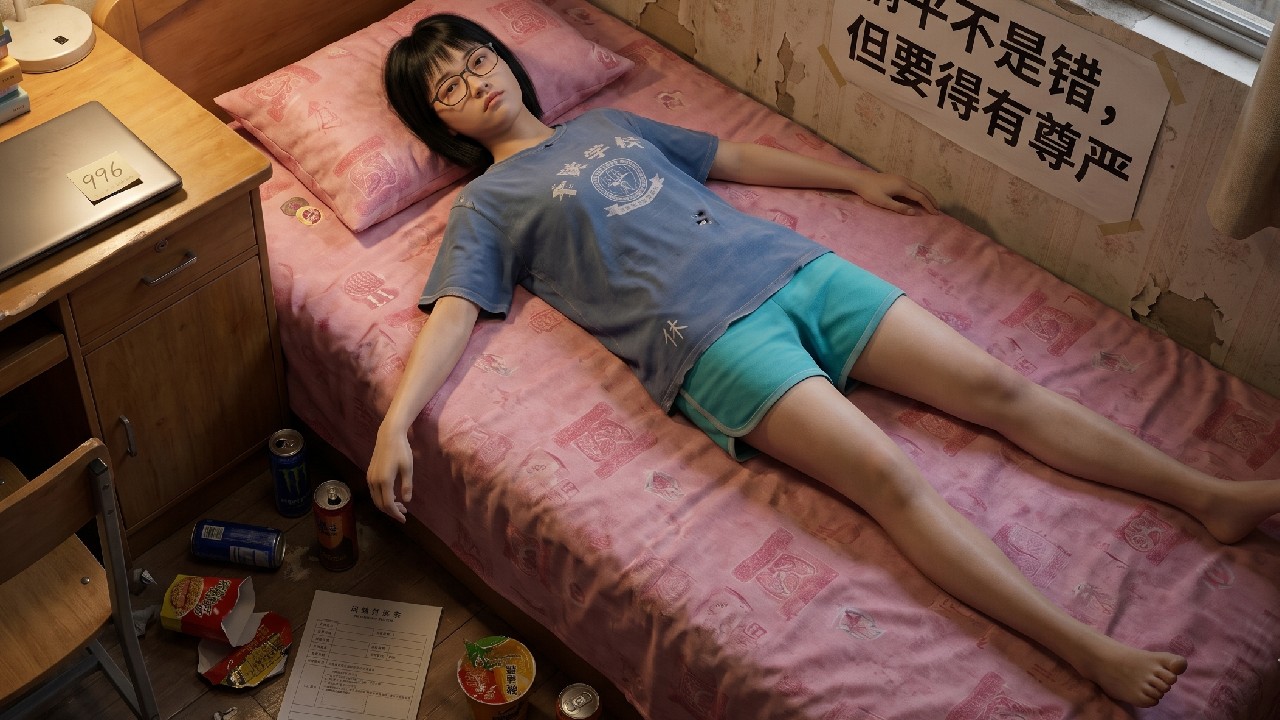
Unsurprisingly, the youth aren't buying it. Instead, a profound cultural nihilism has taken root. Millions have embraced philosophies like "Tang Ping" (Lying Flat) and "Bai Lan" (Let it Rot)—actively withdrawing from the high-stress consumer rat race, refusing to buy property, refusing to marry, and refusing to have children.
The Demography Doom Loop: In a country already facing an unprecedented demographic collapse, an entire generation refusing to reproduce because they cannot afford a stable future is an existential threat to the state's pension systems and long-term economic viability.
The Geopolitical Spillover
Why should the rest of the world care about unemployed 20-somethings in Beijing or Chengdu? Because an economically unstable China is an unpredictable China.
When domestic growth engines sputter, authoritarian regimes historically turn to two playbooks to maintain legitimacy: aggressive export dumping and hyper-nationalism.
We are already seeing the first playbook in action. To compensate for weak domestic consumer spending, Beijing is heavily subsidising its industrial sectors, dumping cheap electric vehicles, solar panels, and legacy semiconductors onto global markets. This has triggered fierce trade frictions with the European Union and the United States, pushing the global economy closer to outright protectionism and fracturing supply chains.
The second playbook is far more dangerous. If economic discontent among the youth reaches a boiling point, the temptation for the CCP to divert internal frustration toward external geopolitical targets—specifically escalating tensions in the Taiwan Strait—increases exponentially. Distracting a frustrated, underemployed population with fierce ethno-nationalism is a classic, high-risk political manoeuvre.
The Inevitable Conclusion
China’s youth unemployment crisis isn't an isolated policy failure; it is the ultimate systemic bottleneck of the Chinese economic model. You cannot build a modern high-consumption superpower while simultaneously treating your highly educated youth as an inconvenient statistical anomaly.
If Beijing cannot pivot away from state-driven industrial overcapacity and foster a genuine, open service-and-innovation economy capable of employing its brightest minds, the "Chinese Dream" will rapidly transform into a stagnation trap. And as the world's second-largest economy downshifts, the ripples will be felt across every market, port, and boardroom on Earth.