China’s economy currently has the peculiar look of a country trying to sprint while wearing concrete shoes. On one side, households are pulling back, businesses do not want to borrow, young graduates are struggling to find work, and investors are hiding in government bonds. On the other, capital is pouring into humanoid robots and low-cost artificial intelligence with the sort of unrestrained enthusiasm that usually ends in a very expensive hangover.
These are not separate stories. They are different expressions of the same problem: Beijing needs a new growth engine urgently, and it is betting heavily that advanced manufacturing and AI can deliver it. The difficulty is that a handful of fashionable industries cannot easily compensate for weak consumption, a wounded property sector, cautious private firms, and millions of young people entering an increasingly unforgiving labour market.
That is the uncomfortable backdrop to three major developments: collapsing government bond yields, a spectacular Unitree Robotics listing, and China’s increasingly credible challenge to America’s AI business model.
Table of Contents
- Chinese bond yields are falling because confidence is falling
- China’s graduate boom is colliding with a weak labour market
- Unitree’s blockbuster listing shows both ambition and excess
- China’s AI strategy is not simply catching up—it is changing the commercial contest
- Open weights are China’s weapon of choice
- The bottom line
Chinese bond yields are falling because confidence is falling.
China’s 10-year government bond yield fell to 1.67%, its lowest level in more than a year. That may sound like a technical detail for people who own too many spreadsheets, but it is actually a rather revealing measure of how investors see the economy.
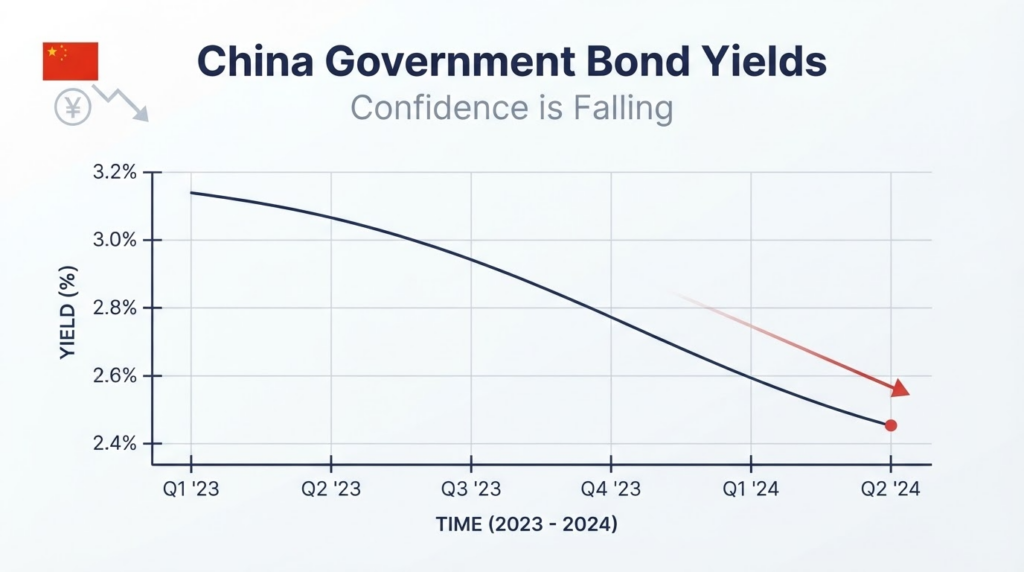
Bond prices and yields move in opposite directions. When investors buy large quantities of government debt, prices rise and yields fall. In this case, the move suggests investors are seeking safety because they expect weak growth, subdued inflation, and limited private-sector demand to persist.
The immediate catalyst was another poor batch of economic data. Industrial production slowed. Consumer spending slowed. New bank lending fell. None of this is particularly revolutionary at this point; it is simply another reminder that China’s economy has a demand problem it has not yet solved.
Private companies are reluctant to borrow because they are unsure that future customers will be there. Households are avoiding debt because the property downturn has destroyed a crucial sense of financial security, while employment uncertainty and weak income expectations make major purchases feel reckless rather than aspirational.
That creates a nasty feedback loop:
- Weak confidence suppresses borrowing, investment, hiring, and consumption.
- Lower demand slows growth further.
- Investors seek the relative safety of sovereign bonds.
- Lower bond yields squeeze bank lending margins.
- Weaker bank profitability can make credit even harder to extend.
In other words, China has plenty of savings but insufficient confidence that those savings can be invested productively. It is the economic equivalent of everyone bringing an umbrella to a picnic, then acting surprised when nobody stays for dessert.
The contrast with other large economies is striking. Ten-year yields stood around 4.74% in the United States and 2.93% in Japan, where fiscal spending and stronger corporate borrowing are creating greater competition for capital. China is dealing with the opposite condition: capital is available, but demand for it is anaemic.
Cheap borrowing can be useful for a government with large fiscal ambitions. But low yields are not inherently good news. They can also signal that markets expect a long period of stagnation. China’s combination of low yields, weak inflation, excess savings, and property-related pessimism has inevitably invited comparisons with Japan’s post-bubble malaise.
That comparison should not be made lazily. China and Japan are very different economies, with different political systems, industrial bases, and policy tools. Still, the broad warning is difficult to ignore: once households and companies become convinced that tomorrow will be weaker than today, getting them to spend and invest again becomes extremely difficult.
China’s graduate boom is colliding with a weak labour market.

China’s youth unemployment rate for 16-to-24-year-olds, excluding students, rose three percentage points in July to 17.9%. It was higher than the official readings recorded in July 2024 and July 2025. The rise coincided with an estimated 12.7 million university graduates entering the workforce, roughly 4% more than the previous year.
Summer unemployment figures are always distorted by graduation season. A large number of people enter the job market at the same time, so some increase is expected. But a reading of 17.9% is still a grim result, particularly when the official measure may not capture the entire scale of underemployment and discouraged job seekers.
The apparent contradiction between a shrinking population and a growing graduate cohort is actually quite simple. China has expanded university participation rapidly over the past decade or so. The number of young people in each age group may be declining, but a far larger proportion of those young people are attending university. The expansion in participation has outpaced the demographic decline.
That is good news in the abstract: more educational opportunity is not a problem. The problem is that the economy is not producing enough attractive graduate-level jobs quickly enough. A degree is becoming a more common credential in a market where the positions that justify the credential are scarce.
The weakness extended beyond younger workers. China’s urban surveyed unemployment rate rose to 5.2%, while unemployment among rural migrant workers rose to 4.9%, ending three consecutive months of improvement. The unemployment rate for people aged 25 to 29 also edged up to 7.2%.
This matters because employment is at the centre of Beijing’s consumption dilemma. A household without confidence in stable income does not suddenly start buying cars, upgrading appliances, or taking on a mortgage because the government offers a modest consumption incentive. It saves. It waits. It postpones.
There is also a policy trap lurking behind the numbers. China needs stronger social security systems, which require more reliable employer contributions. Yet imposing higher or more consistently enforced contributions raises the cost of employing workers. At a moment when private companies already seem hesitant to hire, that is a difficult balance to strike.
Beijing is therefore caught between two urgent imperatives: fund a more resilient social safety net and reduce the costs that discourage businesses from creating jobs. Neither priority is optional. Pursuing both at once is politically and economically awkward.
For a wider look at how weak lending, consumption, and investment are complicating Beijing’s economic strategy, see this analysis of China’s weakening activity data and electricity-driven AI push.
Unitree’s blockbuster listing shows both ambition and excess.
If the macroeconomic story is one of caution, the market story around humanoid robots is one of unapologetic mania.
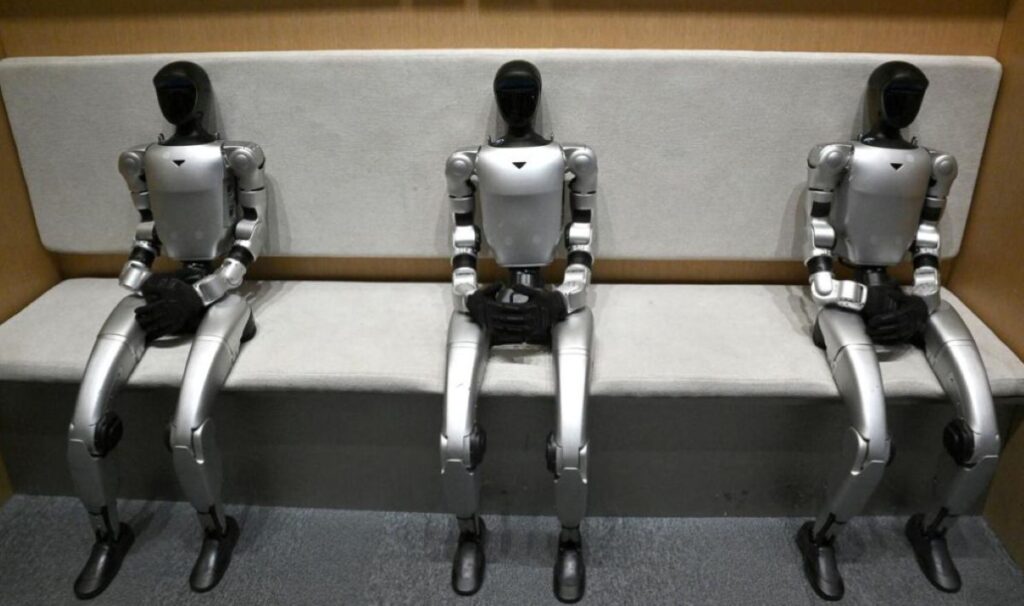
Hangzhou-based Unitree Robotics surged 460% on its first day of trading in Shanghai. Shares were priced at 150.8 RMB, opened at 1,100 RMB, briefly implying a gain of 629%, and later closed at 845 RMB. That left the company with a market capitalisation of roughly 342 billion RMB, or about $48 billion.
Unitree raised 6.1 billion RMB from the offering and became mainland China’s first publicly traded humanoid robot manufacturer. Retail demand was immense, even surpassing the extraordinary interest generated by memory-chip producer CXMT’s major listing the previous month.
The numbers, however, deserve to be stared at for a moment before everyone gets carried away by shiny robots doing backflips.
Unitree generated 1.7 billion RMB in revenue in 2025 and reported net profit of 278 million RMB, with adjusted profit of roughly 600 million RMB. At its closing valuation, the company was valued at approximately:
- 201 times annual revenue;
- 1,230 times reported earnings; and
- 578 times adjusted earnings.
Those are not conventional valuations. They are expressions of a very large collective wager on the future.
To be fair, there is a real underlying growth story. Unitree reportedly shipped more than 5,500 humanoid robots in 2025, ranking first globally according to its prospectus. Cumulative sales of its quadruped robots exceeded 33,000 units. Revenue more than quadrupled from 393 million RMB in 2024, while gross margin rose above 60%.
Global demand forecasts are similarly eye-catching. JPMorgan expects humanoid robot shipments to rise from 18,000 units in 2025 to 60,000 this year, then reach 1.75 million by 2030. China is expected to account for more than half of demand.
Unitree plans to use around 4.2 billion RMB of IPO proceeds on embedded AI models, humanoid-robot research, manufacturing expansion, and new products. It has attracted strategic investors, including DeepSeek, Tencent-linked entities, and major state-owned enterprises. Beijing has made no secret of its interest in “embodied AI”: systems that combine machine intelligence with physical capability.
But a company can be genuinely promising and absurdly priced at the same time. Those two things are not mutually exclusive, despite what a few thousand online investors will insist during a market frenzy.
Indeed, Unitree’s debut was rough for virtually everyone else. More than 100 humanoid-robot-related shares declined as capital rushed into the newly listed company. The Shanghai Composite fell 2.4%, Shenzhen dropped 5%, and the STAR 50 plunged 6.9%. Just 449 A-shares rose, while 5,069 fell.
That is what a narrow speculative stampede looks like: one company’s triumph becomes the broader market’s headache.
China’s AI strategy is not simply catching up—it is changing the commercial contest.

America still leads at the most advanced edge of artificial intelligence. OpenAI and Anthropic remain among the companies producing the strongest systems in the world. But China is becoming increasingly competitive on a different, and arguably more commercially important, battlefield: affordable, customisable, widely accessible AI.
Moonshot AI’s Kimi K3 model nearly matched leading Anthropic systems on several coding, reasoning, and professional benchmarks. On a ranking of practical software tasks, Kimi K3 placed sixth globally with a score of 85%. Alibaba’s Qwen 3.8 Max also entered the global top 10.
Being sixth-best may not sound glamorous in Silicon Valley, where every launch is treated like the invention of fire. But it becomes extremely compelling when the price gap is enormous.
Moonshot charges $15 per million output tokens for Kimi K3. DeepSeek V4 Pro costs $3.96 during peak periods and approximately half that outside peak hours. A comparable premium Anthropic service costs $50. For many companies, a model delivering 90% or 95% of frontier performance at a fraction of the cost is not a compromise. It is simply the sensible procurement decision.
That calculation is already reshaping usage. Airbnb, DoorDash, and Coinbase have reportedly adopted Chinese models hosted on local servers. Alibaba said its open-weight model family reached more than three billion downloads within six months, overtaking Meta and Google to become the world’s most downloaded AI model family.
Chinese models accounted for more than 60% of usage on OpenRouter in July, having overtaken American models in June. They also represented 41.4% of generative-model downloads on Hugging Face, five percentage points above US offerings.
These platforms are not a complete measure of global AI consumption, but they are meaningful indicators of developer preference. And developers appear to be responding to China’s very deliberate open-weight strategy.
Open weights are China’s weapon of choice.
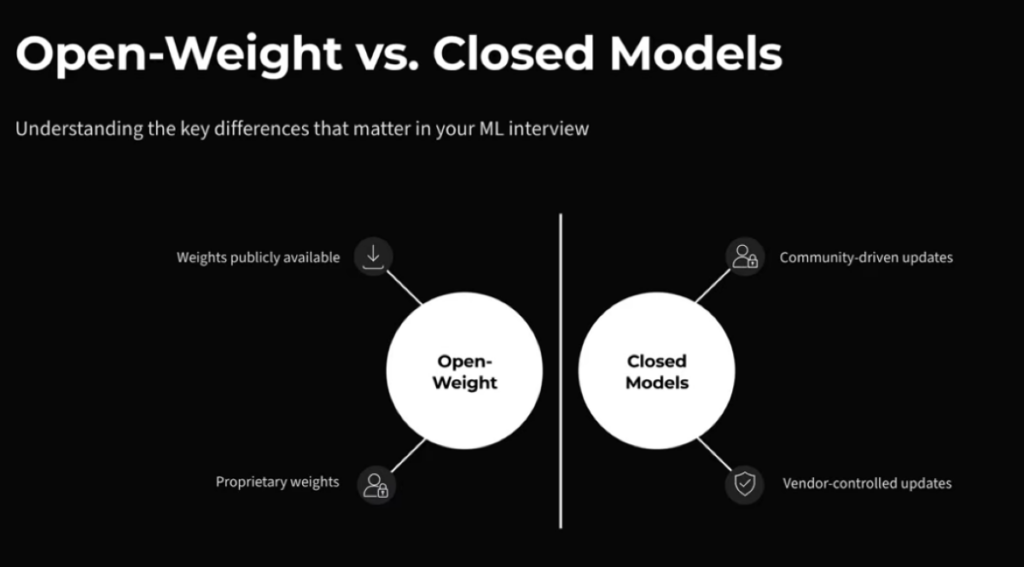
Most leading Chinese AI labs are releasing models that can be downloaded, customised, and run on a company’s own servers. This matters because it gives businesses more control over data, costs, deployment, and specialised applications.
Leading US labs generally keep their best models closed. Customers access them through paid subscriptions or APIs. That gives the model owner stronger control, potentially higher margins, and greater ability to manage safety and misuse. It also makes services more expensive and, in some cases, less flexible.
The cost savings from China’s approach can be dramatic. San Francisco startup Alsyia reportedly reduced its monthly AI bill from around $1 million to $100,000 after moving much of its workload to models from Shanghai-based MiniMax. AI assistant company Lindy reportedly cut spending by 90% after replacing Anthropic with DeepSeek for some tasks.
Of course, the cheap option is not automatically the best option. American models are still widely viewed as more reliable on the hardest tasks, with stronger safety controls and fewer errors in some high-stakes settings. This is encouraging a hybrid model: use lower-cost Chinese systems for routine, back-office, or high-volume workloads, while reserving premium US systems for complicated and consumer-facing functions.
China also has serious structural disadvantages. US computing capacity is estimated to be around ten times greater, while export controls limit Chinese access to leading Nvidia chips and advanced semiconductor manufacturing equipment. Chinese labs may be winning downloads and usage, but low pricing does not automatically translate into profitability.
That is the central contradiction. China’s AI companies may be securing market share by selling intelligence cheaply, but they could remain loss-making for years. America’s leading labs may have stronger monetisation opportunities, but their closed and expensive systems risk losing broad developer adoption.
Beijing is trying to close the infrastructure gap with brute force. China is preparing to invest approximately 2 trillion RMB, or $295 billion, in data centres over the next five years. Lower labour costs, an expanding power supply, and relatively cheap renewable energy could reduce the cost of training and running models.
The United States now faces an awkward policy choice. Restrictions on Chinese models could address national security, political bias, intellectual property, and alleged model distillation concerns. But nearly 200 US companies have reportedly warned that broad bans would raise their costs and make them less competitive internationally. Open-weight models are also exceptionally difficult to police: they can be downloaded, copied, modified, and run privately.
The strategic contest is no longer just about which country owns the single smartest model. It is also about which country can make capable AI cheap, accessible, and indispensable across the global economy. For additional context on the intensifying AI rivalry and concerns over model distillation, read this briefing on US AI firms coordinating against Chinese competition.
The bottom line
China is not short of technological ambition. Its robot and AI sectors are advancing quickly, backed by vast state support, deep manufacturing capacity, competitive domestic firms, and investors apparently willing to price tomorrow’s potential profits as though they are already sitting in the bank.
But technology booms do not magically dissolve macroeconomic weakness. A 460% stock-market debut does not create jobs for millions of graduates. Cheap AI does not fix hesitant consumers. Robot shipments do not make households feel better about property values, debt, or wages.
China’s challenge is not merely to build spectacular new industries. It is to ensure that those industries generate enough income, employment, confidence, and productive investment to lift the wider economy rather than simply becoming glittering islands in an increasingly stagnant sea.
Frequently Asked Questions
Why does a falling Chinese government bond yield matter?
Falling yields generally mean investors are buying more government bonds. In China’s case, this indicates that investors are seeking safety and expect weak growth, subdued inflation, and limited private-sector demand to continue.
Why is youth unemployment rising even though China’s population is shrinking?
University participation has increased faster than the decline in the youth population. As a result, China continues to produce a growing number of graduates even as the overall number of young people falls.
Why was Unitree Robotics valued so highly after its IPO?
Investors are betting that Unitree will become a major winner in China’s push into humanoid robots and embodied AI. The valuation reflected expectations of rapid future growth rather than conventional measures of current earnings or revenue.
How are Chinese AI models competing with American models?
Chinese firms are combining increasingly strong performance with sharply lower prices and open-weight models that companies can customise and host themselves. This has made them particularly attractive for high-volume and cost-sensitive business use cases.
Does China now lead the world in AI?
No. The United States still leads at the technological frontier and has substantially greater computing capacity. China is, however, becoming highly competitive in affordability, openness, deployment flexibility, and developer adoption.