

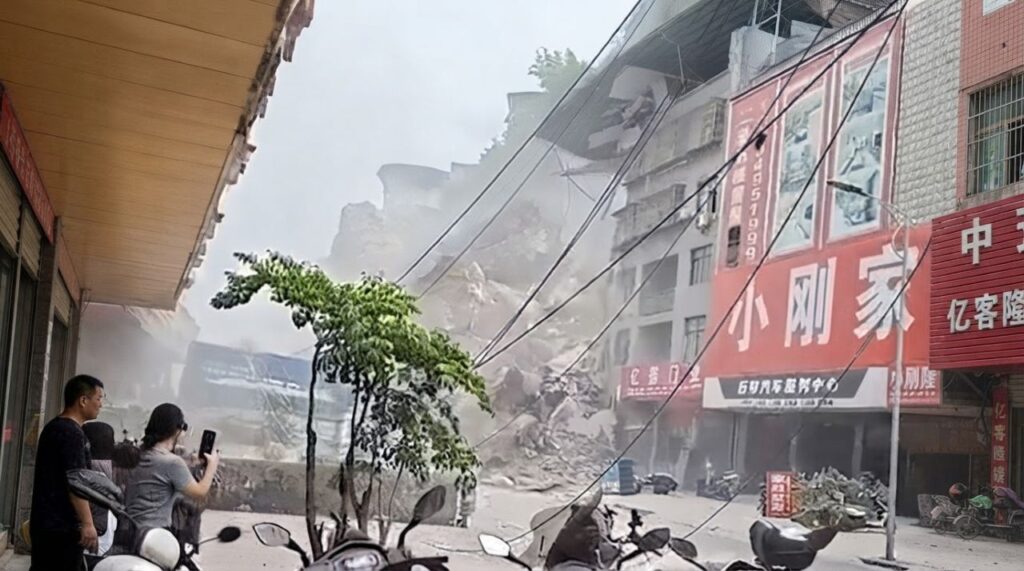
Chongqing Landslide 2026: The Devastating Physics of a Predictable Disaster
On a Friday morning, the sheer, dramatic karst topography of Pengshui Miao and Tujia Autonomous County looked exactly as it had for centuries. Nestled on the southeastern fringe of the gargantuan, hyper-developed Chongqing municipality, the region is a vertical labyrinth of steep limestone cliffs carved out by the Wujiang River.
In a terrifying flash of kinetic energy, 18,000 cubic meters of solid rock and saturated soil violently detached from a sheer cliffside. To put that volume into perspective, it is a cascading wall of debris equivalent to filling several Olympic-sized swimming pools, hurtling down a steep incline at terminal velocity. The largest single fragment of rock involved in the displacement was measured at an astonishing 3,000 cubic metres—a monolithic chunk of stone the size of a multi-storey apartment building, acting as a kinetic battering ram.
Downhill, more than ten residential buildings stood directly in the path of the descent.
As the dust settled over the Hanjia subdistrict, the human toll became agonisingly clear: at least eight individuals were confirmed dead, and 34 remained missing, buried deep within the unstable rubble.
The Anatomy of the Collapse: Why the Karst Yielded
To understand why this happened, we have to look closely at the geological makeup of southwestern China. The landscape surrounding Chongqing is predominantly karst—a topography formed from the dissolution of soluble rocks such as limestone, dolomite, and gypsum. While visually breathtaking, karst landscapes are riddled with subterranean fissures, sinkholes, and underground drainage networks. They are profoundly vulnerable to hydrological changes.
When heavy, relentless seasonal rainfall hits these mountains, the water does not simply run off the surface. It penetrates deep into the bedrock fissures, building up massive hydrostatic pressure from within the cliffside. The water acts simultaneously as a heavy addition of dead weight and a lubricant, drastically reducing the friction coefficient along pre-existing geological fault lines.
Once the critical threshold of shear stress is breached, the failure is instantaneous and catastrophic.
[ Relentless Rainfall ] ➔ [ Infiltration into Bedrock Fissures ]
                                      ⬇
[ Extreme Hydrostatic Pressure ] ➔ [ Friction Failure along Fault Line ]
                                      ⬇
[ Instantaneous Geometric Collapse (18,000 m³ of Debris) ]
What is remarkable about the Pengshui disaster is that the mountain gave a final, desperate warning. Roughly an hour before the primary mass failed, sharp-eyed community workers noticed unusual, scattered rockfalls tumbling down the slope and reported strange, deep groaning sounds emanating from the interior of the hillside.
This micro-evacuation effort managed to pull more than 60 immediate residents away from the impact zone just before the cliff gave way.
While this rapid grassroots response undoubtedly saved dozens of lives, it could not outrun the sheer velocity of the slide. Ten survivors were pulled directly from the mangled debris by first responders, with several suffering catastrophic, life-threatening injuries.
Rescuing Under the Sword of Damocles
The rescue operation launched in Pengshui is an exercise in extreme hazard management. More than 800 emergency personnel, backed by specialised national mine and tunnel rescue teams, converged on the narrow valley.
But in a landslide zone, the arrival of heavy machinery is a double-edged sword. The intense vibrations of excavators digging through loose, uncompacted rock can easily re-trigger a slide.
Compounding the crisis, field surveyors quickly identified massive, fractured rock formations remaining completely unstable at the top of the sheared cliff face.
To mitigate secondary disasters, engineers took the drastic step of cutting off all water, electricity, and gas infrastructure within a one-kilometre radius of the impact site.
The Systemic Fractures in the Miracle
When a disaster of this magnitude occurs, the central government’s response follows a highly polished, predictable script. President Xi Jinping immediately issued a directive demanding an all-out, "scientific" rescue effort and ordered a swift investigation into the underlying causes.
But if we pull back the lens, a far more unsettling reality emerges. The Pengshui landslide is not an isolated freak anomaly of nature. It is merely the latest link in a long, cascading chain of structural failures across the country:
-
July 2026: A landslide in mountainous Gansu province buries 33 people, killing 21.
-
May 2026: Extreme rain triggers massive, channelised debris flows in Chongqing's Yongchuan district, claiming 20 lives.
-
July 2026: A catastrophic factory fire engulfs a manufacturing plant in Fujian, killing 28 workers.
-
2024: A massive slope failure in Yunnan wipes out an entire village, killing 44.
-
2024: A rain-collapsed section of the Meizhou-Dabu Motorway in Guangdong sends vehicles plunging into a ravine, killing 48.
When you look at these events collectively, you realise they are the physical symptoms of a systemic contradiction. Over the past three decades, China engaged in the fastest, most expansive build-out of urban infrastructure in human history. Entire cities were carved into the sides of unstable mountains; high-speed rail lines and multi-lane motorways were driven through volatile geological fault zones.
For years, this rapid urbanisation was hailed as an economic miracle. But infrastructure requires rigorous, relentless maintenance, and more importantly, it requires strict adherence to building safety codes. As China’s economy transitions into a structural slowdown, local municipalities are buried under a mountain of hidden debt. The financial mechanisms that once funded lavish construction projects are drying up.
When local budgets face immense pressure, the allocations for routine geological monitoring, structural reinforcement of retaining walls, and strict enforcement of building codes are often the very first items to be silently slashed. Combine ageing, rapidly built infrastructure with weak local regulatory oversight, and throw in the intensifying wild card of extreme climate-driven weather anomalies, and you have a recipe for ongoing disaster.
The tragedy in Chongqing proves that heroic rescue efforts, no matter how sophisticated or well-funded after the fact, are a poor substitute for structural integrity and proactive prevention. Until the systemic issues of local governance funding and regulatory enforcement are addressed, the hillsides of southwestern China will remain fundamentally unsafe for those living in their shadows.
❓ Frequently Asked Questions
Where exactly did the landslide take place?
The disaster occurred in the Hanjia subdistrict of Pengshui Miao and Tujia Autonomous County, which sits on the southeastern edge of the Chongqing municipality in southwestern China, running alongside the Wujiang River.
What were the documented casualties from the initial collapse?
According to official reports, at least 8 individuals have been confirmed dead, 10 were rescued with injuries (two in critical condition), and 34 residents remain entirely unaccounted for beneath the debris.
What triggered the sudden failure of the cliffside?
While official investigations are ongoing, the collapse was heavily triggered by intense regional rainfall saturating the fragile, karst limestone terrain, which dramatically increased internal hydrostatic pressure until the rock face sheared away.
📑 Footnote: The Macro Business-Risk Reality
For multinational corporations, foreign investors, and global supply chain managers, the recurring pattern of infrastructure and geological disasters across mainland China represents an escalating operational risk that can no longer be ignored.
The Pengshui disaster demonstrates how quickly localised environmental failures can instantly sever critical infrastructure. The emergency shutdown of all electricity, gas, and water within a one-kilometre radius highlights a reality: a single physical failure can cause immediate, cascading utility outages for any commercial or manufacturing facility operating in the zone.
As climate change accelerates extreme weather events, regions that were once considered moderately stable are experiencing unprecedented rainfall and flash flooding. When this volatile weather collides with the variable enforcement of building and safety codes across different Chinese provinces, the physical resilience of your supply base becomes highly unpredictable.
To safeguard operational continuity, international firms must move away from blind faith in local regulatory oversight. Prudent risk management now demands comprehensive physical audits of Chinese supplier facilities, strict geographic mapping to identify links located in flood-prone or landslide-susceptible karst topographies, and the aggressive implementation of dual-sourcing strategies to eliminate single points of failure within the global supply network. Operational resilience in the modern era requires treating climate and infrastructure risks as core elements of corporate procurement strategy.