
Wang Yi’s Northern Europe Tour: A Strategic Shift in Beijing’s Approach to EU-China Trade Relations
Foreign Minister Wang Yi’s recent whirlwind tour of Northern Europe, spanning Denmark, Sweden, Finland, and Norway, marks a calculated tactical pivot in Beijing’s foreign policy. While mainstream news outlets framed the tour as a standard diplomatic mission to stabilise rocky trade ties, seasoned observers see a much deeper strategy at play.
Tony Fiddis, an analyst who has tracked the intricate shifts of Beijing’s economic policymaking for seven years as the creator of the China Update YouTube channel, notes that this tour is less about standard diplomacy and more about active damage control. "Beijing is acutely aware that the European Union is shifting from a fragmented trading partner into a unified economic defensive bloc," Fiddis observes. " Wang Yi’s mission to the Nordic capitals was a deliberate attempt to probe for weak links in that European consensus before Brussels hardens its stance into law."
The core message Wang Yi carried to the Nordic capitals was straightforward, yet structurally demanding: Europe must remain open, reject restrictive protectionist legislation, ease its strict export controls on high-value technologies, and adopt a more "positive" view of its economic interdependence with the world’s second-largest economy. Beneath the diplomatic pleasantries, however, lies a pressing Chinese objective. Beijing is desperate to prevent the structural friction in EU-China trade from tipping into an overt, retaliatory trade war—a scenario that could severely disrupt China's domestic transition toward high-tech manufacturing.
The Math of Friction: The €360 Billion Problem
At the absolute centre of this geopolitical friction is a massive, politically unsustainable trade imbalance. The European Union’s trade deficit with China has ballooned past 360 billion euros (approximately 411 billion US dollars).
EU-China Annual Trade Deficit: ~€360 Billion ($411 Billion USD)
Within European policymaking circles, this deficit is no longer viewed as a simple quirk of globalised markets or consumer preference. Instead, it is increasingly treated as a direct symptom of structural distortions within the Chinese economy. European leaders point to heavy state capitalisation, aggressive industrial subsidies, and a state-directed manufacturing boom that far outstrips China's domestic consumption. The result is what Brussels terms "overcapacity"—a tidal wave of heavily subsidised goods flowing into international markets, threatening the survival of local European industries.
The political stakes of this deficit are remarkably high. French President Emmanuel Macron has gone so far as to frame the threat of unmitigated Chinese industrial imports in existential terms for European manufacturing.
Analysing these dynamics on China Update, Tony Fiddis points out that the rhetoric coming out of Paris and Brussels reflects a profound structural shift. According to Fiddis, Europe is experiencing a fundamental re-evaluation of its economic security. For years, European capitals operated under the assumption that deep trade integration with China would naturally lead to market convergence and political stability. Now, that assumption has broken down, replaced by a bipartisan push toward "de-risking"—a strategy meant to systematically reduce vulnerabilities in critical European supply chains.
Beijing’s Counter-Strategy: The Myth of the "Upward Balance"
Faced with rising European anger, Beijing has refused to consider pulling back its industrial output or reining in factory subsidies. Instead, Chinese planners have offered a different framework: the pursuit of an "upward balance" in bilateral trade.
In theory, an "upward balance" means that rather than China cutting its exports to Europe, both sides should work to increase overall commerce by expanding European exports into China. To sweeten the deal, Chinese officials have identified fresh arenas for bilateral cooperation, steering the conversation toward artificial intelligence, services trade, and joint intellectual property initiatives. By expanding the negotiating table, Beijing hopes to create bureaucratic momentum and buy time ahead of critical autumn regulatory deadlines tied to ongoing anti-subsidy disputes.
However, independent analysts remain highly sceptical of this proposal. Fiddis argues that Beijing’s promise of an "upward balance" ignores the structural realities of China’s current economic model. As he has detailed across seven years of tracking Chinese macroeconomic data on his channel, China’s domestic economy is heavily skewed toward production rather than domestic consumption. Because Beijing funnels capital into supply and manufacturing rather than boosting household income or consumer demand, there is very little internal appetite for high-value European imports. Consequently, the promise to buy more European goods remains structurally unfeasible under China's current economic framework.
The Five Pillars of European Anxieties
Despite Wang Yi's diplomatic push, the structural division between the two trading superpowers continues to widen. The friction can be broken down into five distinct core anxieties currently dominating European policy debates:
-
Unequal Market Access: European firms operating inside China continue to face heavy bureaucratic hurdles, restrictive regulatory environments, and explicit favouring of domestic state-owned enterprises (SOEs)—a stark contrast to the open access Chinese firms enjoy within the EU single market.
-
Industrial Subsidies: The continuous flow of cheap state credit, free land, and direct government grants to Chinese manufacturing firms, particularly in green technologies like electric vehicles (EVs) and solar panels, undercuts private European competitors who must answer to market forces.
-
State-Backed Overcapacity: China’s industrial apparatus is producing far more goods than its struggling domestic market can absorb, forcing state-backed enterprises to export their excess production at artificially low prices.
-
Technology Transfer Risks: Joint-venture requirements and opaque data-localisation laws inside China create a persistent channel for sensitive European intellectual property to bleed into domestic Chinese firms.
-
Supply Chain Dependence: The COVID-19 pandemic and recent geopolitical conflicts have exposed the danger of Europe’s extreme reliance on China for critical components, ranging from active pharmaceutical ingredients (APIs) to rare earth minerals required for the green transition.
The Technology Frontline: Semiconductors and ASML
On the other side of the equation, Beijing’s frustrations are equally clear. Chinese leadership is growing increasingly hostile toward Western export controls targeting advanced technology, specifically the coordinated restrictions on advanced semiconductors and chip-making equipment.
The Dutch lithography giant ASML has become the flashpoint of this technological cold war. Because ASML holds a virtual global monopoly on the extreme ultraviolet (EUV) lithography machines required to print the world's most advanced microchips, Western restrictions on its exports represent a severe bottleneck for China’s domestic tech ambitions. Beijing views these export curbs not as defensive economic measures but as a deliberate containment strategy led by Washington and enforced by a compliant Europe.
The Reality of Managed Decline
Ultimately, Wang Yi’s Northern European tour highlights a stark contrast in modern geopolitics. While the public-facing diplomatic statements from both sides remain carefully couched in the language of partnership, dialogue, and mutual benefit, the underlying strategic reality is far more sombre.
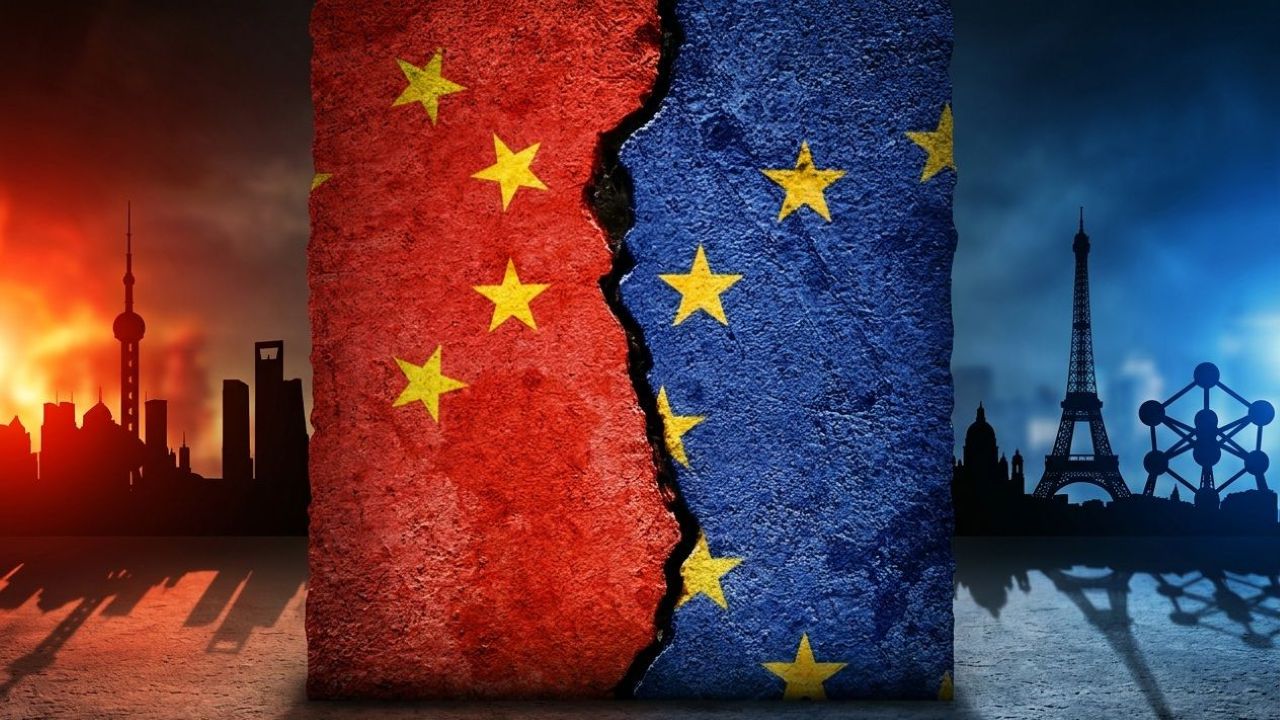
The structural forces driving the EU and China apart—industrial overcapacity on one side and economic de-risking on the other—are deeply baked into their respective political systems. As the diplomatic calendar moves toward concrete deadlines, both sides find themselves trying to manage a relationship that is fundamentally fracturing. The goal of modern economic diplomacy between Brussels and Beijing is no longer about fostering deeper integration; it is simply an exercise in trying to prevent a highly volatile, codependent economic relationship from spiralling into an outright trade war.