
Security News: Chinese Warships Establish
Near-Daily Presence Around Taiwan
By Tony Fiddis Published: June 22, 2026
The strategic landscape of the Taiwan Strait has fundamentally shifted. For years, regional security experts monitored periodic spikes in Chinese military manoeuvres—highly publicised, episodic responses to political events. Today, however, those spikes have flattened into a continuous, permanent reality.
New reporting from regional security officials reveals that five to six Chinese naval vessels are now typically positioned around Taiwan at any given time. This constant encirclement is no longer a temporary show of force or an occasional exercise; it has become a normalised baseline of the Indo-Pacific security environment.
The Incremental Evolution of Beijing’s Naval Posture
The People’s Liberation Army Navy (PLAN) did not establish this near-daily encirclement overnight. Instead, Beijing executed a highly deliberate, multi-staged strategy to reshape regional norms without triggering an open military conflict.
[2020: Patrols Expand to Coast] --> [2022: Near-Continuous Encirclement] --> [2026: Heavy Destroyer Deployment]
-
Pre-2020 Baseline: Historically, it was standard to observe a solitary Chinese warship patrolling the median line of the Taiwan Strait. This posture maintained a symbolic presence while avoiding direct friction.
-
The 2020 Expansion: Beijing expanded its operational envelope, regularly deploying surface combatants off Taiwan’s northern and southern coastlines to systematically test local tracking capabilities.
-
The 2022 Pivot: Following highly publicised visits from foreign officials, PLAN vessels transitioned to a near-continuous presence around the island, introducing sustained operations off Taiwan’s vulnerable eastern coast.
-
The 2024 to 2026 Normalisation: By mid-2026, the volume of maritime activity reached unprecedented levels. Data indicates that in May 2026 alone, security tracking detected 250 Chinese naval vessels operating around Taiwan—the highest monthly frequency recorded in years.
This expansion along the eastern coast is particularly critical. In any cross-strait contingency, eastern Taiwan has traditionally been viewed as a fallback zone and a crucial conduit for international aid. A permanent PLAN presence here signals an increasingly capable operating pattern designed to complicate Taiwan's defence geometry.
Political Triggers and the Logic of Gradual Escalation
Geopolitical analysts emphasise that these incremental expansions almost always build upon specific political developments that Beijing opposes—such as Taiwanese democratic elections, National Day addresses, or high-level diplomatic engagements between Taipei and Washington.
| Era / Trigger Event | Previous PLA Posture | Modernized Normalization Baseline (2026) |
| Routine Cross-Strait Patrols | 1 Frigate in the Strait | 5–6 Warships + Coast Guard permanently stationed |
| High-Level Diplomatic Visits | 48-hour surge exercises | Sustained combat readiness patrols (Multi-axis) |
| Presidential Inaugural Speeches | Temporary missile tests | Constant deployment of Type 055 Destroyers |
By utilising political developments as pretexts for military shifts, Beijing effectively normalises a heavier presence. Each successive deployment builds upon the last. Once a political crisis subsides, the added ships do not fully withdraw. Instead, they remain behind as the new normal, making future escalations far easier to execute and sustain.
From Light Frigates to Guided-Missile Destroyers
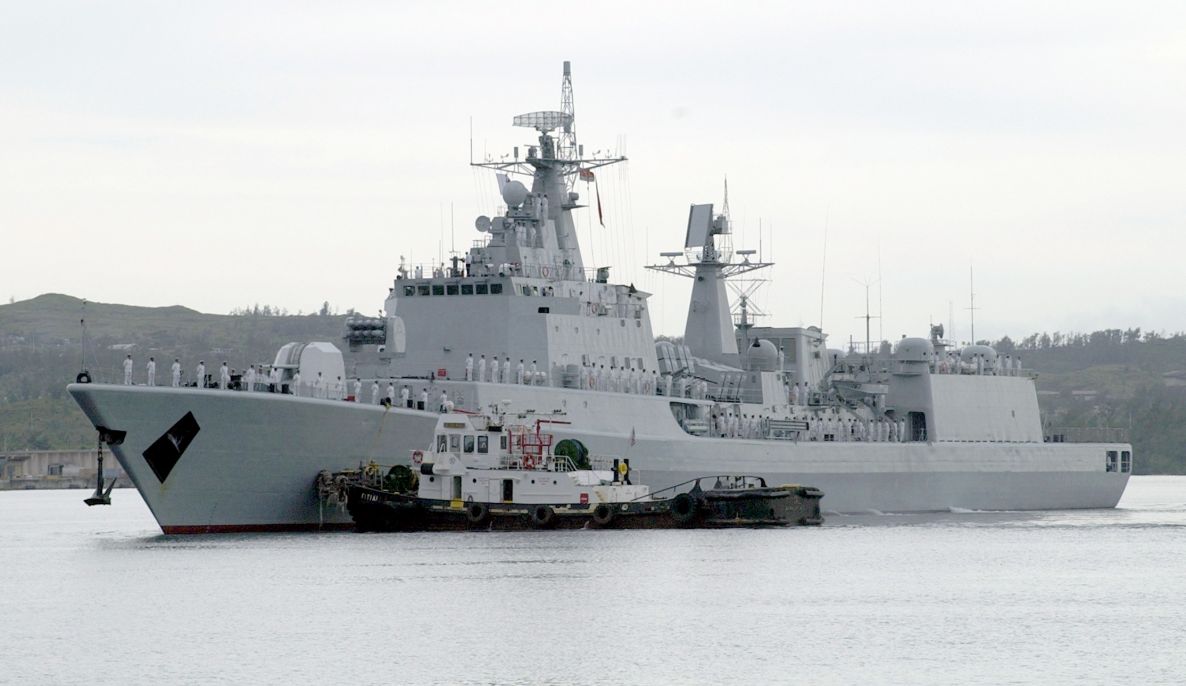
The operational shift is not merely quantitative; it is deeply qualitative. Early maritime patrols relied heavily on smaller, lightly armed frigates. Today, the PLAN increasingly deploys its premier surface combatants, most notably the Type 055-class guided-missile destroyers.
These massive 13,000-tonne warships carry 112 vertical launch cells capable of firing long-range anti-ship, anti-air, and land-attack cruise missiles. The routine positioning of such advanced assets close to Taiwanese waters highlights the rapid modernisation of the Chinese navy, which now ranks as the world’s largest fleet by pure ship count. These advanced platforms are no longer reserved strictly for blue-water deterrence; they are actively leveraged for day-to-day grey-zone coercion.
The Strategic Objectives Behind Beijing's Naval Encirclement
By maintaining a permanent ring of warships around the island, Beijing achieves several interconnected strategic objectives simultaneously:
1. Political Signalling
The permanent deployment serves as a physical reminder to Taipei, Washington, and regional allies that Beijing can apply economic or military pressure whenever it chooses. It projects an image of administrative authority over the surrounding waters.
2. Operational Experience
Sustaining an ongoing naval presence requires complex logistical coordination. PLAN crews gain invaluable, real-world experience in blue-water endurance, multi-ship communications, and long-term deployment cycles right on the doorstep of their primary mission objective.
3. Intelligence Collection
Operating in close proximity allows Chinese vessels to observe Taiwan's defence habits firsthand. The PLAN actively monitors how the Taiwanese Navy and Coast Guard respond, mapping their communication frequencies, reaction times, and operational readiness under prolonged duress.
4. Normalization of Pressure
The psychological impact of this strategy is profound. By transforming an exceptional military manoeuvre into an everyday occurrence, Beijing reshapes the strategic baseline. This permits China to intensify its coercion gradually while remaining carefully below the threshold that would trigger a decisive, unified international intervention.
The Operational Burden on Taiwan's Defense Forces
Taiwan cannot afford to ignore these daily incursions. Whenever a Chinese warship or an "official ship"—such as a China Coast Guard (CCG) vessel—approaches sensitive maritime zones, Taiwan's Ministry of National Defence (MND) must dispatch its own naval vessels or deploy land-based anti-ship missile systems to monitor the threat.
Operational Strain: This constant cat-and-mouse dynamic imposes severe demands on a smaller military. The endless cycle of monitoring, shadowing, and responding rapidly wears down Taiwanese personnel, shortens equipment maintenance cycles, and drains limited defense budgets.
Furthermore, domestic political dynamics complicate the situation. In mid-2026, prolonged legislative delays over Taiwan’s general budget have threatened to disrupt critical funding for defence readiness and international defence procurement. This comes at a time when Taiwan is attempting to expand its domestic anti-ship missile stockpile to over 1,800 units by 2029 to establish an effective defensive "kill zone" in the Strait.
Conclusion: The New Strategic Baseline
The persistent naval activities surrounding Taiwan are far more than mere political theatre. They represent a highly organised, ongoing rehearsal for potential blockade, encirclement, and rapid escalation scenarios.
With Chinese research vessels, escorted by the Coast Guard, now expanding environmental and maritime surveys to the east of the island, Beijing is diversifying its leverage across both military and civil frameworks. For global supply chains heavily reliant on Taiwan’s semiconductor dominance, and for international planners tracking Indo-Pacific stability, this permanent naval presence is the defining security challenge of the era.